
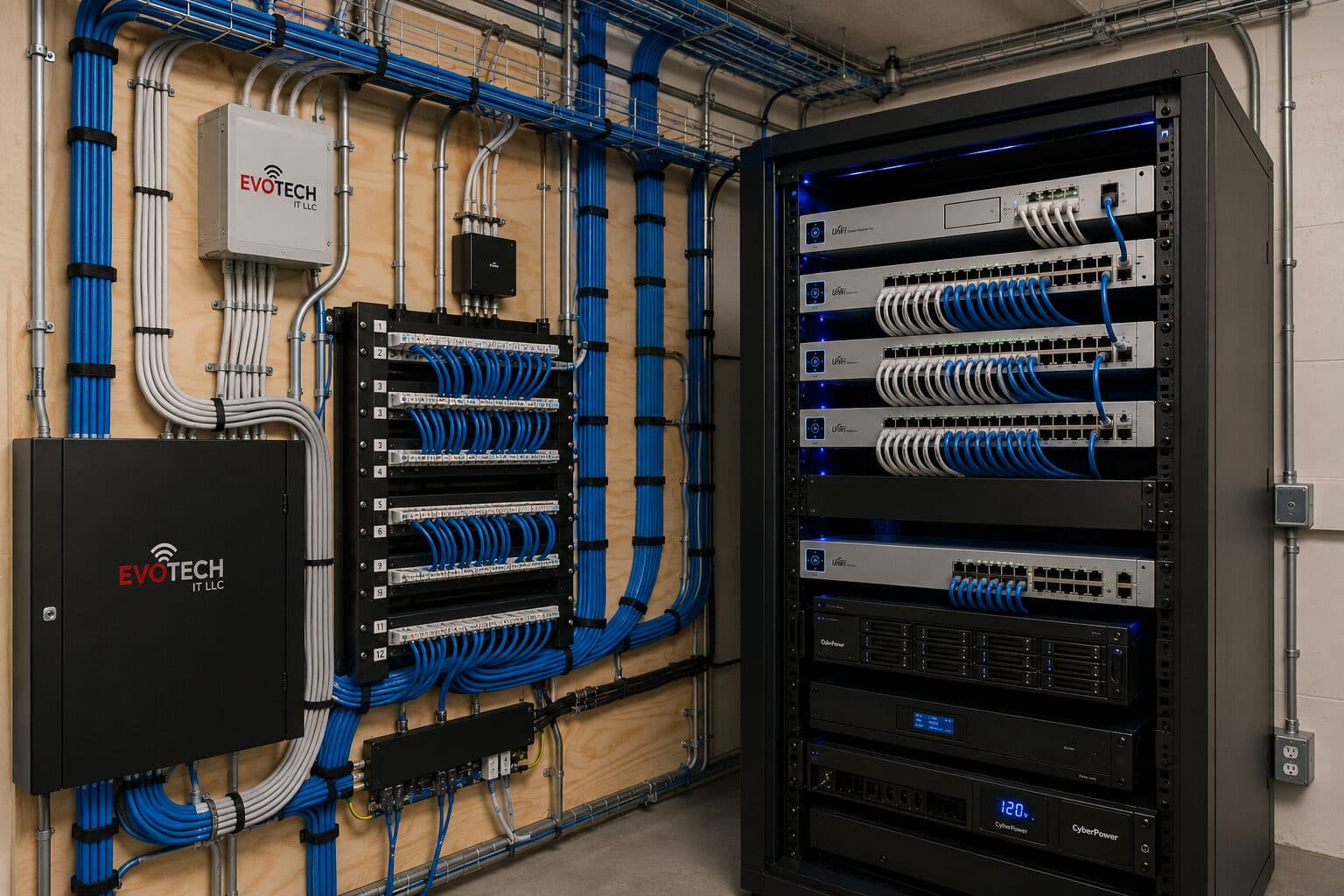
Cat6 cabling in the Champions area, in plain terms
Cat6 cabling in Champions / Willowbrook (77070) answers a specific long-tail search: people in the Champions area looking for exactly this work, in this pocket of Houston. It reads through the conditions that actually define the Champions area rather than treating the whole Houston market as one thing. 77070 around Champions is established 1970s-1980s golf-course suburbia, so the housing is mature two-story tract and custom homes with settled landscaping.
Cat6 carries gigabit Ethernet across the full 100-metre channel without drama, and that covers the overwhelming majority of what plugs into an office or home wall plate: computers, phones, printers, access points, cameras, and door controllers. Where it gets interesting is 10 gigabit. Cat6 can carry 10GBASE-T, but only to roughly 55 metres, and that figure assumes a favourable alien-crosstalk environment — cables not bundled tightly with many neighbours carrying the same signal.
Where cat6 cabling goes wrong — and how it's avoided
The common errors are decisions made once and regretted for years.
- Specifying Cat6 for a run that will need 10G at 80 metres
- Specifying Cat6A everywhere and losing pathway space that a mixed design would have kept
- Terminating a Cat6 run on leftover Cat5e hardware
- Bundling forty identical runs tightly and then expecting short-run 10G to hold
- Treating the certification report as paperwork rather than reading the margins
What the Champions area changes about the job
77070 around Champions is established 1970s-1980s golf-course suburbia, so the housing is mature two-story tract and custom homes with settled landscaping. In the Champions area, that is where the plan begins, because it changes cable paths, device placement, and access-point counts before anything else does. Homes of this era predate structured wiring, so retrofits work through existing attics, chases, and sometimes surface pathways. Golf-course and greenbelt lots create long rear sightlines and back-property camera considerations. None of these are generic checklist items — each moves the design in a direction a citywide assumption would miss, and the honest recommendation always depends on what this particular property allows.
- 77070 around Champions is established 1970s-1980s golf-course suburbia, so the housing is mature two-story tract and custom homes with settled landscaping
- Homes of this era predate structured wiring, so retrofits work through existing attics, chases, and sometimes surface pathways
- Golf-course and greenbelt lots create long rear sightlines and back-property camera considerations
- Mature trees throughout the neighborhoods favor wired backbones over line-of-sight wireless
- Two-story floor plans mean vertical runs and multiple access points rather than a single-level layout
How the work actually runs in the Champions area
A Cat6 installation is a structured cabling installation with a specific component standard applied consistently. The decisions that matter happen before the pull.
Execution in the Champions area is planned around real conditions, not a template. Mature trees throughout the neighborhoods favor wired backbones over line-of-sight wireless. Two-story floor plans mean vertical runs and multiple access points rather than a single-level layout. These decide the sequence, the access, and the method as much as the design does. EVOTECH describes the Champions area as coverage rather than a place it occupies, and omits any area detail it cannot confirm — building and site conditions only, no invented landmarks or promised arrival times.
Who this suits in the Champions area
In the Champions area (77070), cat6 cabling tends to be the right call for the owners and managers described below — the neighborhood's homeowners and residential properties fit this work well.
Cat6 is the right specification for most horizontal runs in small and mid-sized commercial spaces, and for effectively all residential structured wiring. The pairing that shows up most often in practice is Cat6 to general device locations with Cat6A reserved for the handful of runs that genuinely need it.
- Office desk outlets, phone positions, and printer locations
- Residential structured wiring from a media panel to rooms and access-point positions
- Retail point-of-sale stations and back-office equipment
- Ceiling access points in buildings where per-AP throughput stays inside gigabit
- Camera and door-controller runs powered over Ethernet
Popular services nearby
Frequently searched near this area — the pages people look for most.
Frequently asked questions
Do you cover the Champions area (77070)?
Yes. EVOTECH serves the Champions area in 77070 as part of the Houston service area. This is coverage, not an office claim — the page describes the neighborhood's conditions, not a location we occupy.
Is Cat6 enough, or should everything be Cat6A?
For most device locations Cat6 is enough, because most devices need gigabit and will for a long time. Cat6A earns its place on runs that must carry 10G at distance, runs sitting in dense bundles, and uplinks between equipment positions. Specifying Cat6A for the whole building is rarely wrong technically, but it costs pathway space and termination time that a mixed design keeps.