
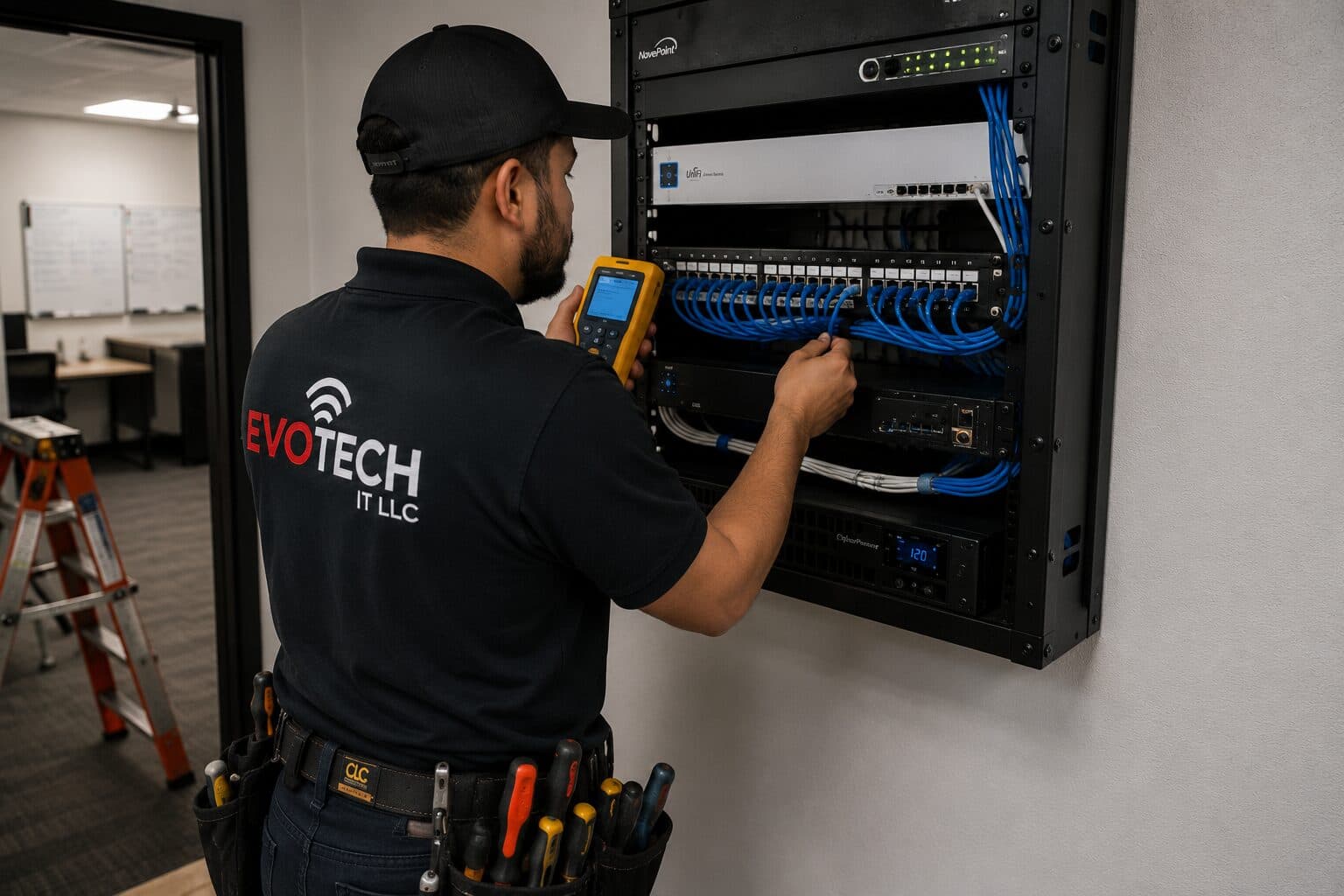
Why this page exists
Network troubleshooting in Spring is scoped around the same physical realities EVOTECH weighs everywhere — but read through Spring's specific conditions: retail and food-service commercial base where payment-system separation is a standing requirement. This page pairs what the service actually involves with what the Spring market changes about it.
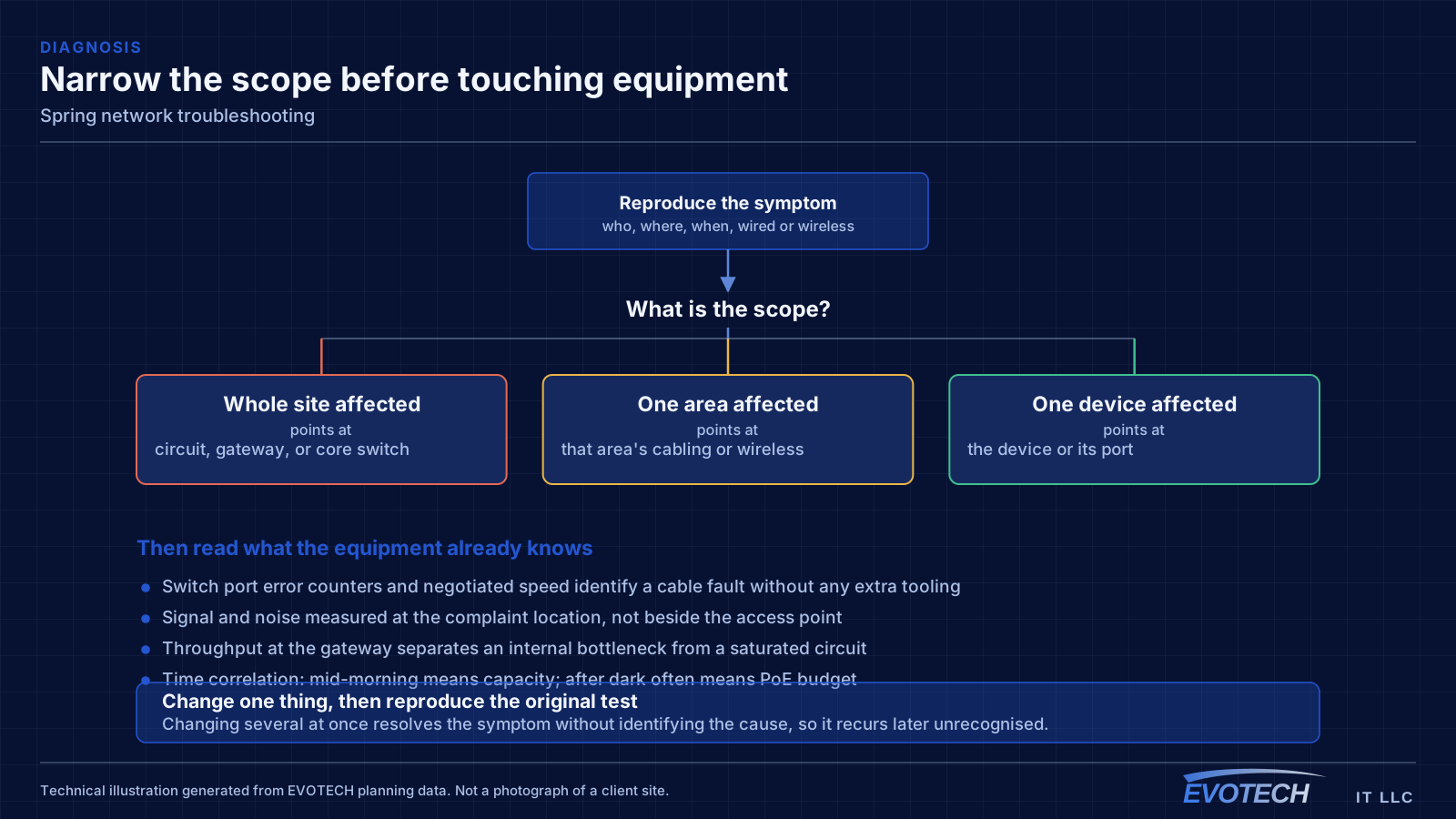
Effective troubleshooting is a process of elimination against a specific, reproducible symptom. 'The internet is slow' is not yet a diagnosis — slow for whom, on which devices, wired or wireless, at what times, to which destinations. Those answers usually point at a layer before any equipment is touched.
What network troubleshooting usually involves
The single most useful distinction is between a problem affecting everything and a problem affecting one device or area. Everything at once points toward the shared path — the circuit, the gateway, or the main switch. One area points toward that area's cabling, its access point, or its switch. One device points at the device or its port.
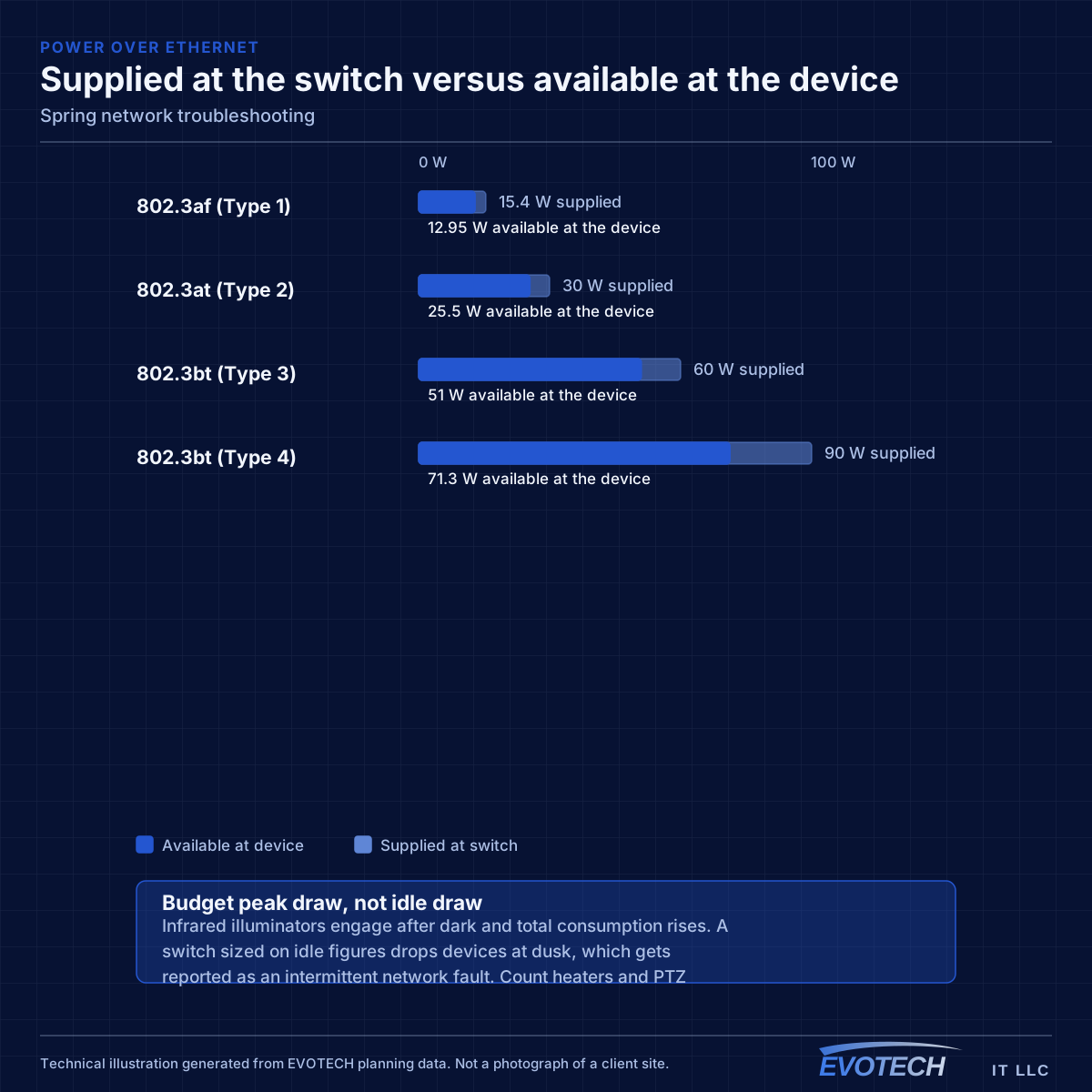
Timing is the second most useful clue. A problem that appears mid-morning and disappears at night is capacity related. A problem that appears after dark suggests something engaging on a schedule — camera illuminators pushing a PoE budget over is the classic example. A problem that appears at random is more often physical: a marginal termination, a failing port, or a cable that moves.
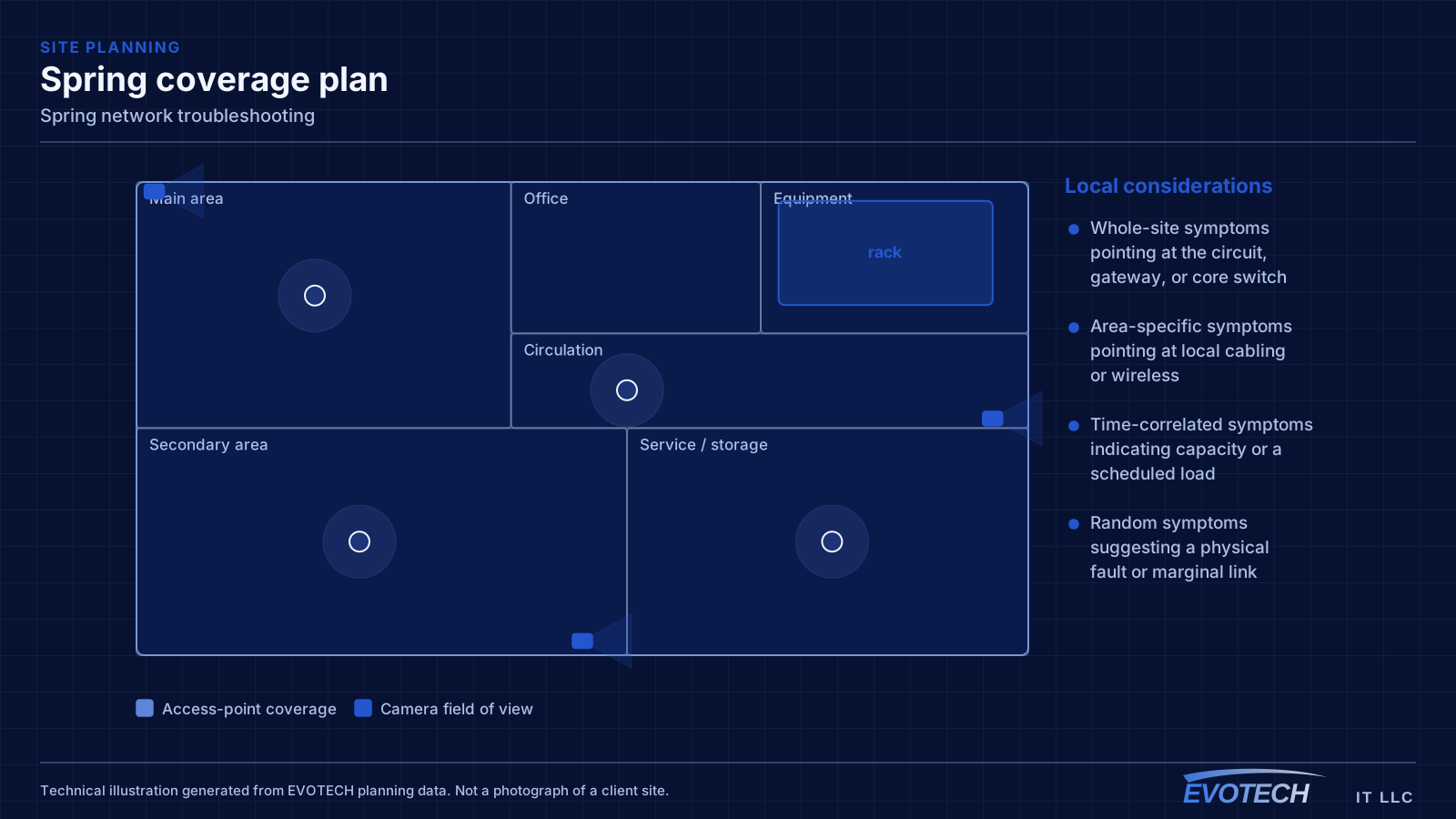
- Whole-site symptoms pointing at the circuit, gateway, or core switch
- Area-specific symptoms pointing at local cabling or wireless
- Time-correlated symptoms indicating capacity or a scheduled load
- Random symptoms suggesting a physical fault or marginal link
- Duplicate addressing or a rogue device handing out addresses
- Switching loops flooding a network after a cable was patched in twice
- Speed or duplex mismatches producing errors rather than outright failure
Spring property conditions that change the plan
Retail and restaurant units in this area span several construction types. A converted space may have open structure overhead and easy routing; a mall unit may be hard lid throughout; a newer pad site usually has suspended grid. The scope difference between these is significant even when the floor area and outlet count are identical.
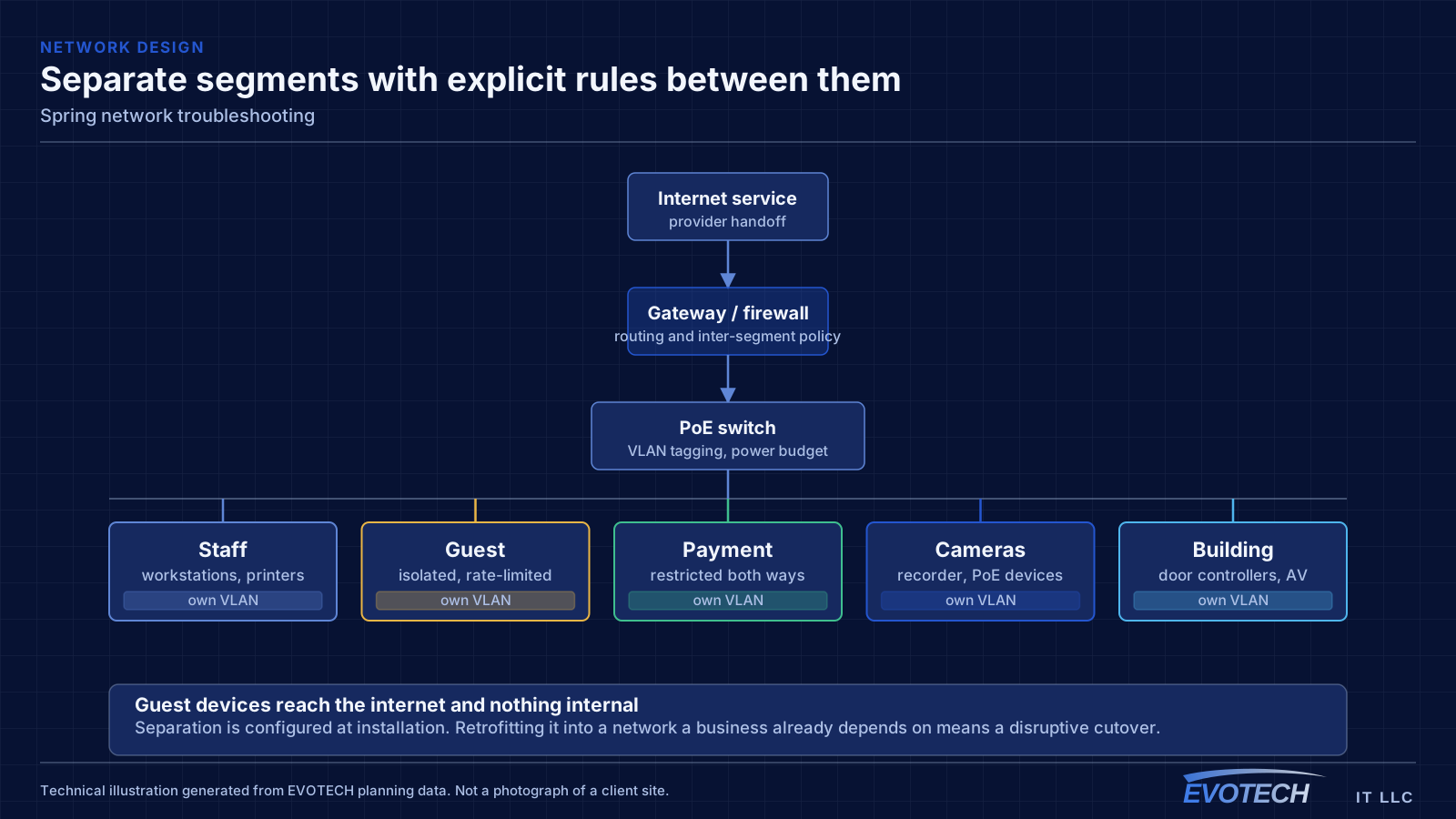
What stays constant across all of them is the network requirement: separate segments for payment, operations, and guest, with guest isolated and rate-limited. That is a configuration matter rather than a construction one, and it applies regardless of what the ceiling looks like.
For commercial work: what the ceiling actually is across the whole unit, where the equipment can live so it stays cool and dry, how the networks will be separated, and what the available working window is.
- Ceiling construction varying widely between adjacent units
- Payment, operations, and guest separation required consistently
- Kitchen environments constraining equipment placement in food service
- Storefront glazing affecting entrance camera framing
- Landlord rules applying in leased and centre units
- Ceiling construction confirmed across the whole unit, not just the front
- Equipment position away from kitchen heat and moisture
- Network segmentation agreed before installation
- Entrance camera positioned to avoid daylight backlighting
- Working window and landlord permissions established
Getting network troubleshooting done in Spring
Switch port statistics are the most underused diagnostic resource on most networks. Error counters, discards, and negotiated speed for each port are already being recorded, and a port showing rising errors identifies a cable or connector problem without any additional testing. A port that negotiated 100 Mbps when it should be at 1 Gbps points at a damaged pair or a marginal termination.
Food-service work happens outside service hours, with each session ending with the site operational for the next opening. Retail work can often proceed during trading with containment and barriered ladder areas, though anything over the sales floor or noisy is better placed before opening.
- Food-service work outside service hours
- Retail work during trading with containment where feasible
- Merchandise and surface protection throughout
- Sessions ending with the site fully operational
- Residential attic work scheduled early during summer
Frequently asked questions
Does EVOTECH have an office in Spring?
No. This is a service-area page: EVOTECH serves Spring without claiming a physical office there. The wording stays as coverage, not a location claim.
Why is the network slow only in the afternoon?
Time-correlated symptoms usually mean capacity rather than a fault. Something is consuming the shared resource at that time — backups, updates, more people on site, or a scheduled process. Measuring at the gateway during the slow period, and comparing it to a quiet period, distinguishes a saturated circuit from an internal bottleneck quickly.
Why does payment-system separation come up on every retail and restaurant project?
Because it addresses both a security and an operational risk. A payment terminal sharing a flat network with guest devices is reachable from those devices, and guest usage can also saturate the connection payment processing depends on. Separating them at installation is straightforward; doing it later in a running business is not.