TV mounting for warehouses, in Webster
TV mounting for warehouses in Webster is a three-part question: what tv mounting involves, what warehouses need from it, and what Webster changes about the install. A concentration of medical suites with controlled areas and clinical scheduling.
The second decision is height, and it is the one most often regretted. A display mounted above a fireplace usually sits well above comfortable seated viewing angle, which means looking up for the length of anything watched there. Sometimes the fireplace is the only option; it is worth being clear that it is a compromise before the holes are drilled.
Height, forklifts, and unconditioned space
High-level work needs lift access, and lift access needs floor space clear of racking, stock, and traffic. Coordinating that with warehouse operations is usually the single biggest scheduling constraint, and it is why warehouse installs often happen during shutdowns or quieter shifts.
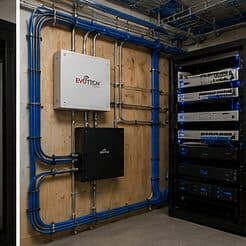
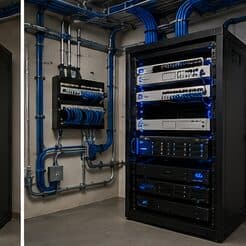
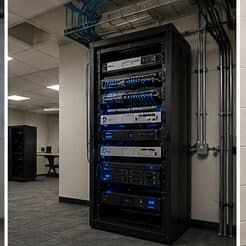
Environmental conditions matter for equipment placement. Much of a warehouse is unconditioned, and equipment placed in that environment is subject to summer temperatures and dust. Enclosures, filtration, or siting equipment in a conditioned office area are the usual responses.
- Lift access requiring clear floor space coordinated with operations
- Work often scheduled during shutdowns or quieter shifts
- Equipment sited in conditioned space or protected enclosures
- Dust protection for anything in the operational area
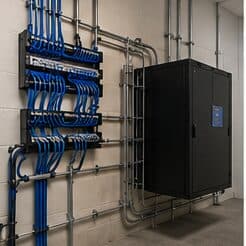
- Cable pathways kept clear of forklift and racking impact zones
What drives the cost of tv mounting here
Wall type and concealment drive the cost more than the display does.
- Wall construction and any backing or reinforcement required
- Display size, weight, and mount type
- Cable concealment and recessed outlet installation
- Height and whether elevated access is needed
- Number of displays and alignment requirements
- Outdoor-rated hardware where applicable
Webster: what the location changes
The starting point for any Webster job is one local fact. A concentration of medical suites with controlled areas and clinical scheduling. That single condition shapes where cable can run, where equipment can sit, and how coverage is laid out — more than any spec sheet does. Two more conditions weigh on it. Retail and hospitality venues requiring guest and payment segmentation. Multi-tenant buildings with base-building rules on riser and core access. Together they make the route specific to this pocket, which is why a short walkthrough or a few clear photos settle the scope faster than a floor plan can.
- A concentration of medical suites with controlled areas and clinical scheduling
- Retail and hospitality venues requiring guest and payment segmentation
- Multi-tenant buildings with base-building rules on riser and core access
- Tenant-improvement buildouts with suspended-grid ceilings and usable pathway
- Slab-foundation residential secondary to the commercial base
Getting it done in Webster
Verification is mechanical and visual, done before the installation is called finished.
Warehouse projects come down to three things: wireless that works down the aisles with stock in place, a network topology that reaches the far end of the building properly, and camera coverage at the points where goods and vehicles move.
Getting Webster work done means planning around the site as it actually is. Tenant-improvement buildouts with suspended-grid ceilings and usable pathway. Slab-foundation residential secondary to the commercial base. Both matter as much as the design to how and when the work happens. The scope is drawn from the real property, the coverage is stated as a service area rather than an office, and unverifiable specifics about Webster are kept off the page on purpose.
Popular services nearby
Frequently searched near this area — the pages people look for most.
Frequently asked questions
Is tv mounting for warehouses different in Webster?
The sector needs stay the same, but the install changes with the place. In Webster, the conditions above — not the warehouses label — decide routes, mounting, and equipment placement, which is why this page pairs all three.
Can a TV be mounted on a metal-stud wall?
Yes, but not with wood-stud technique. Metal studs are thin and will not hold lag bolts under sustained load. The reliable approaches are plywood backing behind the drywall — easy during construction, more involved afterwards — or an anchoring system made for metal studs and rated for the display weight. This matters most with articulating arms, which multiply the load considerably.