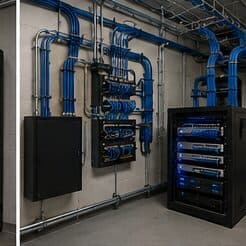
Wi-Fi installation for warehouses, in Stafford
Wi-Fi installation for warehouses in Stafford is a three-part question: what wi-fi installation involves, what warehouses need from it, and what Stafford changes about the install. Commercial base weighted toward warehouse, showroom, and light-industrial buildings rather than office space.
Good Wi-Fi comes from deciding where signal needs to be strong, then placing access points so that each area gets a solid signal from one AP without excessive overlap from others. The target most designs work to is around -67 dBm at the edge of each coverage area for voice and video, with signal comfortably above the local noise floor. Placement follows from that number and from the walls between the AP and the users.
Docks, yard, and inventory movement
Warehouse camera coverage concentrates where goods and vehicles move: dock doors, receiving and shipping areas, yard gates, and the boundary between operational and office space. These views answer the questions warehouse footage is actually asked — what arrived, what left, and when.
Dock doors present a specific lighting challenge. A camera facing an open dock door in daylight is looking at a bright rectangle with a dark interior, which is the worst case for dynamic range. Positioning so the camera views along the dock rather than straight into the opening, or accepting a camera specifically chosen for high contrast, addresses it.
Yard and perimeter coverage runs into distance and power. Positions beyond copper reach need fiber and local power, or a designed wireless link — and either way, the power question has to be answered before the camera is specified.
- Dock doors, receiving, and shipping framed for vehicle and goods movement
- Camera positions that avoid shooting straight into a bright dock opening
- Yard gates and perimeter, with the power and distance question resolved first
- Boundary between operational and office areas
- Retention long enough to cover inventory reconciliation cycles
What drives the cost of wi-fi installation here
Wireless cost is mostly cabling and access-point count, with survey depth as the third variable.
- Number of access points the coverage design requires
- Cable runs to each AP position and the difficulty of those runs
- Ceiling type and mounting hardware, especially at height
- Switch capacity and PoE budget to power the APs
- Survey depth, from a walkthrough to a full measured survey
- Whether outdoor or warehouse coverage is included
Stafford: what the location changes
In Stafford, the plan is built outward from the conditions that are actually here. Commercial base weighted toward warehouse, showroom, and light-industrial buildings rather than office space. Metal building construction that reflects wireless signal and changes coverage behaviour compared with drywall interiors. Building footprints frequently exceeding the 100 m copper channel limit from a single equipment position. Each one changes where cable can run, where equipment can sit, and how coverage is shaped, which is why a walkthrough settles a Stafford scope faster than any generic estimate.
- Commercial base weighted toward warehouse, showroom, and light-industrial buildings rather than office space
- Metal building construction that reflects wireless signal and changes coverage behaviour compared with drywall interiors
- Building footprints frequently exceeding the 100 m copper channel limit from a single equipment position
- Largely unconditioned operational areas where equipment placement has to account for summer temperatures and dust
- Mixed occupancy within single buildings, with small conditioned office areas attached to large operational space
Getting it done in Stafford
A wireless installation is validated by walking it. Signal level, signal-to-noise ratio, and the channel each AP settled on are measured at the places people actually work, not from the middle of the room.
A warehouse surveyed empty and a warehouse full of stock are different radio environments. Metal racking reflects, palletised inventory absorbs, and coverage that measured well across an open floor can disappear once the aisles fill. Any design based on an empty-building survey should be treated as provisional.
On site, the schedule and working method turn on conditions like these. Largely unconditioned operational areas where equipment placement has to account for summer temperatures and dust. Mixed occupancy within single buildings, with small conditioned office areas attached to large operational space. Both shape how and when a crew can actually operate, which is why EVOTECH scopes each Stafford job from the property itself rather than assuming one approach fits every address. Coverage is stated as a service area, never an office claim, and anything about Stafford that cannot be verified is left out instead of invented.
Frequently asked questions
Is wi-fi installation for warehouses different in Stafford?
The sector needs stay the same, but the install changes with the place. In Stafford, the conditions above — not the warehouses label — decide routes, mounting, and equipment placement, which is why this page pairs all three.
Why does a call drop when walking between rooms?
That is a roaming symptom. Either the coverage areas do not overlap enough, so the device holds a fading signal past the point of usefulness, or they overlap heavily on the same channel, so the handoff happens into a congested cell. Both are fixed by adjusting placement, power, and the channel plan rather than by adding another access point at the same settings.