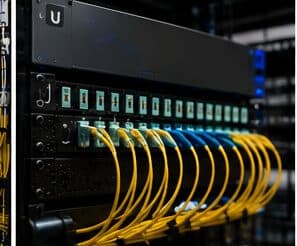
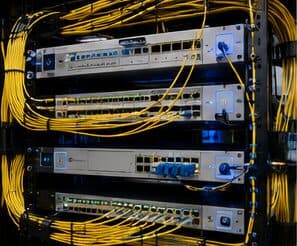
Network-rack installation for warehouses, in Spring
Network-rack installation for warehouses in Spring is a three-part question: what network-rack installation involves, what warehouses need from it, and what Spring changes about the install. Retail and food-service commercial base where payment-system separation is a standing requirement.
Depth matters as much as height and is more often overlooked. A shallow wall-mount cabinet chosen because it fits a hallway will not accept a deeper server or a UPS, and the discovery usually happens after the cabinet is mounted. Checking the deepest intended device against the cabinet's usable depth — behind the mounting rails, allowing for cable bend at the rear — avoids that.
The building changes its own radio environment
A warehouse surveyed empty and a warehouse full of stock are different radio environments. Metal racking reflects, palletised inventory absorbs, and coverage that measured well across an open floor can disappear once the aisles fill. Any design based on an empty-building survey should be treated as provisional.
The second defining feature is distance. Warehouse footprints regularly exceed what a single equipment room can serve within the 100-metre copper limit, which means either intermediate equipment positions connected by fiber or a deliberately distributed design.
- Racking and stock materially change coverage after the survey
- Distances frequently exceed the 100 m copper channel limit
- High ceilings complicate mounting, access, and coverage geometry
- Dock doors, yard, and office areas each have distinct requirements
What changes network-rack installation from job to job
Rack scope moves with location constraints more than with equipment count.
- Total U required including management and growth allowance
- Wall-mount cabinet versus floor-standing rack, and depth required
- Location ventilation and ambient temperature
- Structural mounting requirements for the loaded weight
- Power availability and whether a dedicated circuit is needed
- UPS capacity and its weight and heat contribution
- Whether existing cabling must be re-dressed and re-terminated into new panels
- Access clearance in front of and behind the rack
Spring: what the location changes
What separates a Spring scope from the rest of the city is concrete and local. Retail and food-service commercial base where payment-system separation is a standing requirement. Ceiling construction varying considerably between adjacent units, from open deck to hard lid to suspended grid. Restaurant kitchen environments requiring equipment placement away from heat, steam, and grease-laden air. That short list is what actually drives the design in this pocket, and it is why photographs or a brief site visit beat a floor plan — the plan follows the building's real constraints, not the neighborhood name on the map.
- Retail and food-service commercial base where payment-system separation is a standing requirement
- Ceiling construction varying considerably between adjacent units, from open deck to hard lid to suspended grid
- Restaurant kitchen environments requiring equipment placement away from heat, steam, and grease-laden air
- Storefront glazing on retail units complicating daylight entrance camera placement
- Residential areas following the regional slab-foundation and attic-routing pattern
Getting it done in Spring
A rack is commissioned by checking it under load, not by looking at it when everything is idle.
Where a building exceeds copper reach from a single position, the usual answer is one or more intermediate distribution points fed by fiber, each serving its area with copper within the limit. This is standard structured-cabling practice and it is far more reliable than attempting to stretch copper or bridge wirelessly across the building.
Getting Spring work done means planning around the site as it actually is. Storefront glazing on retail units complicating daylight entrance camera placement. Residential areas following the regional slab-foundation and attic-routing pattern. Both matter as much as the design to how and when the work happens. The scope is drawn from the real property, the coverage is stated as a service area rather than an office, and unverifiable specifics about Spring are kept off the page on purpose.
Popular services nearby
Frequently searched near this area — the pages people look for most.
Frequently asked questions
Is network-rack installation for warehouses different in Spring?
The sector needs stay the same, but the install changes with the place. In Spring, the conditions above — not the warehouses label — decide routes, mounting, and equipment placement, which is why this page pairs all three.
What size rack is needed?
Add the U heights of every intended device, add a U of management between logical groups, add the patch panels, then add roughly a third for growth. The result is usually a size or two larger than the first instinct, and the extra space costs far less than the disruption of replacing an undersized cabinet later.