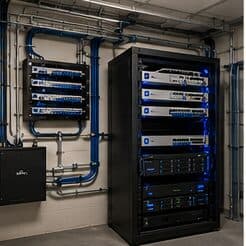
Ubiquiti UniFi installation for warehouses, in Rosenberg
Ubiquiti UniFi installation for warehouses in Rosenberg is a three-part question: what ubiquiti unifi installation involves, what warehouses need from it, and what Rosenberg changes about the install. Warehousing and light-industrial buildings along the highway corridor, with metal construction that reflects wireless signal and needs proper cable support.
The tradeoff is ecosystem commitment. Mixed-vendor networks give more freedom to choose the best component for each role; single-vendor networks give a more coherent day-to-day experience and simpler support. Neither is universally correct, and it is worth deciding deliberately rather than by default.
Height, forklifts, and unconditioned space
High-level work needs lift access, and lift access needs floor space clear of racking, stock, and traffic. Coordinating that with warehouse operations is usually the single biggest scheduling constraint, and it is why warehouse installs often happen during shutdowns or quieter shifts.
Environmental conditions matter for equipment placement. Much of a warehouse is unconditioned, and equipment placed in that environment is subject to summer temperatures and dust. Enclosures, filtration, or siting equipment in a conditioned office area are the usual responses.
- Lift access requiring clear floor space coordinated with operations
- Work often scheduled during shutdowns or quieter shifts
- Equipment sited in conditioned space or protected enclosures
- Dust protection for anything in the operational area
- Cable pathways kept clear of forklift and racking impact zones
What drives the cost of ubiquiti unifi installation here
Equipment is visible, but configuration and cabling usually decide the total.
- Device count across gateway, switching, wireless, cameras, and access
- Cable runs and their difficulty
- Storage capacity for the camera retention target
- Number of segments and depth of the policy configuration
- Migration complexity from existing equipment
- Whether structured documentation and handover training are included
Rosenberg: what the location changes
What separates a Rosenberg scope from the rest of the city is concrete and local. Warehousing and light-industrial buildings along the highway corridor, with metal construction that reflects wireless signal and needs proper cable support. An older rail-town commercial core with masonry buildings and limited existing pathway. Newer suburban subdivisions on slab foundations following the regional attic-routing pattern. That short list is what actually drives the design in this pocket, and it is why photographs or a brief site visit beat a floor plan — the plan follows the building's real constraints, not the neighborhood name on the map.
- Warehousing and light-industrial buildings along the highway corridor, with metal construction that reflects wireless signal and needs proper cable support
- An older rail-town commercial core with masonry buildings and limited existing pathway
- Newer suburban subdivisions on slab foundations following the regional attic-routing pattern
- Dust exposure in industrial and distribution environments, affecting rack and equipment placement
- Gulf Coast humidity and driven-rain events requiring rated exterior housings and sealed penetrations
Getting it done in Rosenberg
Validation covers the network design as well as the radio coverage, because segmentation that was configured but not tested is not yet segmentation.
Warehouse projects come down to three things: wireless that works down the aisles with stock in place, a network topology that reaches the far end of the building properly, and camera coverage at the points where goods and vehicles move.
Execution in Rosenberg is planned around real conditions, not a template. Dust exposure in industrial and distribution environments, affecting rack and equipment placement. Gulf Coast humidity and driven-rain events requiring rated exterior housings and sealed penetrations. These decide the sequence, the access, and the method as much as the design does. EVOTECH describes Rosenberg as coverage rather than a place it occupies, and omits any area detail it cannot confirm — building and site conditions only, no invented landmarks or promised arrival times.
Frequently asked questions
Is ubiquiti unifi installation for warehouses different in Rosenberg?
The sector needs stay the same, but the install changes with the place. In Rosenberg, the conditions above — not the warehouses label — decide routes, mounting, and equipment placement, which is why this page pairs all three.
Is UniFi the right choice for a small business?
It suits sites that want proper segmentation, decent wireless, and cameras under one interface without employing a network administrator. The tradeoff is committing to one vendor's ecosystem. A mixed-vendor design gives more freedom to pick the best component for each role; the single-vendor version is easier to live with day to day. Both are defensible — it is worth choosing on purpose.