NVR installation for warehouses, in Rosenberg
NVR installation for warehouses in Rosenberg is a three-part question: what nvr installation involves, what warehouses need from it, and what Rosenberg changes about the install. Warehousing and light-industrial buildings along the highway corridor, with metal construction that reflects wireless signal and needs proper cable support.
The most common disappointment is discovering that a system advertised as recording for a month is actually holding eight days, because the calculation assumed motion-only recording and the cameras are recording continuously, or assumed a compression efficiency the scene does not achieve. Doing the arithmetic before purchase, with the intended settings, avoids that.
Height, forklifts, and unconditioned space
High-level work needs lift access, and lift access needs floor space clear of racking, stock, and traffic. Coordinating that with warehouse operations is usually the single biggest scheduling constraint, and it is why warehouse installs often happen during shutdowns or quieter shifts.
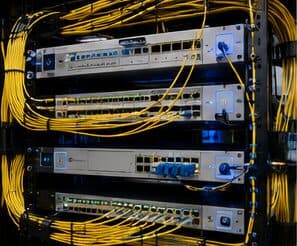
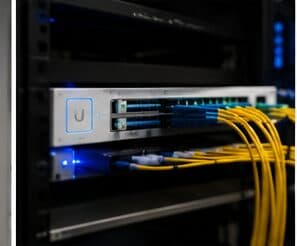
Environmental conditions matter for equipment placement. Much of a warehouse is unconditioned, and equipment placed in that environment is subject to summer temperatures and dust. Enclosures, filtration, or siting equipment in a conditioned office area are the usual responses.
- Lift access requiring clear floor space coordinated with operations
- Work often scheduled during shutdowns or quieter shifts
- Equipment sited in conditioned space or protected enclosures
- Dust protection for anything in the operational area
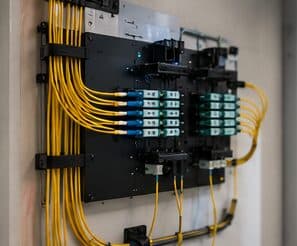
- Cable pathways kept clear of forklift and racking impact zones
What drives the cost of nvr installation here
Storage capacity is the main variable, and it is set by the retention decision.
- Retention target, which drives total capacity
- Camera count, resolution, and frame rate
- Drive capacity, count, and any redundancy
- Recorder capability, including supported channel count
- UPS protection for the recorder
- Remote-access setup and user configuration
Rosenberg: what the location changes
What separates a Rosenberg scope from the rest of the city is concrete and local. Warehousing and light-industrial buildings along the highway corridor, with metal construction that reflects wireless signal and needs proper cable support. An older rail-town commercial core with masonry buildings and limited existing pathway. Newer suburban subdivisions on slab foundations following the regional attic-routing pattern. That short list is what actually drives the design in this pocket, and it is why photographs or a brief site visit beat a floor plan — the plan follows the building's real constraints, not the neighborhood name on the map.
- Warehousing and light-industrial buildings along the highway corridor, with metal construction that reflects wireless signal and needs proper cable support
- An older rail-town commercial core with masonry buildings and limited existing pathway
- Newer suburban subdivisions on slab foundations following the regional attic-routing pattern
- Dust exposure in industrial and distribution environments, affecting rack and equipment placement
- Gulf Coast humidity and driven-rain events requiring rated exterior housings and sealed penetrations
Getting it done in Rosenberg
Verification means letting the system run and measuring, because the calculation is a projection until real footage lands on the disk.
Warehouse projects come down to three things: wireless that works down the aisles with stock in place, a network topology that reaches the far end of the building properly, and camera coverage at the points where goods and vehicles move.
Getting Rosenberg work done means planning around the site as it actually is. Dust exposure in industrial and distribution environments, affecting rack and equipment placement. Gulf Coast humidity and driven-rain events requiring rated exterior housings and sealed penetrations. Both matter as much as the design to how and when the work happens. The scope is drawn from the real property, the coverage is stated as a service area rather than an office, and unverifiable specifics about Rosenberg are kept off the page on purpose.
Frequently asked questions
Is nvr installation for warehouses different in Rosenberg?
The sector needs stay the same, but the install changes with the place. In Rosenberg, the conditions above — not the warehouses label — decide routes, mounting, and equipment placement, which is why this page pairs all three.
How much storage is needed for 30 days of footage?
It is a calculation, not a fixed number: per-camera bitrate multiplied by hours recorded per day multiplied by thirty, summed across cameras. Resolution, frame rate, recording mode, and how busy each scene is all move the result substantially. Two eight-camera systems can differ by a factor of three for the same retention target.