TV mounting for warehouses, in Richmond
TV mounting for warehouses in Richmond is a three-part question: what tv mounting involves, what warehouses need from it, and what Richmond changes about the install. High proportion of new residential and commercial construction, making rough-in timing the dominant scheduling factor.
The second decision is height, and it is the one most often regretted. A display mounted above a fireplace usually sits well above comfortable seated viewing angle, which means looking up for the length of anything watched there. Sometimes the fireplace is the only option; it is worth being clear that it is a compromise before the holes are drilled.
Cover the aisles, reach the far end, watch the docks
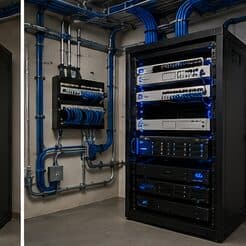
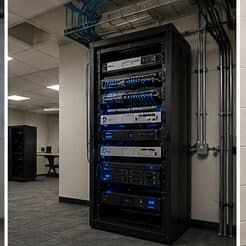
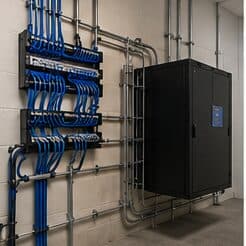
Warehouse projects come down to three things: wireless that works down the aisles with stock in place, a network topology that reaches the far end of the building properly, and camera coverage at the points where goods and vehicles move.
Office areas within the warehouse are comparatively ordinary and are usually the easiest part of the project.
- Access points positioned to cover along aisles rather than across them
- Intermediate equipment positions linked by fiber where distance requires
- Dock doors, receiving, and yard gates covered by cameras
- Scanner and handheld roaming validated with stock in place
- Equipment protected from dust and temperature in unconditioned areas
Where tv mounting goes wrong — and how it's avoided
Mounting mistakes range from cosmetic to genuinely unsafe.
- Anchoring an articulating mount into drywall or a single stud
- Treating metal studs like wood framing
- Setting masonry anchors into mortar joints
- Running a standard power cord inside the wall
- Mounting before running signal cable, leaving no route afterwards
- Choosing height for the wall's convenience rather than the seating
- Using indoor hardware on a covered patio and watching it corrode
Richmond: what the location changes
What separates a Richmond scope from the rest of the city is concrete and local. High proportion of new residential and commercial construction, making rough-in timing the dominant scheduling factor. Larger lots producing long runs to gates, outbuildings, and driveway camera positions that approach or exceed copper distance limits. Slab-on-grade construction with the rough-in window falling between electrical and drywall. That short list is what actually drives the design in this pocket, and it is why photographs or a brief site visit beat a floor plan — the plan follows the building's real constraints, not the neighborhood name on the map.
- High proportion of new residential and commercial construction, making rough-in timing the dominant scheduling factor
- Larger lots producing long runs to gates, outbuildings, and driveway camera positions that approach or exceed copper distance limits
- Slab-on-grade construction with the rough-in window falling between electrical and drywall
- Conduit and sleeve decisions made during rough-in determining what is possible for the following decade
- Detached structures common enough that between-building links are a routine design question rather than an exception
Getting it done in Richmond
Verification is mechanical and visual, done before the installation is called finished.
Warehouse camera coverage concentrates where goods and vehicles move: dock doors, receiving and shipping areas, yard gates, and the boundary between operational and office space. These views answer the questions warehouse footage is actually asked — what arrived, what left, and when.
Execution in Richmond is planned around real conditions, not a template. Conduit and sleeve decisions made during rough-in determining what is possible for the following decade. Detached structures common enough that between-building links are a routine design question rather than an exception. These decide the sequence, the access, and the method as much as the design does. EVOTECH describes Richmond as coverage rather than a place it occupies, and omits any area detail it cannot confirm — building and site conditions only, no invented landmarks or promised arrival times.
Popular services nearby
Frequently searched near this area — the pages people look for most.
Frequently asked questions
Is tv mounting for warehouses different in Richmond?
The sector needs stay the same, but the install changes with the place. In Richmond, the conditions above — not the warehouses label — decide routes, mounting, and equipment placement, which is why this page pairs all three.
Can a TV be mounted on a metal-stud wall?
Yes, but not with wood-stud technique. Metal studs are thin and will not hold lag bolts under sustained load. The reliable approaches are plywood backing behind the drywall — easy during construction, more involved afterwards — or an anchoring system made for metal studs and rated for the display weight. This matters most with articulating arms, which multiply the load considerably.