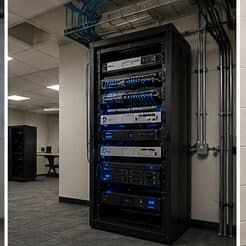
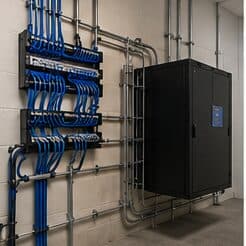
Ethernet installation for warehouses, in Pasadena
Ethernet installation for warehouses in Pasadena is a three-part question: what ethernet installation involves, what warehouses need from it, and what Pasadena changes about the install. Older industrial and service-corridor commercial stock, with rugged operational environments harder on equipment than office settings.
Ethernet installation in an existing building means finding a path from a central equipment position to each room that needs a wired connection, getting cable through that path without opening more wall than necessary, and terminating both ends cleanly. In a two-storey house with an accessible attic, that is often straightforward. In a single-storey house on a slab with a hard ceiling, it is the whole job.
Docks, yard, and inventory movement
Warehouse camera coverage concentrates where goods and vehicles move: dock doors, receiving and shipping areas, yard gates, and the boundary between operational and office space. These views answer the questions warehouse footage is actually asked — what arrived, what left, and when.
Dock doors present a specific lighting challenge. A camera facing an open dock door in daylight is looking at a bright rectangle with a dark interior, which is the worst case for dynamic range. Positioning so the camera views along the dock rather than straight into the opening, or accepting a camera specifically chosen for high contrast, addresses it.
Yard and perimeter coverage runs into distance and power. Positions beyond copper reach need fiber and local power, or a designed wireless link — and either way, the power question has to be answered before the camera is specified.
- Dock doors, receiving, and shipping framed for vehicle and goods movement
- Camera positions that avoid shooting straight into a bright dock opening
- Yard gates and perimeter, with the power and distance question resolved first
- Boundary between operational and office areas
- Retention long enough to cover inventory reconciliation cycles
Where ethernet installation goes wrong — and how it's avoided
Retrofit mistakes are usually decided at the planning stage, not the pull.
- Choosing an equipment position with no power or no ventilation
- Running a single cable to a location that will obviously need two
- Terminating in a wall plate with no slack, leaving no room to re-terminate
- Routing cable across recessed lighting fixtures in the attic
- Skipping labeling because the run count is small — the same tracing cost applies later
Pasadena: what the location changes
In Pasadena, the plan is built outward from the conditions that are actually here. Older industrial and service-corridor commercial stock, with rugged operational environments harder on equipment than office settings. Metal and mixed-construction buildings requiring proper cable support and camera housings rated for the environment. Established residential neighbourhoods predating structured wiring, needing genuine retrofit. Each one changes where cable can run, where equipment can sit, and how coverage is shaped, which is why a walkthrough settles a Pasadena scope faster than any generic estimate.
- Older industrial and service-corridor commercial stock, with rugged operational environments harder on equipment than office settings
- Metal and mixed-construction buildings requiring proper cable support and camera housings rated for the environment
- Established residential neighbourhoods predating structured wiring, needing genuine retrofit
- Coastal-adjacent humidity and driven rain requiring durable exterior sealing
- Network rooms that grew organically and need remediation rather than expansion
Getting it done in Pasadena
Every run gets a wire-map and length check at minimum, which catches the errors that actually happen in retrofit work: a reversed pair at a hastily terminated jack, a split pair, or a run longer than it looked.
A warehouse surveyed empty and a warehouse full of stock are different radio environments. Metal racking reflects, palletised inventory absorbs, and coverage that measured well across an open floor can disappear once the aisles fill. Any design based on an empty-building survey should be treated as provisional.
On site, the schedule and working method turn on conditions like these. Coastal-adjacent humidity and driven rain requiring durable exterior sealing. Network rooms that grew organically and need remediation rather than expansion. Both shape how and when a crew can actually operate, which is why EVOTECH scopes each Pasadena job from the property itself rather than assuming one approach fits every address. Coverage is stated as a service area, never an office claim, and anything about Pasadena that cannot be verified is left out instead of invented.
Frequently asked questions
Is ethernet installation for warehouses different in Pasadena?
The sector needs stay the same, but the install changes with the place. In Pasadena, the conditions above — not the warehouses label — decide routes, mounting, and equipment placement, which is why this page pairs all three.
Can Ethernet be added without cutting into walls?
Often yes, when the destination is an interior wall reachable from an attic or crawl space and there is no blocking in the cavity. When there is no viable cavity path, the choices are a small access cut that then gets patched, a surface raceway, or moving the device to a wall that can be reached. Which one makes sense is worth deciding before work starts rather than mid-pull.