Soundbar mounting for warehouses, in League City
Soundbar mounting for warehouses in League City is a three-part question: what soundbar mounting involves, what warehouses need from it, and what League City changes about the install. Coastal proximity raising the weight on exterior sealing, rated housings, and surge protection.
A soundbar upgrades a TV's sound in one tidy bar, and mounting one well is about three things: getting it centered and level relative to the screen so it looks intentional, getting the audio connection working so it turns on and off with the TV, and concealing the cable so the whole thing reads as clean. Done casually, it sits slightly off-center with a cable dangling and the volume controlled by the wrong remote.
Cover the aisles, reach the far end, watch the docks
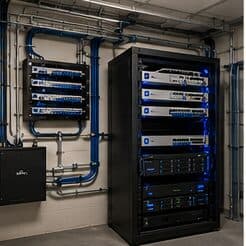
Warehouse projects come down to three things: wireless that works down the aisles with stock in place, a network topology that reaches the far end of the building properly, and camera coverage at the points where goods and vehicles move.
Office areas within the warehouse are comparatively ordinary and are usually the easiest part of the project.
- Access points positioned to cover along aisles rather than across them
- Intermediate equipment positions linked by fiber where distance requires
- Dock doors, receiving, and yard gates covered by cameras
- Scanner and handheld roaming validated with stock in place
- Equipment protected from dust and temperature in unconditioned areas
What changes soundbar mounting from job to job
A small job, with a few things that change it.
- Wall construction and mounting method
- Above- versus below-screen placement
- Cable concealment: in-wall versus surface
- Whether a subwoofer or rear speakers are included
- ARC/eARC support on the specific TV and bar
- Whether it is paired with a new TV mount
League City: what the location changes
In League City, the plan is built outward from the conditions that are actually here. Coastal proximity raising the weight on exterior sealing, rated housings, and surge protection. Storm-season resilience planning, favouring UPS and failover where uptime matters. Newer suburban slab-foundation homes with multi-room coverage needs. Each one changes where cable can run, where equipment can sit, and how coverage is shaped, which is why a walkthrough settles a League City scope faster than any generic estimate.
- Coastal proximity raising the weight on exterior sealing, rated housings, and surge protection
- Storm-season resilience planning, favouring UPS and failover where uptime matters
- Newer suburban slab-foundation homes with multi-room coverage needs
- Growing medical and retail commercial space
- Gulf Coast humidity and driven-rain events as a routine design factor
Getting it done in League City
A soundbar is checked for alignment, control, and clean cabling.
Warehouse camera coverage concentrates where goods and vehicles move: dock doors, receiving and shipping areas, yard gates, and the boundary between operational and office space. These views answer the questions warehouse footage is actually asked — what arrived, what left, and when.
On site, the schedule and working method turn on conditions like these. Growing medical and retail commercial space. Gulf Coast humidity and driven-rain events as a routine design factor. Both shape how and when a crew can actually operate, which is why EVOTECH scopes each League City job from the property itself rather than assuming one approach fits every address. Coverage is stated as a service area, never an office claim, and anything about League City that cannot be verified is left out instead of invented.
Frequently asked questions
Is soundbar mounting for warehouses different in League City?
The sector needs stay the same, but the install changes with the place. In League City, the conditions above — not the warehouses label — decide routes, mounting, and equipment placement, which is why this page pairs all three.
Why won't one remote control my soundbar volume?
Almost always ARC/eARC is not enabled on both devices. When it is set up on the TV and matched on the bar, the TV hands volume and power control to a single remote over the HDMI cable. Without it, the system falls back to optical, which plays sound but gives up single-remote control and, on some content, audio quality.