Business phone & VoIP for warehouses, in League City
Business phone & VoIP for warehouses in League City is a three-part question: what business phone & voip involves, what warehouses need from it, and what League City changes about the install. Coastal proximity raising the weight on exterior sealing, rated housings, and surge protection.
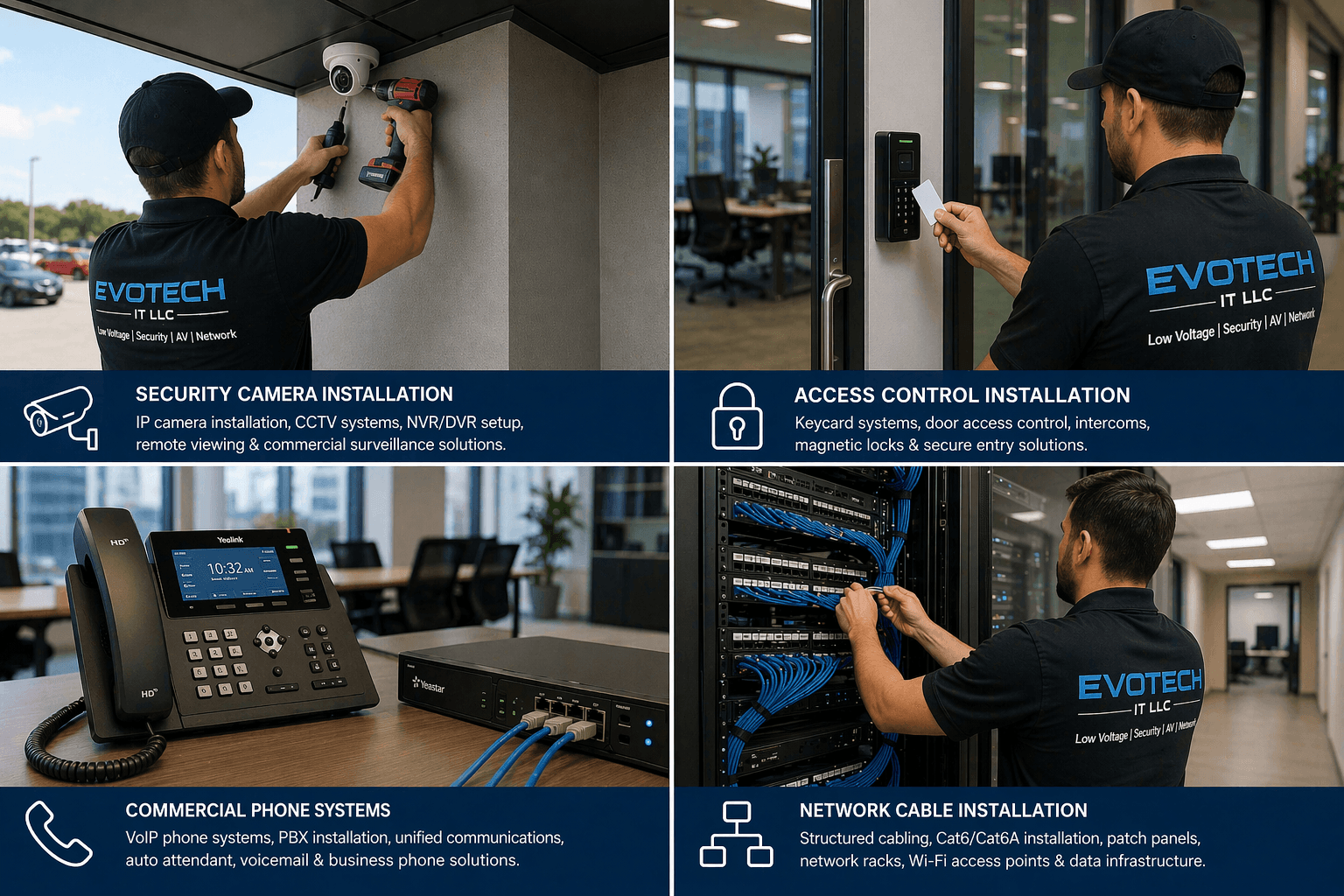
Modern business phones run over the data network — VoIP handsets plug into the same switches as everything else and draw their power from PoE. That is the appeal: one cabling system, central management, and features like auto-attendant, voicemail-to-email, call groups, and remote extensions that older key systems could not offer. The decision that shapes the rest is on-premise versus cloud: an on-site call server you own and maintain, or a hosted service where the provider runs the platform and the site just needs handsets, power, and a good circuit.
Cover the aisles, reach the far end, watch the docks
Warehouse projects come down to three things: wireless that works down the aisles with stock in place, a network topology that reaches the far end of the building properly, and camera coverage at the points where goods and vehicles move.
Office areas within the warehouse are comparatively ordinary and are usually the easiest part of the project.
- Access points positioned to cover along aisles rather than across them
- Intermediate equipment positions linked by fiber where distance requires
- Dock doors, receiving, and yard gates covered by cameras
- Scanner and handheld roaming validated with stock in place
- Equipment protected from dust and temperature in unconditioned areas
What changes business phone & voip from job to job
Phone-system scope moves with the number of extensions and the call features, not the building size.
- Handset count and any conference, paging, or door-phone endpoints
- On-premise call server versus a hosted platform
- Peak concurrent calls and the resulting upload requirement
- Whether the existing cabling and switching can carry the handsets
- Number porting complexity and how many numbers move
- Auto-attendant, voicemail, call-group, and after-hours routing complexity
- Multi-site dial plan requirements
League City: what the location changes
In League City, the plan is built outward from the conditions that are actually here. Coastal proximity raising the weight on exterior sealing, rated housings, and surge protection. Storm-season resilience planning, favouring UPS and failover where uptime matters. Newer suburban slab-foundation homes with multi-room coverage needs. Each one changes where cable can run, where equipment can sit, and how coverage is shaped, which is why a walkthrough settles a League City scope faster than any generic estimate.
- Coastal proximity raising the weight on exterior sealing, rated housings, and surge protection
- Storm-season resilience planning, favouring UPS and failover where uptime matters
- Newer suburban slab-foundation homes with multi-room coverage needs
- Growing medical and retail commercial space
- Gulf Coast humidity and driven-rain events as a routine design factor
Getting it done in League City
Phones are commissioned by making real calls under real conditions, not by confirming the handsets register.
Warehouse camera coverage concentrates where goods and vehicles move: dock doors, receiving and shipping areas, yard gates, and the boundary between operational and office space. These views answer the questions warehouse footage is actually asked — what arrived, what left, and when.
On site, the schedule and working method turn on conditions like these. Growing medical and retail commercial space. Gulf Coast humidity and driven-rain events as a routine design factor. Both shape how and when a crew can actually operate, which is why EVOTECH scopes each League City job from the property itself rather than assuming one approach fits every address. Coverage is stated as a service area, never an office claim, and anything about League City that cannot be verified is left out instead of invented.
Frequently asked questions
Is business phone & voip for warehouses different in League City?
The sector needs stay the same, but the install changes with the place. In League City, the conditions above — not the warehouses label — decide routes, mounting, and equipment placement, which is why this page pairs all three.
Why do our VoIP calls sound choppy when the internet seems fine?
Almost always jitter or contention rather than raw bandwidth. Voice packets are time-sensitive, and on a network that treats them the same as a backup or a large upload they get delayed or dropped whenever the network is busy. A dedicated voice segment with quality-of-service prioritisation fixes the majority of these cases without changing the internet plan.