Digital signage for warehouses, in Jersey Village
Digital signage for warehouses in Jersey Village is a three-part question: what digital signage involves, what warehouses need from it, and what Jersey Village changes about the install. Established mid-century residential stock predating structured wiring.
A digital sign is not a television. It runs many hours a day, often near a window in bright ambient light, and it has to show scheduled content on its own without anyone touching it. That means a display rated for commercial duty cycle and adequate brightness, a content player that drives it reliably, and a way to change what it shows remotely — so a menu, a promotion, or a directory can be updated from a desk rather than a step-ladder.
Height, forklifts, and unconditioned space
High-level work needs lift access, and lift access needs floor space clear of racking, stock, and traffic. Coordinating that with warehouse operations is usually the single biggest scheduling constraint, and it is why warehouse installs often happen during shutdowns or quieter shifts.
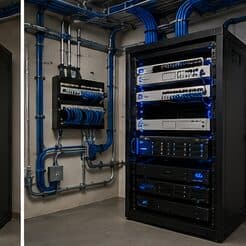
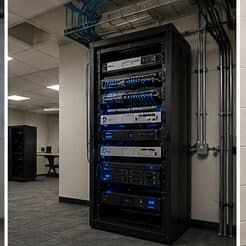
Environmental conditions matter for equipment placement. Much of a warehouse is unconditioned, and equipment placed in that environment is subject to summer temperatures and dust. Enclosures, filtration, or siting equipment in a conditioned office area are the usual responses.
- Lift access requiring clear floor space coordinated with operations
- Work often scheduled during shutdowns or quieter shifts
- Equipment sited in conditioned space or protected enclosures
- Dust protection for anything in the operational area
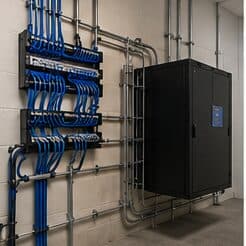
- Cable pathways kept clear of forklift and racking impact zones
What drives the cost of digital signage here
Commercial displays and the content system carry the cost, not the mounting.
- Number, size, and grade of displays
- Brightness class required by the environment
- Content players and any management subscription
- Video-wall mounting and signal distribution
- Network and power provision
- Mounting height and access requirements
Jersey Village: what the location changes
In Jersey Village, the plan is built outward from the conditions that are actually here. Established mid-century residential stock predating structured wiring. Compact small-commercial and office buildings suited to single-visit work. Slab-foundation homes with attic-to-interior-wall retrofit routing. Each one changes where cable can run, where equipment can sit, and how coverage is shaped, which is why a walkthrough settles a Jersey Village scope faster than any generic estimate.
- Established mid-century residential stock predating structured wiring
- Compact small-commercial and office buildings suited to single-visit work
- Slab-foundation homes with attic-to-interior-wall retrofit routing
- Built-out character meaning mostly retrofit and remediation, not new construction
- Gulf Coast humidity requiring rated exterior housings
Getting it done in Jersey Village
Signage is commissioned by confirming it reads correctly and runs unattended.
Warehouse projects come down to three things: wireless that works down the aisles with stock in place, a network topology that reaches the far end of the building properly, and camera coverage at the points where goods and vehicles move.
Getting Jersey Village work done means planning around the site as it actually is. Built-out character meaning mostly retrofit and remediation, not new construction. Gulf Coast humidity requiring rated exterior housings. Both matter as much as the design to how and when the work happens. The scope is drawn from the real property, the coverage is stated as a service area rather than an office, and unverifiable specifics about Jersey Village are kept off the page on purpose.
Popular services nearby
Frequently searched near this area — the pages people look for most.
Frequently asked questions
Is digital signage for warehouses different in Jersey Village?
The sector needs stay the same, but the install changes with the place. In Jersey Village, the conditions above — not the warehouses label — decide routes, mounting, and equipment placement, which is why this page pairs all three.
Can we just use a regular TV for a menu board?
For a few hours a day, maybe. For open-to-close operation it is a false economy — consumer televisions are not rated for that duty cycle and fail earlier, and they are often too dim to read against daylight. A commercial display rated for the hours and the brightness costs more up front and far less over its life in a signage role.