Floodlight camera installation for warehouses, in Houston
Floodlight camera installation for warehouses in Houston is a three-part question: what floodlight camera installation involves, what warehouses need from it, and what Houston changes about the install. Building stock spanning multiple construction eras within short distances, producing very different ceiling and pathway conditions.
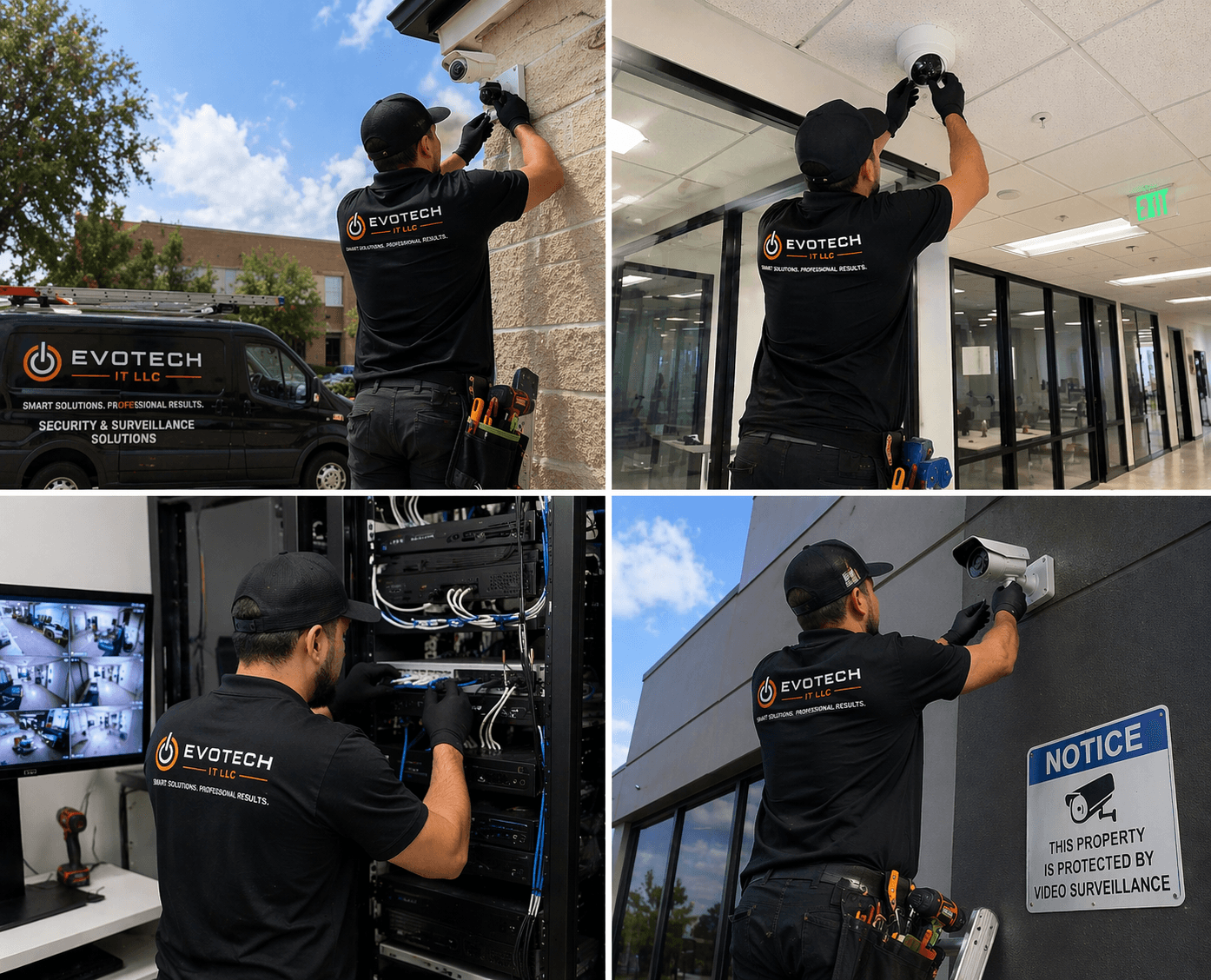
A floodlight camera combines a motion-activated light with a camera, so an area lights up and records when something moves — good for deterrence and for usable colour footage at night. The catch is that the camera is looking into its own light source, so placement has to give useful footage without the floodlight washing out the near field or throwing hard shadows, and the motion detection has to trigger on people rather than every passing car or swaying tree.
Topology, mounting height, and roaming for handhelds
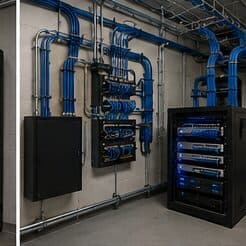
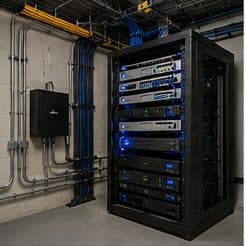
Where a building exceeds copper reach from a single position, the usual answer is one or more intermediate distribution points fed by fiber, each serving its area with copper within the limit. This is standard structured-cabling practice and it is far more reliable than attempting to stretch copper or bridge wirelessly across the building.
Access-point mounting height is a genuine design decision in high-ceiling spaces, not a default. Mounting at the roof deck maximises line of sight but puts the access point far from the devices and often above the racking, where the signal has to travel down through stock. Mounting lower — at or just above racking height, aimed along the aisles — frequently produces better coverage where the scanners actually are.
Roaming matters because the primary clients are mobile. A forklift-mounted or handheld scanner moving down an aisle needs clean handoffs between cells. That is a function of overlap and channel planning, and it is best validated by walking the aisles with the racking loaded.
- Fiber to intermediate distribution points where distance exceeds copper limits
- Mounting height chosen deliberately rather than defaulting to the roof deck
- Coverage designed along aisles, with directional antennas where useful
- Roaming validated by walking loaded aisles, not an empty floor
- Office, operations, and building-system traffic segmented
What drives the cost of floodlight camera installation here
Power, mounting access, and count drive the cost.
- Wired versus battery power and any wiring run
- Mounting height and access
- Number of units and approaches
- Recording and storage where continuous
- Remote-access setup
- Any network coverage needed at the position
Houston: what the location changes
Building stock spanning multiple construction eras within short distances, producing very different ceiling and pathway conditions. In Houston, that is where the plan begins, because it changes cable paths, device placement, and access-point counts before anything else does. Slab-on-grade foundations dominate residential construction, which pushes retrofit cable routes into the attic rather than under the floor. Gulf Coast humidity and heavy rainfall events make exterior equipment sealing and drip-loop practice a routine requirement rather than an optional detail. None of these are generic checklist items — each moves the design in a direction a citywide assumption would miss, and the honest recommendation always depends on what this particular property allows.
- Building stock spanning multiple construction eras within short distances, producing very different ceiling and pathway conditions
- Slab-on-grade foundations dominate residential construction, which pushes retrofit cable routes into the attic rather than under the floor
- Gulf Coast humidity and heavy rainfall events make exterior equipment sealing and drip-loop practice a routine requirement rather than an optional detail
- Summer attic temperatures constrain the working window for residential retrofit and rooftop-adjacent work
- Mixed land-use patterns place commercial, light industrial, and residential structures adjacent to each other, so neighbouring buildings often need entirely different approaches
Getting it done in Houston
A floodlight camera is judged by its footage at night, not its live view by day.
High-level work needs lift access, and lift access needs floor space clear of racking, stock, and traffic. Coordinating that with warehouse operations is usually the single biggest scheduling constraint, and it is why warehouse installs often happen during shutdowns or quieter shifts.
Getting Houston work done means planning around the site as it actually is. Summer attic temperatures constrain the working window for residential retrofit and rooftop-adjacent work. Mixed land-use patterns place commercial, light industrial, and residential structures adjacent to each other, so neighbouring buildings often need entirely different approaches. Both matter as much as the design to how and when the work happens. The scope is drawn from the real property, the coverage is stated as a service area rather than an office, and unverifiable specifics about Houston are kept off the page on purpose.
Popular services nearby
Frequently searched near this area — the pages people look for most.
Frequently asked questions
Is floodlight camera installation for warehouses different in Houston?
The sector needs stay the same, but the install changes with the place. In Houston, the conditions above — not the warehouses label — decide routes, mounting, and equipment placement, which is why this page pairs all three.
Why is my floodlight camera's footage washed out at night?
The camera is fighting its own light. If the floodlight blows out the near field or reflects off a nearby wall or soffit back into the lens, the footage is worse than a plain camera would give. Aiming the light onto the scene and off the lens's immediate foreground — and away from reflective surfaces — is what fixes it.