Why this page exists
Technology for warehouses in EaDo (East Downtown) sits where two things meet: how warehouses actually operate, and what EaDo (East Downtown) specifically brings to the building. EaDo 77003 is a former warehouse and light-industrial district now mixing brick industrial conversions with new mid-rise residential, so one block can be exposed-structure adaptive reuse and the next slab-on-grade new build.
A warehouse surveyed empty and a warehouse full of stock are different radio environments. Metal racking reflects, palletised inventory absorbs, and coverage that measured well across an open floor can disappear once the aisles fill. Any design based on an empty-building survey should be treated as provisional.
The building changes its own radio environment
A warehouse surveyed empty and a warehouse full of stock are different radio environments. Metal racking reflects, palletised inventory absorbs, and coverage that measured well across an open floor can disappear once the aisles fill. Any design based on an empty-building survey should be treated as provisional.
The second defining feature is distance. Warehouse footprints regularly exceed what a single equipment room can serve within the 100-metre copper limit, which means either intermediate equipment positions connected by fiber or a deliberately distributed design.
- Racking and stock materially change coverage after the survey
- Distances frequently exceed the 100 m copper channel limit
- High ceilings complicate mounting, access, and coverage geometry
- Dock doors, yard, and office areas each have distinct requirements
EaDo (East Downtown): what the location adds
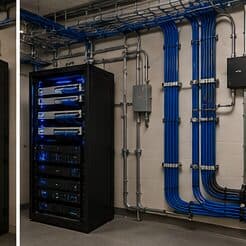
In EaDo (East Downtown), the plan is built outward from the conditions that are actually here. EaDo 77003 is a former warehouse and light-industrial district now mixing brick industrial conversions with new mid-rise residential, so one block can be exposed-structure adaptive reuse and the next slab-on-grade new build. Exposed-ceiling conversions leave conduit and cable trays visible, which raises the bar on how cleanly runs are dressed and where equipment is mounted. Masonry and tilt-wall shells limit fishing, so pathways are often surface raceway or existing conduit rather than in-wall. Each one changes where cable can run, where equipment can sit, and how coverage is shaped, which is why a walkthrough settles a EaDo (East Downtown) scope faster than any generic estimate.
- EaDo 77003 is a former warehouse and light-industrial district now mixing brick industrial conversions with new mid-rise residential, so one block can be exposed-structure adaptive reuse and the next slab-on-grade new build
- Exposed-ceiling conversions leave conduit and cable trays visible, which raises the bar on how cleanly runs are dressed and where equipment is mounted
- Masonry and tilt-wall shells limit fishing, so pathways are often surface raceway or existing conduit rather than in-wall
- New mixed-use construction here is frequently prewired during the build, which is a very different scope from retrofitting an older shell
- Ground-floor commercial suites under residential units mean camera and network design has to separate tenant systems from the building's own
Cover the aisles, reach the far end, watch the docks
Warehouse projects come down to three things: wireless that works down the aisles with stock in place, a network topology that reaches the far end of the building properly, and camera coverage at the points where goods and vehicles move.
Office areas within the warehouse are comparatively ordinary and are usually the easiest part of the project.
- Access points positioned to cover along aisles rather than across them
- Intermediate equipment positions linked by fiber where distance requires
- Dock doors, receiving, and yard gates covered by cameras
- Scanner and handheld roaming validated with stock in place
- Equipment protected from dust and temperature in unconditioned areas
Installing in EaDo (East Downtown)
Where a building exceeds copper reach from a single position, the usual answer is one or more intermediate distribution points fed by fiber, each serving its area with copper within the limit. This is standard structured-cabling practice and it is far more reliable than attempting to stretch copper or bridge wirelessly across the building.
On site, the schedule and working method turn on conditions like these. New mixed-use construction here is frequently prewired during the build, which is a very different scope from retrofitting an older shell. Ground-floor commercial suites under residential units mean camera and network design has to separate tenant systems from the building's own. Both shape how and when a crew can actually operate, which is why EVOTECH scopes each EaDo (East Downtown) job from the property itself rather than assuming one approach fits every address. Coverage is stated as a service area, never an office claim, and anything about EaDo (East Downtown) that cannot be verified is left out instead of invented.
Popular services nearby
Frequently searched near this area — the pages people look for most.
Frequently asked questions
What do warehouses in EaDo (East Downtown) usually need first?
It varies by site, but the pattern for warehouses holds in EaDo (East Downtown): get the network and cabling backbone right, then layer cameras and access on top. What EaDo (East Downtown) changes is the physical install — the conditions listed above drive routes and equipment placement more than the sector alone does.
Why did warehouse Wi-Fi get worse after the racking was stocked?
Because the stock changed the radio environment. Metal racking reflects and palletised goods absorb, so coverage measured across an open floor no longer applies. This is why warehouse designs should assume loaded conditions and why validation should happen with the aisles full.