Projector & screen installation for warehouses, in Conroe
Projector & screen installation for warehouses in Conroe is a three-part question: what projector & screen installation involves, what warehouses need from it, and what Conroe changes about the install. Fast commercial and medical growth with newer buildouts and tenant-improvement conditions.
A projector fills a wall in a way no flat panel matches, but it only looks good when three things line up: the throw distance (how far the projector sits from the screen for the image size you want), the screen size for the room's viewing distance, and the ambient light. Get the geometry wrong and the image overshoots or underfills the screen; ignore the light and a bright room washes the picture out.
Cover the aisles, reach the far end, watch the docks
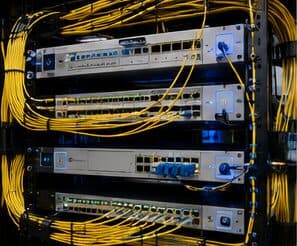
Warehouse projects come down to three things: wireless that works down the aisles with stock in place, a network topology that reaches the far end of the building properly, and camera coverage at the points where goods and vehicles move.
Office areas within the warehouse are comparatively ordinary and are usually the easiest part of the project.
- Access points positioned to cover along aisles rather than across them
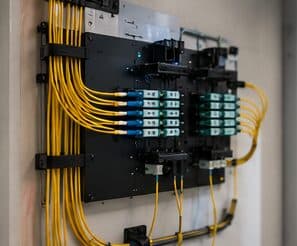
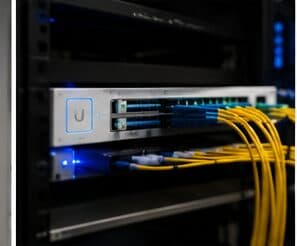
- Intermediate equipment positions linked by fiber where distance requires
- Dock doors, receiving, and yard gates covered by cameras
- Scanner and handheld roaming validated with stock in place
- Equipment protected from dust and temperature in unconditioned areas
What changes projector & screen installation from job to job
Scope depends on the room, the light, and the mounting.
- Screen size and type for the room and light
- Projector throw ratio and mounting distance
- Ceiling mount height and structure
- Long cable run length and whether an extender is needed
- Ambient light control versus an ALR screen
- Motorised versus fixed screen
Conroe: what the location changes
In Conroe, the plan is built outward from the conditions that are actually here. Fast commercial and medical growth with newer buildouts and tenant-improvement conditions. Older commercial stock needing pathway remediation. Larger residential properties, including lake-area homes with outbuildings. Each one changes where cable can run, where equipment can sit, and how coverage is shaped, which is why a walkthrough settles a Conroe scope faster than any generic estimate.
- Fast commercial and medical growth with newer buildouts and tenant-improvement conditions
- Older commercial stock needing pathway remediation
- Larger residential properties, including lake-area homes with outbuildings
- Detached structures and longer runs raising distance considerations
- Ongoing new construction where prewire is the high-value decision
Getting it done in Conroe
A projector is commissioned by confirming geometry, light, and signal.
Warehouse camera coverage concentrates where goods and vehicles move: dock doors, receiving and shipping areas, yard gates, and the boundary between operational and office space. These views answer the questions warehouse footage is actually asked — what arrived, what left, and when.
Getting Conroe work done means planning around the site as it actually is. Detached structures and longer runs raising distance considerations. Ongoing new construction where prewire is the high-value decision. Both matter as much as the design to how and when the work happens. The scope is drawn from the real property, the coverage is stated as a service area rather than an office, and unverifiable specifics about Conroe are kept off the page on purpose.
Popular services nearby
Frequently searched near this area — the pages people look for most.
Frequently asked questions
Is projector & screen installation for warehouses different in Conroe?
The sector needs stay the same, but the install changes with the place. In Conroe, the conditions above — not the warehouses label — decide routes, mounting, and equipment placement, which is why this page pairs all three.
How far should the projector be from the screen?
It is set by the projector's throw ratio and the screen size you want — a calculation, not a guess. The projector produces a given image size only at the right distance, so the mount goes where the geometry says, kept square to the screen so keystone correction, which softens the image, stays minimal.