Why this page exists
Video wall installation for schools and educational facilities is shaped by how the space is used, not just by the service itself. Schools and educational facilities bring their own operating constraints, and this page pairs what video wall installation actually involves with what that environment changes about it.
A video wall is an array of thin-bezel panels driven so that content spans them as a single image. What makes it a distinct discipline from hanging displays is precision: the panels have to align to a fraction of a millimetre, the thin gaps (mullions) between them have to be compensated so the image reads as continuous, a processor has to split and scale content across the array, and the whole wall has to stay serviceable when one panel needs attention.
Density in bursts, across a campus
A classroom with thirty students on devices is one of the densest wireless environments in any building type, and it happens simultaneously in every classroom on a bell schedule. That is a capacity problem of a specific shape: predictable, synchronised, and concentrated.
The campus dimension compounds it. Multiple buildings, outdoor circulation, portable classrooms, gymnasiums, and administrative areas each need coverage, and the distances involved usually exceed what copper alone can serve from one position.
- Classroom device density peaking simultaneously across the campus
- Multiple buildings and outdoor areas requiring distributed infrastructure
- Portable and temporary classrooms with their own connectivity needs
- Entry control and visitor management as standing requirements
What video wall installation usually involves
The defining problem is precision. Consumer-mounting practice is nowhere near tight enough — panels have to be co-planar and aligned so a horizontal line crosses the seams without stepping, which needs mounts with fine micro-adjustment and careful setting. A wall that looks 'close' reads as broken.
The second is the system behind it: without a proper video-wall processor, content is not split and scaled correctly across the array and the mullions are not compensated, so the image looks like separate screens rather than one. And thermal and service access — panels generate heat and eventually need attention — has to be designed in, or maintenance becomes a demolition job.
- Panels not co-planar or aligned, so lines step across the seams
- Colour mismatched between panels, breaking the single-image look
- No processor, so content is not split, scaled, or mullion-compensated
- Heat build-up in a tightly packed array
- No service access, so one panel means dismantling the wall
- Consumer mounts without the fine adjustment a wall needs
Classroom capacity and campus topology
Classroom wireless is a capacity design. A single access point serving a full class of devices needs adequate spectrum, and neighbouring classrooms on the same channel will contend with each other through the wall. That makes the channel plan across a corridor of classrooms as important as the access-point count — a plan that ignores the neighbours produces a corridor where every room is slow.
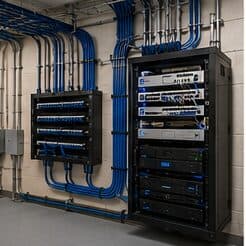
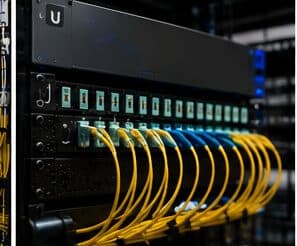
Campus topology follows standard structured-cabling practice at a larger scale: a main equipment position, fiber to distribution points in each building or wing, and copper from those points out to classrooms within the distance limit. Between-building links are fiber for both distance and electrical isolation.
Segmentation separates student devices, staff devices, administrative systems, and building systems such as cameras and door controllers. Student access is typically the most restricted and the most heavily used, and separating it means student traffic cannot affect administrative systems.
- Capacity designed per classroom with a corridor-wide channel plan
- Fiber backbone between buildings and to per-building distribution
- Student, staff, administrative, and building-system segments
- Coverage for gymnasiums, libraries, cafeterias, and outdoor areas
- Portable classroom connectivity planned rather than improvised
Precision mounting, the processor, calibration, and service
Video-wall mounts are built for the job: they hold panels co-planar and provide micro-adjustment in every axis so each panel aligns to its neighbours to a fraction of a millimetre, and many pull the panel forward for service access. Setting the array flat and aligned is painstaking and is most of the installation's skill — it is what makes the seams disappear into a single image.
- Video-wall mounts with fine micro-adjustment, holding panels co-planar
- Panels aligned to a fraction of a millimetre across the array
- A processor to split, scale, and mullion-compensate content
- Colour and brightness calibration for a uniform image
- Heat managed for the packed panel environment
- Pull-out or serviceable mounting for single-panel access
Frequently asked questions
What changes about video wall installation in schools and educational facilities?
The operating environment does. Schools and educational facilities bring specific constraints — how the space is used, when work can happen, and what has to keep running — and those shape the video wall installation plan as much as the service's own technical requirements.
How is a video wall different from mounting several TVs?
Precision and the system behind it. A video wall's panels must be co-planar and aligned to a fraction of a millimetre so seams read as continuous, driven by a processor that splits and scales content and compensates for the gaps, and built so one panel can be serviced without dismantling the array. Hanging several TVs is nowhere near that tolerance — treat a wall that way and it looks like separate screens.
How many access points does a classroom need?
It is a capacity question rather than a coverage one. A classroom with a full class on devices concentrates demand into one cell, and neighbouring classrooms on the same channel contend through the wall. That usually means one access point per classroom with a corridor-wide channel plan, rather than fewer access points at higher power.