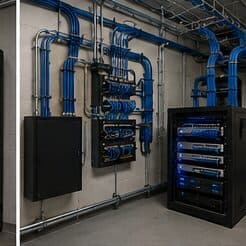
Cat6 cabling for schools and educational facilities, in The Woodlands
Cat6 cabling for schools and educational facilities in The Woodlands is a three-part question: what cat6 cabling involves, what schools and educational facilities need from it, and what The Woodlands changes about the install. Mature tree cover on many residential lots, attenuating outdoor wireless signal and generating constant motion in camera scenes.
Cat6 carries gigabit Ethernet across the full 100-metre channel without drama, and that covers the overwhelming majority of what plugs into an office or home wall plate: computers, phones, printers, access points, cameras, and door controllers. Where it gets interesting is 10 gigabit. Cat6 can carry 10GBASE-T, but only to roughly 55 metres, and that figure assumes a favourable alien-crosstalk environment — cables not bundled tightly with many neighbours carrying the same signal.
The academic calendar sets the schedule
Substantial infrastructure work happens during breaks. That concentrates a lot of activity into a short window and makes preparation disproportionately important — materials on site, pathways confirmed, and decisions made before the window opens, because there is no extending it.
Work during term time is possible but constrained: classroom access has to fit around teaching, and any work in occupied areas requires appropriate coordination with the school's own procedures for contractors on site.
- Major work concentrated into scheduled breaks
- Preparation completed before the window opens, since it cannot be extended
- Term-time work coordinated around teaching schedules
- Contractor procedures and site access governed by school policy
- Phased approaches common where budgets follow academic years
Where cat6 cabling goes wrong — and how it's avoided
The common errors are decisions made once and regretted for years.
- Specifying Cat6 for a run that will need 10G at 80 metres
- Specifying Cat6A everywhere and losing pathway space that a mixed design would have kept
- Terminating a Cat6 run on leftover Cat5e hardware
- Bundling forty identical runs tightly and then expecting short-run 10G to hold
- Treating the certification report as paperwork rather than reading the margins
The Woodlands: what the location changes
In The Woodlands, the plan is built outward from the conditions that are actually here. Mature tree cover on many residential lots, attenuating outdoor wireless signal and generating constant motion in camera scenes. Corporate and professional office stock with meeting-room density driving wireless capacity requirements. Larger residential lots with detached structures and outbuildings beyond practical house-coverage range. Each one changes where cable can run, where equipment can sit, and how coverage is shaped, which is why a walkthrough settles a The Woodlands scope faster than any generic estimate.
- Mature tree cover on many residential lots, attenuating outdoor wireless signal and generating constant motion in camera scenes
- Corporate and professional office stock with meeting-room density driving wireless capacity requirements
- Larger residential lots with detached structures and outbuildings beyond practical house-coverage range
- Master-planned development producing relatively consistent, newer commercial construction with usable pathway
- Wooded exterior camera positions requiring careful framing to avoid constant vegetation-triggered motion events
Getting it done in The Woodlands
Certification for a Cat6 link measures the parameters that define the category: insertion loss, near-end and far-end crosstalk, return loss, and propagation delay skew across the frequency range up to 250 MHz. A pass means the link meets the standard's limits with margin recorded.
Two priorities dominate: enough wireless capacity in each classroom to serve a full class simultaneously, and controlled entry at the points where people come into the campus.
Getting The Woodlands work done means planning around the site as it actually is. Master-planned development producing relatively consistent, newer commercial construction with usable pathway. Wooded exterior camera positions requiring careful framing to avoid constant vegetation-triggered motion events. Both matter as much as the design to how and when the work happens. The scope is drawn from the real property, the coverage is stated as a service area rather than an office, and unverifiable specifics about The Woodlands are kept off the page on purpose.
Popular services nearby
Frequently searched near this area — the pages people look for most.
Frequently asked questions
Is cat6 cabling for schools and educational facilities different in The Woodlands?
The sector needs stay the same, but the install changes with the place. In The Woodlands, the conditions above — not the schools and educational facilities label — decide routes, mounting, and equipment placement, which is why this page pairs all three.
Is Cat6 enough, or should everything be Cat6A?
For most device locations Cat6 is enough, because most devices need gigabit and will for a long time. Cat6A earns its place on runs that must carry 10G at distance, runs sitting in dense bundles, and uplinks between equipment positions. Specifying Cat6A for the whole building is rarely wrong technically, but it costs pathway space and termination time that a mixed design keeps.