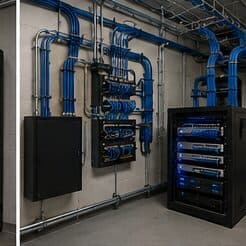
Cat6 cabling for schools and educational facilities, in Richmond
Cat6 cabling for schools and educational facilities in Richmond is a three-part question: what cat6 cabling involves, what schools and educational facilities need from it, and what Richmond changes about the install. High proportion of new residential and commercial construction, making rough-in timing the dominant scheduling factor.
So the honest framing is this: specify Cat6 when the device locations need gigabit and the building is unlikely to push 10G to the desk. Specify Cat6A when a run has to support 10G at full distance, when the cable will sit in a dense bundle, or when the location feeds equipment that already asks for more than gigabit.
Density in bursts, across a campus
A classroom with thirty students on devices is one of the densest wireless environments in any building type, and it happens simultaneously in every classroom on a bell schedule. That is a capacity problem of a specific shape: predictable, synchronised, and concentrated.
The campus dimension compounds it. Multiple buildings, outdoor circulation, portable classrooms, gymnasiums, and administrative areas each need coverage, and the distances involved usually exceed what copper alone can serve from one position.
- Classroom device density peaking simultaneously across the campus
- Multiple buildings and outdoor areas requiring distributed infrastructure
- Portable and temporary classrooms with their own connectivity needs
- Entry control and visitor management as standing requirements
What drives the cost of cat6 cabling here
Cable is a small share of an installed run. The spread between a cheap and an expensive Cat6 project comes from access and count, with component quality a distant third.
- Number of runs and their average length
- Ceiling and wall construction along the pathway
- Whether Cat6A is specified for some or all runs
- Shielded versus unshielded construction and the extra termination time shielding adds
- Certification depth and documentation format
Richmond: what the location changes
The starting point for any Richmond job is one local fact. High proportion of new residential and commercial construction, making rough-in timing the dominant scheduling factor. That single condition shapes where cable can run, where equipment can sit, and how coverage is laid out — more than any spec sheet does. Two more conditions weigh on it. Larger lots producing long runs to gates, outbuildings, and driveway camera positions that approach or exceed copper distance limits. Slab-on-grade construction with the rough-in window falling between electrical and drywall. Together they make the route specific to this pocket, which is why a short walkthrough or a few clear photos settle the scope faster than a floor plan can.
- High proportion of new residential and commercial construction, making rough-in timing the dominant scheduling factor
- Larger lots producing long runs to gates, outbuildings, and driveway camera positions that approach or exceed copper distance limits
- Slab-on-grade construction with the rough-in window falling between electrical and drywall
- Conduit and sleeve decisions made during rough-in determining what is possible for the following decade
- Detached structures common enough that between-building links are a routine design question rather than an exception
Getting it done in Richmond
Certification for a Cat6 link measures the parameters that define the category: insertion loss, near-end and far-end crosstalk, return loss, and propagation delay skew across the frequency range up to 250 MHz. A pass means the link meets the standard's limits with margin recorded.
Classroom wireless is a capacity design. A single access point serving a full class of devices needs adequate spectrum, and neighbouring classrooms on the same channel will contend with each other through the wall. That makes the channel plan across a corridor of classrooms as important as the access-point count — a plan that ignores the neighbours produces a corridor where every room is slow.
Getting Richmond work done means planning around the site as it actually is. Conduit and sleeve decisions made during rough-in determining what is possible for the following decade. Detached structures common enough that between-building links are a routine design question rather than an exception. Both matter as much as the design to how and when the work happens. The scope is drawn from the real property, the coverage is stated as a service area rather than an office, and unverifiable specifics about Richmond are kept off the page on purpose.
Popular services nearby
Frequently searched near this area — the pages people look for most.
Frequently asked questions
Is cat6 cabling for schools and educational facilities different in Richmond?
The sector needs stay the same, but the install changes with the place. In Richmond, the conditions above — not the schools and educational facilities label — decide routes, mounting, and equipment placement, which is why this page pairs all three.
Is Cat6 enough, or should everything be Cat6A?
For most device locations Cat6 is enough, because most devices need gigabit and will for a long time. Cat6A earns its place on runs that must carry 10G at distance, runs sitting in dense bundles, and uplinks between equipment positions. Specifying Cat6A for the whole building is rarely wrong technically, but it costs pathway space and termination time that a mixed design keeps.