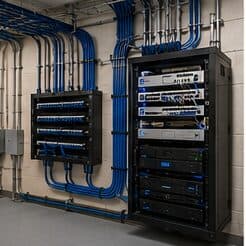
Video wall installation for schools and educational facilities, in Kingwood
Video wall installation for schools and educational facilities in Kingwood is a three-part question: what video wall installation involves, what schools and educational facilities need from it, and what Kingwood changes about the install. Mature tree cover on wooded residential lots, attenuating outdoor wireless and generating camera motion events.
Get any of that wrong and it stops reading as one display: panels misaligned so lines step across the seams, colour mismatched between panels, content that does not account for the mullions, or a wall built so tightly that servicing one panel means dismantling the array.
Per-classroom capacity and controlled entry
Two priorities dominate: enough wireless capacity in each classroom to serve a full class simultaneously, and controlled entry at the points where people come into the campus.
Both benefit from being designed at a campus level rather than building by building, because the addressing, segmentation, and management overhead of a piecemeal approach grows quickly.
- Access-point capacity planned per classroom, not per building area
- Fiber backbone between buildings and to distribution points
- Controlled entry at main and secondary access points
- Separate segments for student, staff, administrative, and building systems
- Coverage extended to gymnasiums, libraries, and outdoor gathering areas
What changes video wall installation from job to job
Scope depends on array size, panel grade, and content.
- Array size and panel count
- Panel grade and bezel width
- Processor and source requirements
- Wall structure and flatness
- Content complexity and spanning needs
- Service-access and mounting type
Kingwood: what the location changes
The starting point for any Kingwood job is one local fact. Mature tree cover on wooded residential lots, attenuating outdoor wireless and generating camera motion events. That single condition shapes where cable can run, where equipment can sit, and how coverage is laid out — more than any spec sheet does. Two more conditions weigh on it. Larger lots with detached garages, workshops, and pool structures needing their own connectivity. Predominantly newer slab-foundation homes with good attic access. Together they make the route specific to this pocket, which is why a short walkthrough or a few clear photos settle the scope faster than a floor plan can.
- Mature tree cover on wooded residential lots, attenuating outdoor wireless and generating camera motion events
- Larger lots with detached garages, workshops, and pool structures needing their own connectivity
- Predominantly newer slab-foundation homes with good attic access
- Multi-storey floor plans benefiting from a wired access point per floor
- Seasonal foliage variation affecting any wireless link between structures
Getting it done in Kingwood
A video wall is commissioned as one display, panel by panel.
Camera coverage on a school campus concentrates on entrances, circulation between buildings, parking and drop-off areas, and the perimeter. Corridors are common; classrooms are not, and that boundary is agreed at design.
Execution in Kingwood is planned around real conditions, not a template. Multi-storey floor plans benefiting from a wired access point per floor. Seasonal foliage variation affecting any wireless link between structures. These decide the sequence, the access, and the method as much as the design does. EVOTECH describes Kingwood as coverage rather than a place it occupies, and omits any area detail it cannot confirm — building and site conditions only, no invented landmarks or promised arrival times.
Frequently asked questions
Is video wall installation for schools and educational facilities different in Kingwood?
The sector needs stay the same, but the install changes with the place. In Kingwood, the conditions above — not the schools and educational facilities label — decide routes, mounting, and equipment placement, which is why this page pairs all three.
How is a video wall different from mounting several TVs?
Precision and the system behind it. A video wall's panels must be co-planar and aligned to a fraction of a millimetre so seams read as continuous, driven by a processor that splits and scales content and compensates for the gaps, and built so one panel can be serviced without dismantling the array. Hanging several TVs is nowhere near that tolerance — treat a wall that way and it looks like separate screens.