Network troubleshooting for schools and educational facilities, in Humble
Network troubleshooting for schools and educational facilities in Humble is a three-part question: what network troubleshooting involves, what schools and educational facilities need from it, and what Humble changes about the install. A retail and commercial hub with a broad mix of building ages.
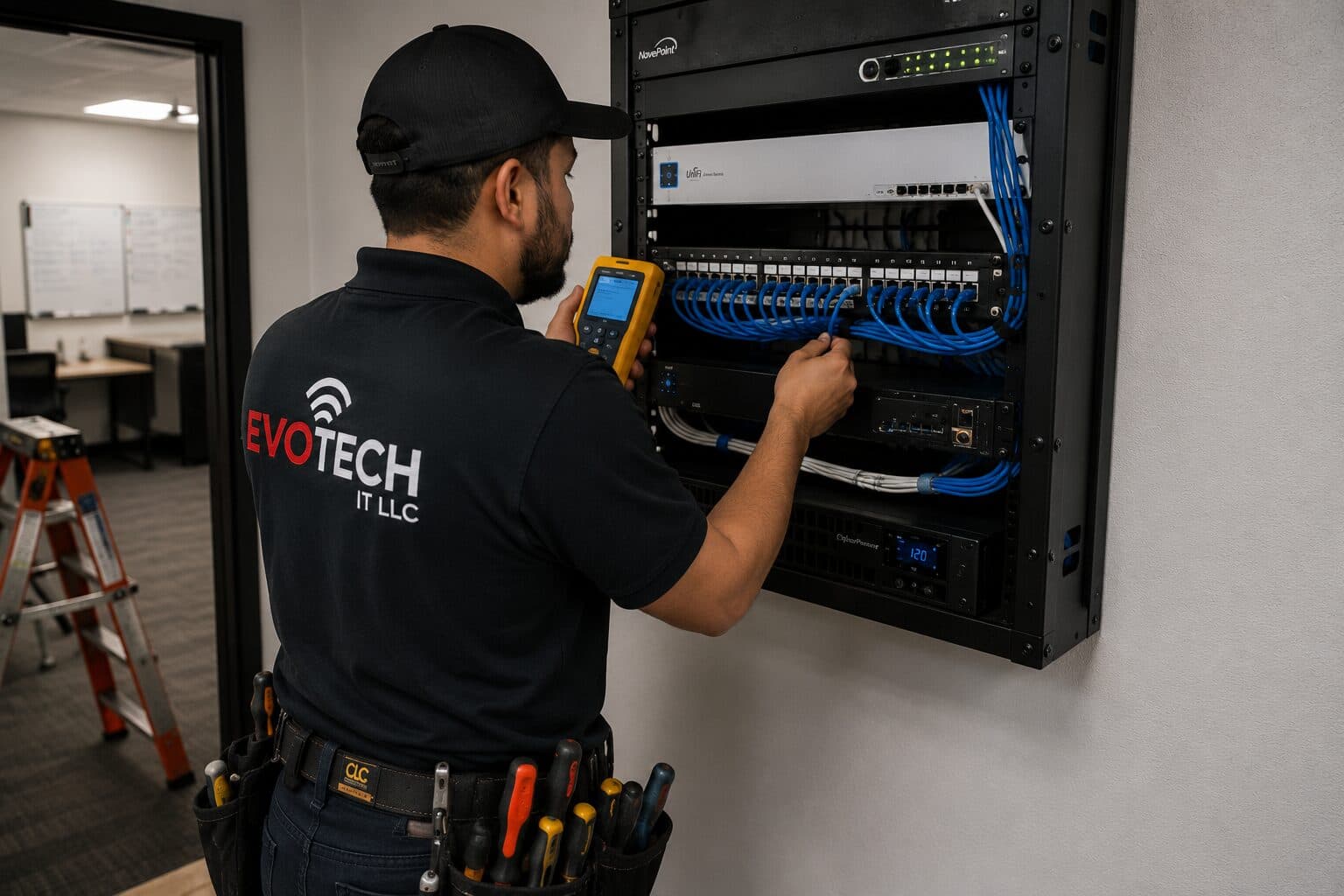
Effective troubleshooting is a process of elimination against a specific, reproducible symptom. 'The internet is slow' is not yet a diagnosis — slow for whom, on which devices, wired or wireless, at what times, to which destinations. Those answers usually point at a layer before any equipment is touched.
Per-classroom capacity and controlled entry
Two priorities dominate: enough wireless capacity in each classroom to serve a full class simultaneously, and controlled entry at the points where people come into the campus.
Both benefit from being designed at a campus level rather than building by building, because the addressing, segmentation, and management overhead of a piecemeal approach grows quickly.
- Access-point capacity planned per classroom, not per building area
- Fiber backbone between buildings and to distribution points
- Controlled entry at main and secondary access points
- Separate segments for student, staff, administrative, and building systems
- Coverage extended to gymnasiums, libraries, and outdoor gathering areas
What changes network troubleshooting from job to job
Troubleshooting effort depends mostly on how much is already known about the network.
- Whether documentation and labeling exist
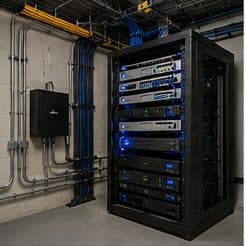
- Whether the switching is manageable and reporting statistics
- How reproducible the symptom is
- Site size and the number of areas and devices involved
- How many changes have already been made in attempts to fix it
- Whether access to the equipment and to the circuit is available
- Whether the fault is intermittent, which extends observation time
Humble: what the location changes
A retail and commercial hub with a broad mix of building ages. In Humble, that is where the plan begins, because it changes cable paths, device placement, and access-point counts before anything else does. Warehousing and distribution requiring aisle coverage and longer runs. Older commercial stock needing pathway remediation and rack cleanup. None of these are generic checklist items — each moves the design in a direction a citywide assumption would miss, and the honest recommendation always depends on what this particular property allows.
- A retail and commercial hub with a broad mix of building ages
- Warehousing and distribution requiring aisle coverage and longer runs
- Older commercial stock needing pathway remediation and rack cleanup
- Retail point-of-sale environments requiring network segmentation
- Slab-foundation residential across established and newer neighbourhoods
Getting it done in Humble
The test that matters is the one that reproduces the original complaint, run again after the change.
Camera coverage on a school campus concentrates on entrances, circulation between buildings, parking and drop-off areas, and the perimeter. Corridors are common; classrooms are not, and that boundary is agreed at design.
On site, the schedule and working method turn on conditions like these. Retail point-of-sale environments requiring network segmentation. Slab-foundation residential across established and newer neighbourhoods. Both shape how and when a crew can actually operate, which is why EVOTECH scopes each Humble job from the property itself rather than assuming one approach fits every address. Coverage is stated as a service area, never an office claim, and anything about Humble that cannot be verified is left out instead of invented.
Frequently asked questions
Is network troubleshooting for schools and educational facilities different in Humble?
The sector needs stay the same, but the install changes with the place. In Humble, the conditions above — not the schools and educational facilities label — decide routes, mounting, and equipment placement, which is why this page pairs all three.
Why is the network slow only in the afternoon?
Time-correlated symptoms usually mean capacity rather than a fault. Something is consuming the shared resource at that time — backups, updates, more people on site, or a scheduled process. Measuring at the gateway during the slow period, and comparing it to a quiet period, distinguishes a saturated circuit from an internal bottleneck quickly.