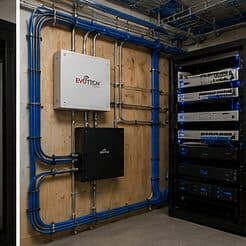
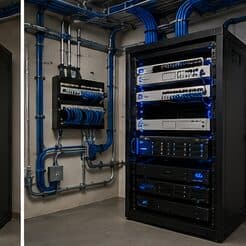
PoE camera installation for schools and educational facilities, in Brookshire
PoE camera installation for schools and educational facilities in Brookshire is a three-part question: what poe camera installation involves, what schools and educational facilities need from it, and what Brookshire changes about the install. Large warehousing and distribution buildings along the I-10 corridor.
The design consequence is that the switch is now a power supply. Each camera draws a certain class of power, and the total across every powered device has to fit within the switch's PoE budget with room to spare. A switch with enough ports but not enough watts produces intermittent camera reboots that look like network faults.
The academic calendar sets the schedule
Substantial infrastructure work happens during breaks. That concentrates a lot of activity into a short window and makes preparation disproportionately important — materials on site, pathways confirmed, and decisions made before the window opens, because there is no extending it.
Work during term time is possible but constrained: classroom access has to fit around teaching, and any work in occupied areas requires appropriate coordination with the school's own procedures for contractors on site.
- Major work concentrated into scheduled breaks
- Preparation completed before the window opens, since it cannot be extended
- Term-time work coordinated around teaching schedules
- Contractor procedures and site access governed by school policy
- Phased approaches common where budgets follow academic years
What changes poe camera installation from job to job
Scope depends on the power profile as much as the camera count.
- Camera count and the class each one requires
- Whether any devices need higher-power classes for motors, heaters, or illuminators
- Cable distance to each position
- Switch selection and whether existing switching has budget available
- Exterior penetrations, junction boxes, and weather sealing
- UPS capacity for the desired runtime
- Access requirements for elevated mounting
Brookshire: what the location changes
The starting point for any Brookshire job is one local fact. Large warehousing and distribution buildings along the I-10 corridor. That single condition shapes where cable can run, where equipment can sit, and how coverage is laid out — more than any spec sheet does. Two more conditions weigh on it. Metal construction that reflects wireless signal and complicates coverage. Building footprints frequently exceeding the 100 m copper channel limit. Together they make the route specific to this pocket, which is why a short walkthrough or a few clear photos settle the scope faster than a floor plan can.
- Large warehousing and distribution buildings along the I-10 corridor
- Metal construction that reflects wireless signal and complicates coverage
- Building footprints frequently exceeding the 100 m copper channel limit
- Unconditioned operational areas affecting equipment placement
- Long cable runs and yard/dock areas needing distinct approaches
Getting it done in Brookshire
The meaningful PoE test is under peak load after dark, because that is the condition that exposes budget problems.
Two priorities dominate: enough wireless capacity in each classroom to serve a full class simultaneously, and controlled entry at the points where people come into the campus.
Execution in Brookshire is planned around real conditions, not a template. Unconditioned operational areas affecting equipment placement. Long cable runs and yard/dock areas needing distinct approaches. These decide the sequence, the access, and the method as much as the design does. EVOTECH describes Brookshire as coverage rather than a place it occupies, and omits any area detail it cannot confirm — building and site conditions only, no invented landmarks or promised arrival times.
Frequently asked questions
Is poe camera installation for schools and educational facilities different in Brookshire?
The sector needs stay the same, but the install changes with the place. In Brookshire, the conditions above — not the schools and educational facilities label — decide routes, mounting, and equipment placement, which is why this page pairs all three.
Why do cameras reboot at night but work fine during the day?
Almost always PoE budget. Infrared illuminators engage after dark and the total draw rises, pushing the switch past its budget. It presents as intermittent camera dropouts and gets misdiagnosed as a network fault. The fix is a switch with sufficient budget and headroom, calculated from peak draw rather than idle.