Access-control installation for schools and educational facilities, in Baytown
Access-control installation for schools and educational facilities in Baytown is a three-part question: what access-control installation involves, what schools and educational facilities need from it, and what Baytown changes about the install. An industrial and refining base with rugged operational environments.
The part that demands the most care is not the software. It is the door. A controlled door has to release for anyone leaving, under all conditions including power loss and fire alarm, and it has to do so in the manner the building's life-safety requirements dictate. Getting that wrong is a serious matter, and it is why door hardware selection is a design decision rather than a purchasing one.
Per-classroom capacity and controlled entry
Two priorities dominate: enough wireless capacity in each classroom to serve a full class simultaneously, and controlled entry at the points where people come into the campus.
Both benefit from being designed at a campus level rather than building by building, because the addressing, segmentation, and management overhead of a piecemeal approach grows quickly.
- Access-point capacity planned per classroom, not per building area
- Fiber backbone between buildings and to distribution points
- Controlled entry at main and secondary access points
- Separate segments for student, staff, administrative, and building systems
- Coverage extended to gymnasiums, libraries, and outdoor gathering areas
Where access-control installation goes wrong — and how it's avoided
Access-control mistakes range from irritating to genuinely unsafe.
- Choosing a lock type without considering egress and power-loss behaviour
- Installing a magnetic lock without proper release arrangements
- Mounting the controller on the unsecured side of the door
- Automating a door whose closer or alignment was already unreliable
- Issuing shared credentials, which destroys the audit record
- Having no defined revocation process, so old credentials stay valid
- Deploying legacy proximity credentials that are trivial to copy
Baytown: what the location changes
The starting point for any Baytown job is one local fact. An industrial and refining base with rugged operational environments. That single condition shapes where cable can run, where equipment can sit, and how coverage is laid out — more than any spec sheet does. Two more conditions weigh on it. Older commercial stock needing pathway remediation and rack cleanup. Newer retail development with more straightforward conditions. Together they make the route specific to this pocket, which is why a short walkthrough or a few clear photos settle the scope faster than a floor plan can.
- An industrial and refining base with rugged operational environments
- Older commercial stock needing pathway remediation and rack cleanup
- Newer retail development with more straightforward conditions
- Coastal humidity and driven rain requiring durable exterior sealing and surge protection
- Slab-foundation residential following the regional pattern
Getting it done in Baytown
Access-control commissioning is about failure modes, not just successful entry.
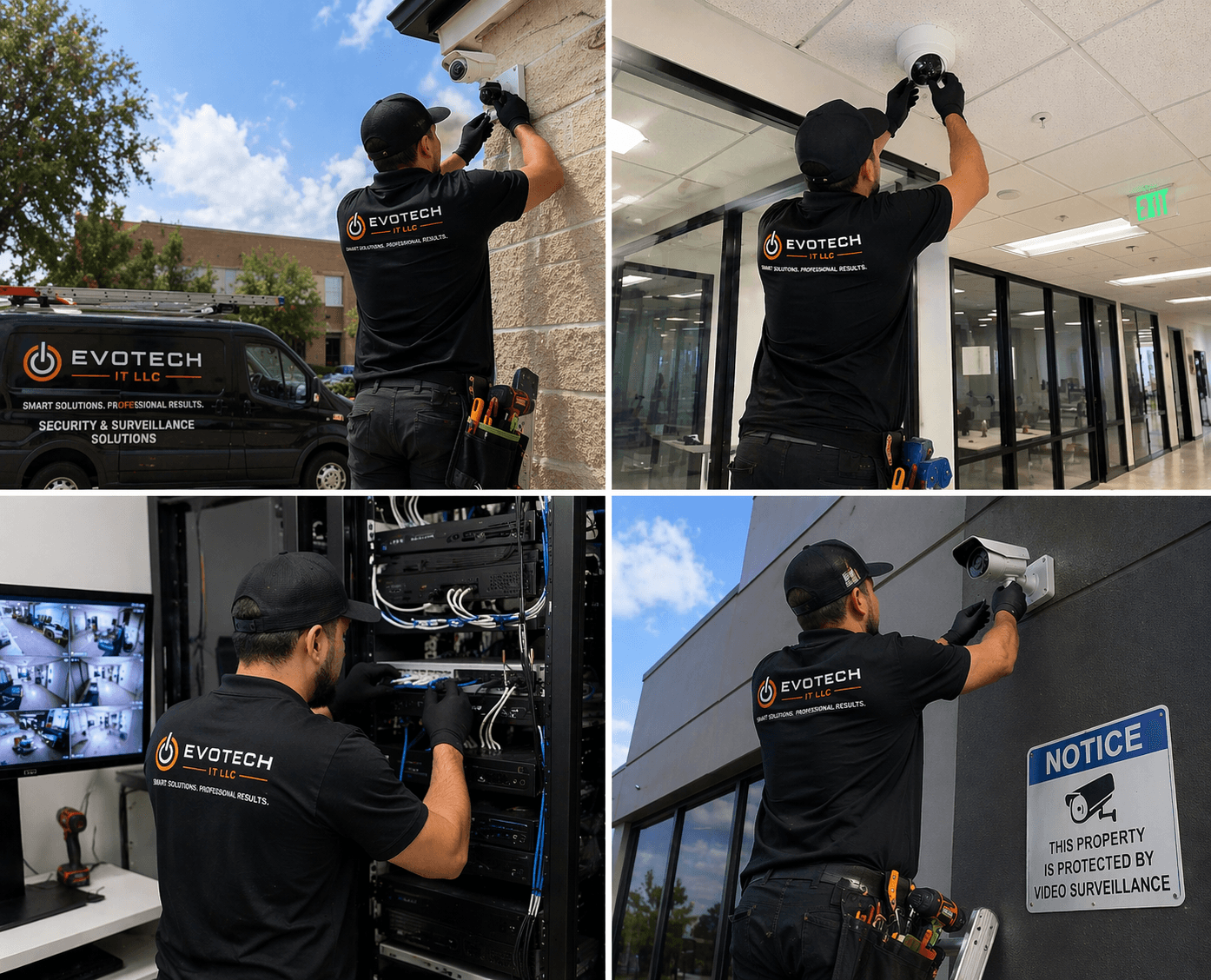
Camera coverage on a school campus concentrates on entrances, circulation between buildings, parking and drop-off areas, and the perimeter. Corridors are common; classrooms are not, and that boundary is agreed at design.
Execution in Baytown is planned around real conditions, not a template. Coastal humidity and driven rain requiring durable exterior sealing and surge protection. Slab-foundation residential following the regional pattern. These decide the sequence, the access, and the method as much as the design does. EVOTECH describes Baytown as coverage rather than a place it occupies, and omits any area detail it cannot confirm — building and site conditions only, no invented landmarks or promised arrival times.
Frequently asked questions
Is access-control installation for schools and educational facilities different in Baytown?
The sector needs stay the same, but the install changes with the place. In Baytown, the conditions above — not the schools and educational facilities label — decide routes, mounting, and equipment placement, which is why this page pairs all three.
What is the difference between fail-safe and fail-secure?
It describes what happens when power is lost. Fail-safe hardware — typically a magnetic lock — releases and the door becomes passable. Fail-secure hardware — typically a standard electric strike — stays locked, though the door can still be opened from the inside by its mechanical hardware. Which is correct for a given opening depends on its role and on applicable life-safety requirements, so it is a design decision rather than a preference.