Wireless bridge (point-to-point) for retail stores, in Pearland
Wireless bridge (point-to-point) for retail stores in Pearland is a three-part question: what wireless bridge (point-to-point) involves, what retail stores need from it, and what Pearland changes about the install. Newer residential subdivisions with wide floor plans and builder-installed structured cable of variable quality.
The engineering is about the path, not the hardware. The two radios need clear line of sight and a clear Fresnel zone (the football-shaped space around the direct line that also has to stay unobstructed), precise alignment so the narrow beams actually meet, and realistic expectations that throughput falls with distance and obstruction. Where those conditions hold, a bridge is reliable; where they don't, no radio fixes it.
Design for the next layout, not this one
The cheapest moment to add a cable is while the ceiling is already open. Retail benefits more than most environments from spare runs terminated at likely future positions, because the alternative is a surface raceway across a sales floor.
Coverage should be planned by zone — sales floor, fitting areas, stockroom, receiving, office — rather than by pointing access points at where equipment currently sits. Zones survive resets; equipment positions do not.
- Spare terminated runs at likely fixture and register positions
- Zone-based wireless coverage rather than equipment-position coverage
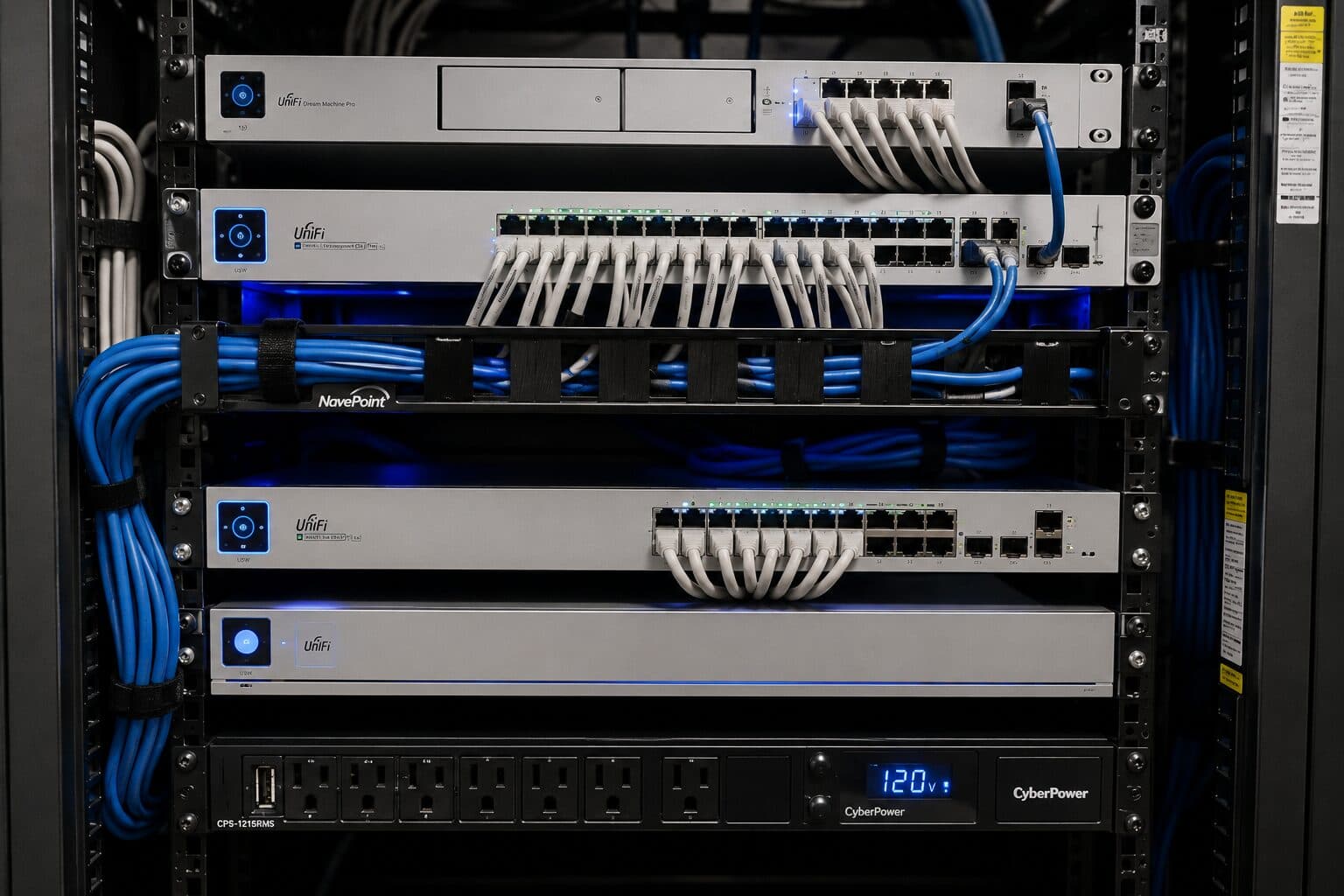
- Rack sized with genuine spare capacity
- Stockroom and receiving treated as distinct coverage areas
- Payment systems segmented from guest and general store traffic
What changes wireless bridge (point-to-point) from job to job
Scope depends on distance, obstruction, and mounting.
- Distance between the two points
- Line-of-sight quality and required mounting height
- Radios and antennas for the throughput target
- Mounting structures and access at each end
- Power provision at both ends
- Local interference in the chosen band
Pearland: what the location changes
The starting point for any Pearland job is one local fact. Newer residential subdivisions with wide floor plans and builder-installed structured cable of variable quality. That single condition shapes where cable can run, where equipment can sit, and how coverage is laid out — more than any spec sheet does. Two more conditions weigh on it. Expanding medical office space with controlled-area access requirements and clinical scheduling constraints. Food-service commercial space with kitchen environments and narrow after-hours working windows. Together they make the route specific to this pocket, which is why a short walkthrough or a few clear photos settle the scope faster than a floor plan can.
- Newer residential subdivisions with wide floor plans and builder-installed structured cable of variable quality
- Expanding medical office space with controlled-area access requirements and clinical scheduling constraints
- Food-service commercial space with kitchen environments and narrow after-hours working windows
- Slab-on-grade residential foundations making attic routing the standard retrofit path
- Newer commercial construction generally offering suspended-grid ceilings and usable pathway
Getting it done in Pearland
A bridge is commissioned on signal, throughput, and stability.
Retail camera coverage typically concentrates on registers, entrances and exits, the stockroom door, and receiving. Those four locations answer most of what retail footage gets asked about — transaction disputes, entry and exit identification, and inventory movement.
Getting Pearland work done means planning around the site as it actually is. Slab-on-grade residential foundations making attic routing the standard retrofit path. Newer commercial construction generally offering suspended-grid ceilings and usable pathway. Both matter as much as the design to how and when the work happens. The scope is drawn from the real property, the coverage is stated as a service area rather than an office, and unverifiable specifics about Pearland are kept off the page on purpose.
Popular services nearby
Frequently searched near this area — the pages people look for most.
Frequently asked questions
Is wireless bridge (point-to-point) for retail stores different in Pearland?
The sector needs stay the same, but the install changes with the place. In Pearland, the conditions above — not the retail stores label — decide routes, mounting, and equipment placement, which is why this page pairs all three.
When should I use a wireless bridge instead of running cable?
When a physical run is genuinely impractical — a road, a parking lot, or a distance that would mean major trenching between two buildings. Where a cable can reasonably go, especially fiber between separately grounded structures, it is more reliable. A bridge is the right tool specifically when the gap can't be crossed physically and there is clear line of sight.