Paging & PA systems for retail stores, in Pasadena
Paging & PA systems for retail stores in Pasadena is a three-part question: what paging & pa systems involves, what retail stores need from it, and what Pasadena changes about the install. Older industrial and service-corridor commercial stock, with rugged operational environments harder on equipment than office settings.
It is a distinct discipline from a door intercom. Paging is one-to-many announcement across zones, usually built on constant-voltage (70V/100V) distributed speakers, and often integrated with the phone system so anyone can page from a handset. The ambient noise of the space — a quiet office versus a loud warehouse — drives the speaker type and density.
Design for the next layout, not this one
The cheapest moment to add a cable is while the ceiling is already open. Retail benefits more than most environments from spare runs terminated at likely future positions, because the alternative is a surface raceway across a sales floor.
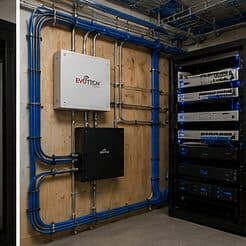
Coverage should be planned by zone — sales floor, fitting areas, stockroom, receiving, office — rather than by pointing access points at where equipment currently sits. Zones survive resets; equipment positions do not.
- Spare terminated runs at likely fixture and register positions
- Zone-based wireless coverage rather than equipment-position coverage
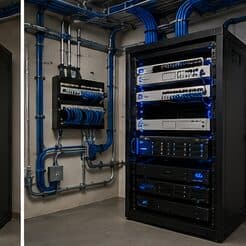
- Rack sized with genuine spare capacity
- Stockroom and receiving treated as distinct coverage areas
- Payment systems segmented from guest and general store traffic
What changes paging & pa systems from job to job
Scope depends on area, noise, and zone complexity.
- Area size and ceiling height
- Ambient noise and resulting speaker type and density
- Number of zones and priority requirements
- Horn versus ceiling speakers
- Phone-system integration
- Background-music sources
Pasadena: what the location changes
What separates a Pasadena scope from the rest of the city is concrete and local. Older industrial and service-corridor commercial stock, with rugged operational environments harder on equipment than office settings. Metal and mixed-construction buildings requiring proper cable support and camera housings rated for the environment. Established residential neighbourhoods predating structured wiring, needing genuine retrofit. That short list is what actually drives the design in this pocket, and it is why photographs or a brief site visit beat a floor plan — the plan follows the building's real constraints, not the neighborhood name on the map.
- Older industrial and service-corridor commercial stock, with rugged operational environments harder on equipment than office settings
- Metal and mixed-construction buildings requiring proper cable support and camera housings rated for the environment
- Established residential neighbourhoods predating structured wiring, needing genuine retrofit
- Coastal-adjacent humidity and driven rain requiring durable exterior sealing
- Network rooms that grew organically and need remediation rather than expansion
Getting it done in Pasadena
A paging system is commissioned by listening in every area under real conditions.
Retail camera coverage typically concentrates on registers, entrances and exits, the stockroom door, and receiving. Those four locations answer most of what retail footage gets asked about — transaction disputes, entry and exit identification, and inventory movement.
Getting Pasadena work done means planning around the site as it actually is. Coastal-adjacent humidity and driven rain requiring durable exterior sealing. Network rooms that grew organically and need remediation rather than expansion. Both matter as much as the design to how and when the work happens. The scope is drawn from the real property, the coverage is stated as a service area rather than an office, and unverifiable specifics about Pasadena are kept off the page on purpose.
Popular services nearby
Frequently searched near this area — the pages people look for most.
Frequently asked questions
Is paging & pa systems for retail stores different in Pasadena?
The sector needs stay the same, but the install changes with the place. In Pasadena, the conditions above — not the retail stores label — decide routes, mounting, and equipment placement, which is why this page pairs all three.
Why can't we just use one loud speaker to page?
Because it is deafening up close and unintelligible across the room. Paging works through distributed speakers at a sensible density so the announcement is clear everywhere at a comfortable level. In a noisy warehouse that means horn speakers with the projection to cut through; in an office, discreet ceiling speakers spread for even coverage.