In-wall cable concealment for retail stores, in Houston
In-wall cable concealment for retail stores in Houston is a three-part question: what in-wall cable concealment involves, what retail stores need from it, and what Houston changes about the install. Building stock spanning multiple construction eras within short distances, producing very different ceiling and pathway conditions.
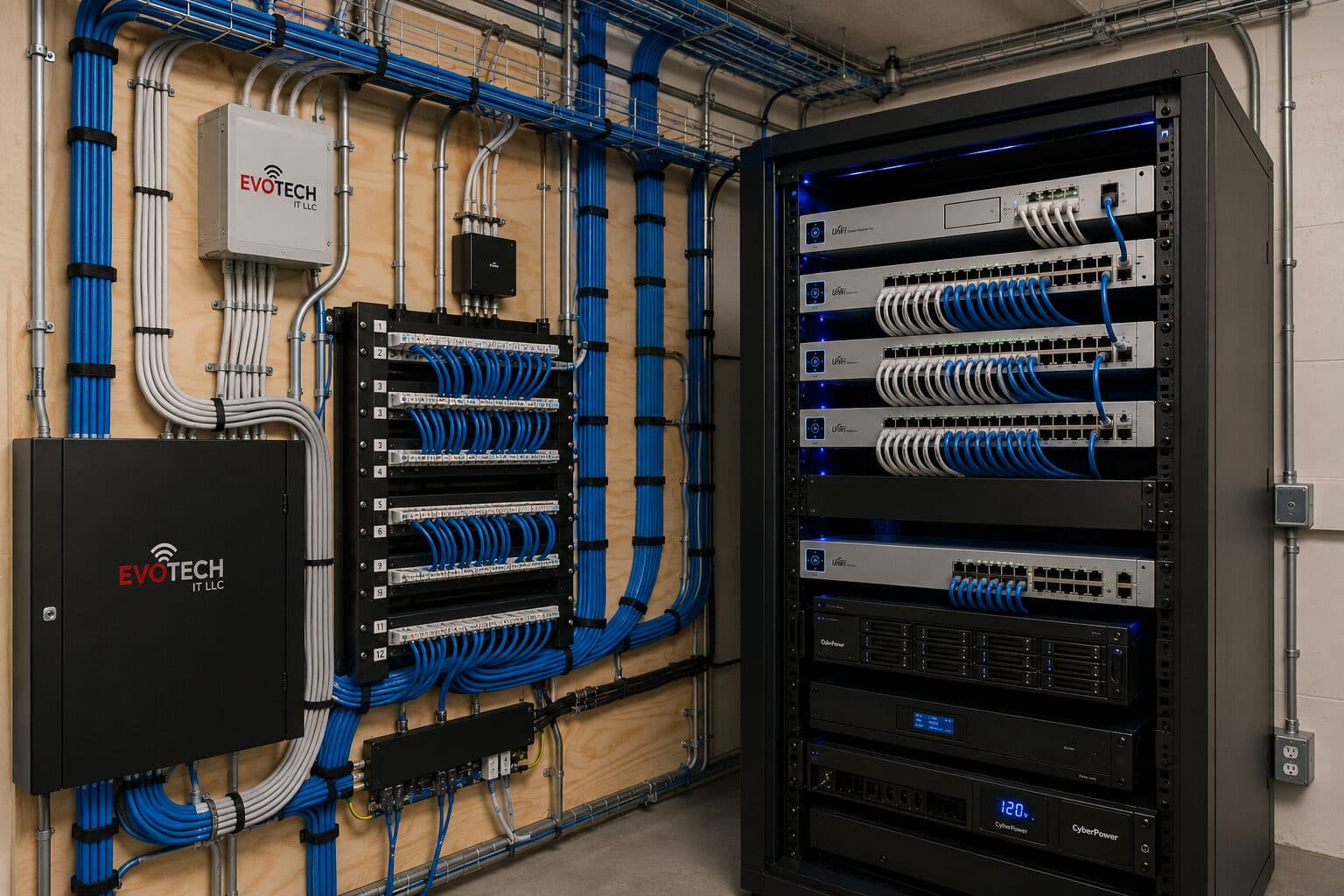
Concealing the cables behind a wall-mounted TV or AV setup is what turns it from a device with wires hanging down into something that looks built-in. The signal cables — HDMI, network, speaker — can be routed inside the wall to a recessed box behind the display, but power is different: a standard power cord must never be run inside a wall. Power is handled with a recessed outlet behind the display or an in-wall rated power solution, which keeps the installation safe and to code.
Registers, handhelds, and the guest question
Payment systems sit on their own segment for the same reasons they do in food service. What differs in retail is the number of mobile devices: handheld scanners, mobile checkout tablets, and inventory devices that move continuously across the floor and depend on clean roaming between access points.
Roaming is therefore a first-class design concern rather than an afterthought. A scanner that drops its session walking from the sales floor into the stockroom generates a support call every day. That means coverage areas need to overlap enough for a clean handoff, with a channel plan that keeps adjacent cells from contending.
Guest Wi-Fi in retail is a marketing decision as much as a technical one. Where it exists, it needs isolation and a bandwidth cap. Where it does not, saying so plainly is better than an open network nobody maintains.
- Payment systems on a dedicated segment
- Coverage designed for clean roaming across the sales floor and into the stockroom
- Handheld and mobile checkout devices treated as the primary wireless clients
- Guest access isolated and rate-limited where offered
- Back-office and inventory systems separated from customer-facing traffic
What drives the cost of in-wall cable concealment here
Wall construction and the power solution drive the cost.
- Wall construction and cavity contents
- Recessed outlet or rated power-relocation kit
- Distance and number of cables
- Any access cuts and their patch-and-paint
- Surface raceway where no in-wall path exists
- Whether it is bundled with a TV or soundbar mount
Houston: what the location changes
Building stock spanning multiple construction eras within short distances, producing very different ceiling and pathway conditions. In Houston, that is where the plan begins, because it changes cable paths, device placement, and access-point counts before anything else does. Slab-on-grade foundations dominate residential construction, which pushes retrofit cable routes into the attic rather than under the floor. Gulf Coast humidity and heavy rainfall events make exterior equipment sealing and drip-loop practice a routine requirement rather than an optional detail. None of these are generic checklist items — each moves the design in a direction a citywide assumption would miss, and the honest recommendation always depends on what this particular property allows.
- Building stock spanning multiple construction eras within short distances, producing very different ceiling and pathway conditions
- Slab-on-grade foundations dominate residential construction, which pushes retrofit cable routes into the attic rather than under the floor
- Gulf Coast humidity and heavy rainfall events make exterior equipment sealing and drip-loop practice a routine requirement rather than an optional detail
- Summer attic temperatures constrain the working window for residential retrofit and rooftop-adjacent work
- Mixed land-use patterns place commercial, light industrial, and residential structures adjacent to each other, so neighbouring buildings often need entirely different approaches
Getting it done in Houston
Concealment is judged by a clean result and a safe, code-compliant power path.
Retail work often happens during trading hours, which introduces constraints food service does not have: customers moving through the space, merchandise that must be protected from dust, and ladder work that has to be barriered off. Some work is genuinely better done before opening, but a lot of it can proceed with proper containment.
On site, the schedule and working method turn on conditions like these. Summer attic temperatures constrain the working window for residential retrofit and rooftop-adjacent work. Mixed land-use patterns place commercial, light industrial, and residential structures adjacent to each other, so neighbouring buildings often need entirely different approaches. Both shape how and when a crew can actually operate, which is why EVOTECH scopes each Houston job from the property itself rather than assuming one approach fits every address. Coverage is stated as a service area, never an office claim, and anything about Houston that cannot be verified is left out instead of invented.
Popular services nearby
Frequently searched near this area — the pages people look for most.
Frequently asked questions
Is in-wall cable concealment for retail stores different in Houston?
The sector needs stay the same, but the install changes with the place. In Houston, the conditions above — not the retail stores label — decide routes, mounting, and equipment placement, which is why this page pairs all three.
Can the power cord be hidden in the wall too?
Not the standard cord — running one inside a wall is against code and a genuine hazard. Power is concealed correctly with a recessed outlet behind the display or a rated in-wall power-relocation kit, which puts the outlet where the TV needs it without burying a cord. The signal cables can go in the wall; power is handled the right way.