Network troubleshooting for retail stores, in Fulshear
Network troubleshooting for retail stores in Fulshear is a three-part question: what network troubleshooting involves, what retail stores need from it, and what Fulshear changes about the install. Predominantly recent residential construction, so prewire timing rather than retrofit access is the usual constraint.
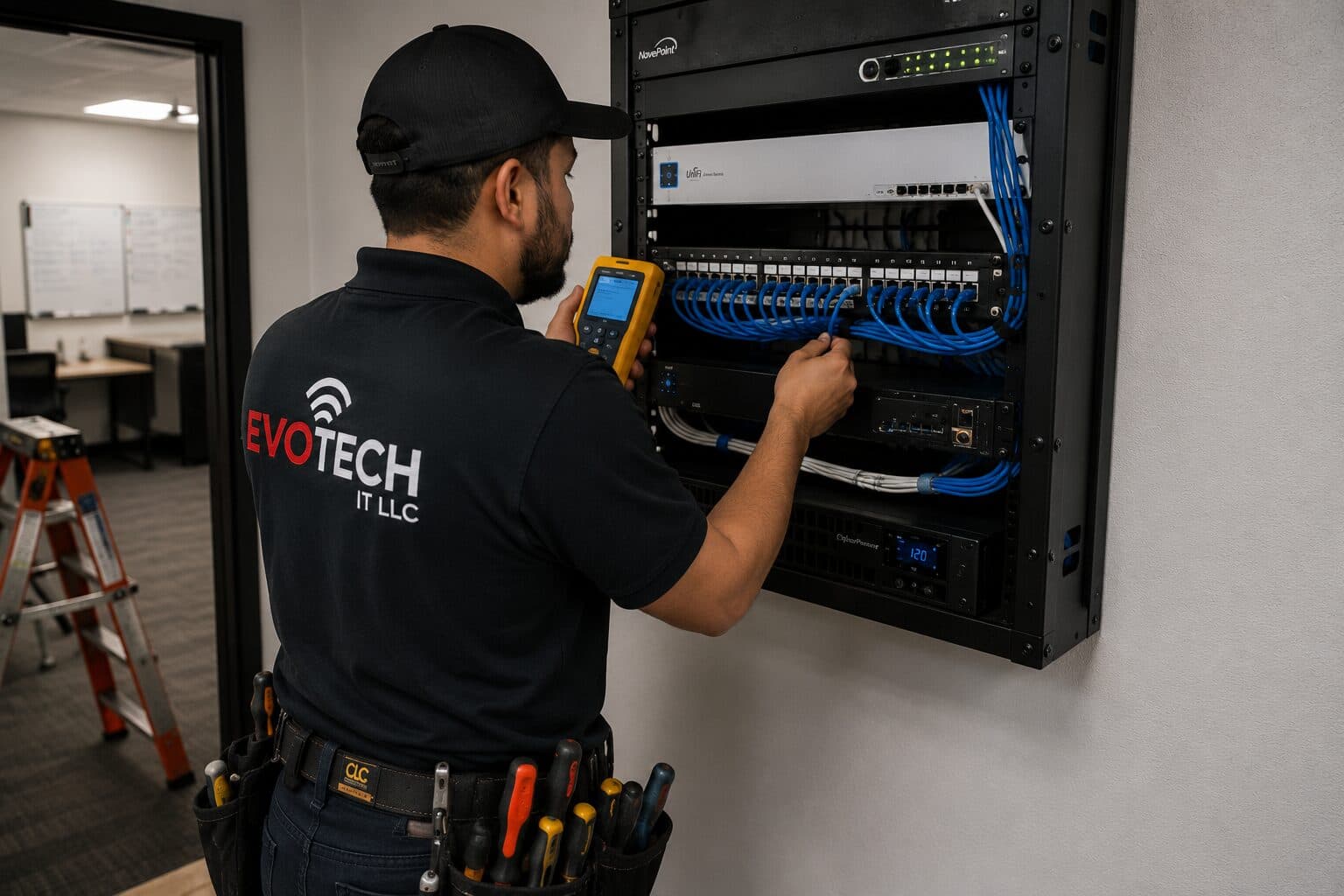
Effective troubleshooting is a process of elimination against a specific, reproducible symptom. 'The internet is slow' is not yet a diagnosis — slow for whom, on which devices, wired or wireless, at what times, to which destinations. Those answers usually point at a layer before any equipment is touched.
Coverage that answers retail questions
Retail camera coverage typically concentrates on registers, entrances and exits, the stockroom door, and receiving. Those four locations answer most of what retail footage gets asked about — transaction disputes, entry and exit identification, and inventory movement.
Sales floor coverage is a different objective. It shows activity and general movement rather than identifying individuals, and framing it that way avoids the common mistake of installing wide floor cameras and expecting identification-grade footage from them.
Entrances have a lighting problem worth planning around. A camera pointed at a glass storefront during daylight sees a bright background and a dark figure. Positioning the identification camera to view the approach from inside, rather than shooting straight out through the glass, produces far better results than any camera setting.
- Register views framed for transaction detail
- Entrance and exit views framed for identification, avoiding backlight
- Stockroom and receiving door coverage for inventory questions
- Sales floor coverage framed for activity rather than identification
- Retention set to cover the lag before discrepancies are noticed
What changes network troubleshooting from job to job
Troubleshooting effort depends mostly on how much is already known about the network.
- Whether documentation and labeling exist
- Whether the switching is manageable and reporting statistics
- How reproducible the symptom is
- Site size and the number of areas and devices involved
- How many changes have already been made in attempts to fix it
- Whether access to the equipment and to the circuit is available
- Whether the fault is intermittent, which extends observation time
Fulshear: what the location changes
Predominantly recent residential construction, so prewire timing rather than retrofit access is the usual constraint. In Fulshear, that is where the plan begins, because it changes cable paths, device placement, and access-point counts before anything else does. Large single-family floor plans requiring multiple wired coverage positions rather than a single router. Builder-provided media enclosures frequently undersized, unventilated, or awkwardly positioned for wireless coverage. None of these are generic checklist items — each moves the design in a direction a citywide assumption would miss, and the honest recommendation always depends on what this particular property allows.
- Predominantly recent residential construction, so prewire timing rather than retrofit access is the usual constraint
- Large single-family floor plans requiring multiple wired coverage positions rather than a single router
- Builder-provided media enclosures frequently undersized, unventilated, or awkwardly positioned for wireless coverage
- Slab-on-grade foundations with accessible attics for post-construction additions
- Larger lots with detached garages and outbuildings needing their own deliberate connectivity approach
Getting it done in Fulshear
The test that matters is the one that reproduces the original complaint, run again after the change.
Retail interiors get reset. Fixtures move, register positions shift for seasonal layouts, and a stockroom gets reorganised around whatever the current inventory demands. A network installed as if the layout were fixed becomes an obstacle within a couple of resets.
Getting Fulshear work done means planning around the site as it actually is. Slab-on-grade foundations with accessible attics for post-construction additions. Larger lots with detached garages and outbuildings needing their own deliberate connectivity approach. Both matter as much as the design to how and when the work happens. The scope is drawn from the real property, the coverage is stated as a service area rather than an office, and unverifiable specifics about Fulshear are kept off the page on purpose.
Popular services nearby
Frequently searched near this area — the pages people look for most.
Frequently asked questions
Is network troubleshooting for retail stores different in Fulshear?
The sector needs stay the same, but the install changes with the place. In Fulshear, the conditions above — not the retail stores label — decide routes, mounting, and equipment placement, which is why this page pairs all three.
Why is the network slow only in the afternoon?
Time-correlated symptoms usually mean capacity rather than a fault. Something is consuming the shared resource at that time — backups, updates, more people on site, or a scheduled process. Measuring at the gateway during the slow period, and comparing it to a quiet period, distinguishes a saturated circuit from an internal bottleneck quickly.