Wi-Fi installation for retail stores, in Brookshire
Wi-Fi installation for retail stores in Brookshire is a three-part question: what wi-fi installation involves, what retail stores need from it, and what Brookshire changes about the install. Large warehousing and distribution buildings along the I-10 corridor.
The part people skip is the channel plan. Two access points on the same channel that can hear each other do not add capacity — they share it, because Wi-Fi devices take turns on a channel. That is why adding more access points to a struggling network sometimes makes it worse, and why 2.4 GHz, with only three non-overlapping channels, is usually the band causing the complaints.
Design for the next layout, not this one
The cheapest moment to add a cable is while the ceiling is already open. Retail benefits more than most environments from spare runs terminated at likely future positions, because the alternative is a surface raceway across a sales floor.
Coverage should be planned by zone — sales floor, fitting areas, stockroom, receiving, office — rather than by pointing access points at where equipment currently sits. Zones survive resets; equipment positions do not.
- Spare terminated runs at likely fixture and register positions
- Zone-based wireless coverage rather than equipment-position coverage
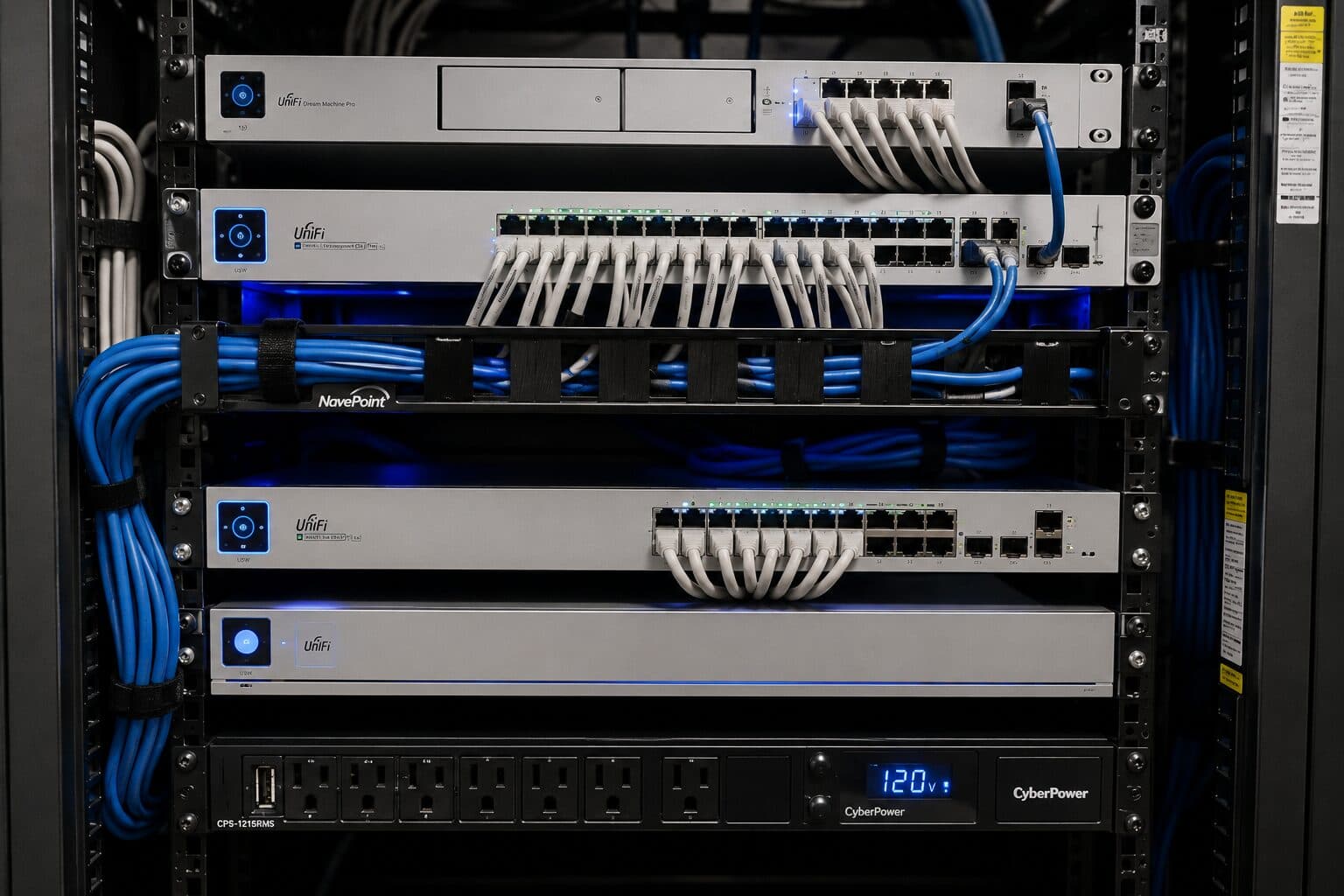
- Rack sized with genuine spare capacity
- Stockroom and receiving treated as distinct coverage areas
- Payment systems segmented from guest and general store traffic
Where wi-fi installation goes wrong — and how it's avoided
Most wireless disappointment traces back to a small number of repeated decisions.
- Adding access points to fix congestion, which increases contention instead
- Mounting APs inside closets, above ceiling tiles, or behind ductwork
- Leaving every radio on maximum power, which enlarges cells and worsens overlap
- Using wireless uplinks where cable was available
- Running wide channels in a dense deployment
- Judging the network by the signal bars rather than by measured signal and noise
Brookshire: what the location changes
The starting point for any Brookshire job is one local fact. Large warehousing and distribution buildings along the I-10 corridor. That single condition shapes where cable can run, where equipment can sit, and how coverage is laid out — more than any spec sheet does. Two more conditions weigh on it. Metal construction that reflects wireless signal and complicates coverage. Building footprints frequently exceeding the 100 m copper channel limit. Together they make the route specific to this pocket, which is why a short walkthrough or a few clear photos settle the scope faster than a floor plan can.
- Large warehousing and distribution buildings along the I-10 corridor
- Metal construction that reflects wireless signal and complicates coverage
- Building footprints frequently exceeding the 100 m copper channel limit
- Unconditioned operational areas affecting equipment placement
- Long cable runs and yard/dock areas needing distinct approaches
Getting it done in Brookshire
A wireless installation is validated by walking it. Signal level, signal-to-noise ratio, and the channel each AP settled on are measured at the places people actually work, not from the middle of the room.
Retail camera coverage typically concentrates on registers, entrances and exits, the stockroom door, and receiving. Those four locations answer most of what retail footage gets asked about — transaction disputes, entry and exit identification, and inventory movement.
Getting Brookshire work done means planning around the site as it actually is. Unconditioned operational areas affecting equipment placement. Long cable runs and yard/dock areas needing distinct approaches. Both matter as much as the design to how and when the work happens. The scope is drawn from the real property, the coverage is stated as a service area rather than an office, and unverifiable specifics about Brookshire are kept off the page on purpose.
Popular services nearby
Frequently searched near this area — the pages people look for most.
Frequently asked questions
Is wi-fi installation for retail stores different in Brookshire?
The sector needs stay the same, but the install changes with the place. In Brookshire, the conditions above — not the retail stores label — decide routes, mounting, and equipment placement, which is why this page pairs all three.
Why does a call drop when walking between rooms?
That is a roaming symptom. Either the coverage areas do not overlap enough, so the device holds a fading signal past the point of usefulness, or they overlap heavily on the same channel, so the handoff happens into a congested cell. Both are fixed by adjusting placement, power, and the channel plan rather than by adding another access point at the same settings.