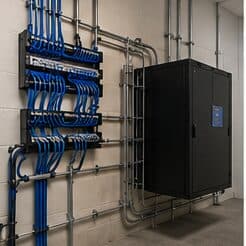
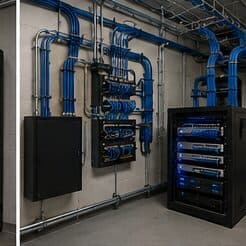
Network cabling for restaurants, in West University Place
Network cabling for restaurants in West University Place is a three-part question: what network cabling involves, what restaurants need from it, and what West University Place changes about the install. Dense established homes on small residential lots.
Network cabling is the permanent copper and fiber pathway between a building's equipment room and every device location. Done properly it is a structured system — horizontal runs from a patch panel out to labeled outlets, each one under the 90-metre permanent-link limit, each one tested and documented. Done casually it is a bundle of unlabeled patch cords stapled to a joist, and every future change costs someone an afternoon of tracing.
Segmentation and the point-of-sale question
The payment environment should sit on its own network segment with restricted access to and from everything else. That is standard practice, it simplifies any compliance conversation the operator has with their payment provider, and it means a compromised guest device cannot reach a terminal. Building it in at installation is straightforward; retrofitting it into a flat network during business hours is not.
Operations traffic — kitchen display screens, tablets, printers, back-office computers, phone systems — belongs on a third segment. These need reliability more than bandwidth, and several of them work better wired than wireless. A kitchen display or receipt printer on a cable stops being a wireless troubleshooting problem permanently.
Guest Wi-Fi should be isolated from everything internal, isolated from other guest devices, and rate-limited. Without a limit, a handful of guests streaming can degrade the connection that the payment system depends on, which turns a hospitality feature into an operational risk.
- Payment systems on a dedicated segment with restricted cross-network access
- Kitchen displays, printers, and back-office equipment wired where practical
- Guest network isolated from internal systems and from other guest devices
- Guest bandwidth capped so it cannot starve operations at peak
- Access points covering the dining room, bar, and patio as distinct areas
What changes network cabling from job to job
Two buildings with the same square footage can differ by a factor of three in cabling effort. What drives that spread is access, not area.
- Ceiling type: accessible grid versus hard lid, and whether the plenum is shared
- Building age and whether existing pathway can be reused
- Number of outlets and whether each location gets one, two, or more
- Rack or wall-cabinet location relative to the incoming service
- Fire-rated wall and floor penetrations requiring proper sleeving and firestop
- Occupied-space constraints: after-hours access, dust control, furniture protection
- Whether the design leaves spare capacity for the next expansion
West University Place: what the location changes
Dense established homes on small residential lots. In West University Place, that is where the plan begins, because it changes cable paths, device placement, and access-point counts before anything else does. Continuous teardown-and-rebuild activity, making prewire valuable. High finish expectations with limited space for equipment positions. None of these are generic checklist items — each moves the design in a direction a citywide assumption would miss, and the honest recommendation always depends on what this particular property allows.
- Dense established homes on small residential lots
- Continuous teardown-and-rebuild activity, making prewire valuable
- High finish expectations with limited space for equipment positions
- Slab foundations with attic-to-interior-wall retrofit routing
- Compact footprints keeping runs short but concealment demanding
Getting it done in West University Place
Testing is what separates a cabling installation from a cable pull. A basic continuity or wire-map check confirms the pairs land in the right order; it says nothing about whether the link will carry its rated bandwidth. Certification testing against the relevant TIA channel or permanent-link limits measures insertion loss, return loss, near-end crosstalk, and delay skew, and produces a per-port record.
Nearly all restaurant installation happens outside operating hours. That does not usually change the total labour, but it changes the sequencing: every session has to end with the site fully operational, because the doors open regardless of whether the project is finished.
On site, the schedule and working method turn on conditions like these. Slab foundations with attic-to-interior-wall retrofit routing. Compact footprints keeping runs short but concealment demanding. Both shape how and when a crew can actually operate, which is why EVOTECH scopes each West University Place job from the property itself rather than assuming one approach fits every address. Coverage is stated as a service area, never an office claim, and anything about West University Place that cannot be verified is left out instead of invented.
Popular services nearby
Frequently searched near this area — the pages people look for most.
Frequently asked questions
Is network cabling for restaurants different in West University Place?
The sector needs stay the same, but the install changes with the place. In West University Place, the conditions above — not the restaurants label — decide routes, mounting, and equipment placement, which is why this page pairs all three.
How long can a single network cable run be?
The fixed cable between patch panel and outlet is limited to 90 metres, with patch cords at each end bringing the total channel to 100 metres. Beyond that, the answer is not a longer cable — it is either an intermediate equipment location or a fiber link to a secondary switch.