Wi-Fi installation for restaurants, in Stafford
Wi-Fi installation for restaurants in Stafford is a three-part question: what wi-fi installation involves, what restaurants need from it, and what Stafford changes about the install. Commercial base weighted toward warehouse, showroom, and light-industrial buildings rather than office space.
Good Wi-Fi comes from deciding where signal needs to be strong, then placing access points so that each area gets a solid signal from one AP without excessive overlap from others. The target most designs work to is around -67 dBm at the edge of each coverage area for voice and video, with signal comfortably above the local noise floor. Placement follows from that number and from the walls between the AP and the users.
Working around service
Nearly all restaurant installation happens outside operating hours. That does not usually change the total labour, but it changes the sequencing: every session has to end with the site fully operational, because the doors open regardless of whether the project is finished.
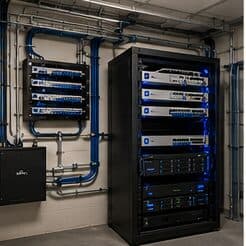
Physical constraints compound this. Ceiling access above a kitchen line may only be reachable when equipment is cold and the area is clean. Cable pathways need to avoid hood systems, steam, and grease-laden air. Anything mounted in a wash-down area needs an enclosure appropriate to being sprayed.
- Sessions planned so the site is operational at the end of each one
- Kitchen ceiling access scheduled around cleaning and cool-down
- Pathways routed away from hood systems and grease-laden air
- Appropriate enclosures for wash-down and high-humidity areas
- Equipment position chosen for temperature as much as convenience
What changes wi-fi installation from job to job
Access-point count is an output of the design, not an input. What drives it:
- Construction materials: drywall behaves very differently from masonry, tile, or metal stud with foil-backed board
- Ceiling height, which changes both coverage radius and mounting method
- Device density per area and what those devices do
- Whether coverage is needed outdoors, in stairwells, or in parking areas
- Cable reachability to each candidate AP position
- Neighbouring networks competing for the same spectrum
- Whether the client population includes older devices limited to 2.4 GHz
Stafford: what the location changes
In Stafford, the plan is built outward from the conditions that are actually here. Commercial base weighted toward warehouse, showroom, and light-industrial buildings rather than office space. Metal building construction that reflects wireless signal and changes coverage behaviour compared with drywall interiors. Building footprints frequently exceeding the 100 m copper channel limit from a single equipment position. Each one changes where cable can run, where equipment can sit, and how coverage is shaped, which is why a walkthrough settles a Stafford scope faster than any generic estimate.
- Commercial base weighted toward warehouse, showroom, and light-industrial buildings rather than office space
- Metal building construction that reflects wireless signal and changes coverage behaviour compared with drywall interiors
- Building footprints frequently exceeding the 100 m copper channel limit from a single equipment position
- Largely unconditioned operational areas where equipment placement has to account for summer temperatures and dust
- Mixed occupancy within single buildings, with small conditioned office areas attached to large operational space
Getting it done in Stafford
A wireless installation is validated by walking it. Signal level, signal-to-noise ratio, and the channel each AP settled on are measured at the places people actually work, not from the middle of the room.
In order of consequence: keep the payment systems isolated, put the equipment somewhere it will survive, cover the dining room and patio properly, and place cameras where they answer real questions.
Getting Stafford work done means planning around the site as it actually is. Largely unconditioned operational areas where equipment placement has to account for summer temperatures and dust. Mixed occupancy within single buildings, with small conditioned office areas attached to large operational space. Both matter as much as the design to how and when the work happens. The scope is drawn from the real property, the coverage is stated as a service area rather than an office, and unverifiable specifics about Stafford are kept off the page on purpose.
Popular services nearby
Frequently searched near this area — the pages people look for most.
Frequently asked questions
Is wi-fi installation for restaurants different in Stafford?
The sector needs stay the same, but the install changes with the place. In Stafford, the conditions above — not the restaurants label — decide routes, mounting, and equipment placement, which is why this page pairs all three.
Why does a call drop when walking between rooms?
That is a roaming symptom. Either the coverage areas do not overlap enough, so the device holds a fading signal past the point of usefulness, or they overlap heavily on the same channel, so the handoff happens into a congested cell. Both are fixed by adjusting placement, power, and the channel plan rather than by adding another access point at the same settings.