Why this page exists
Technology for restaurants in Sharpstown sits where two things meet: how restaurants actually operate, and what Sharpstown specifically brings to the building. Sharpstown 77036 is dense with older multifamily apartment complexes and a busy, diverse commercial corridor, so much of the work is garden-apartment and small-business grade.
Restaurant networks do not carry much data. What makes them difficult is everything else: heat and grease near the kitchen, wash-down areas, a guest population that will connect anything to anything, payment systems that must not share a network with either, and an operating schedule that leaves a narrow window for anyone to work.
The environment is harder on equipment than the traffic is
Restaurant networks do not carry much data. What makes them difficult is everything else: heat and grease near the kitchen, wash-down areas, a guest population that will connect anything to anything, payment systems that must not share a network with either, and an operating schedule that leaves a narrow window for anyone to work.
The result is that restaurant technology projects are planned around constraints rather than capacity. Where equipment can physically live, how it stays clean and cool, what has to stay isolated, and when a technician is allowed on a ladder are the questions that shape the design.
- Kitchen heat, grease, and moisture degrade equipment placed without protection
- Payment systems require separation from guest and general operations traffic
- Guest Wi-Fi demand is unpredictable and must not consume the whole circuit
- Work windows are narrow — before opening, after closing, or on a closure day
Sharpstown: what the location adds
In Sharpstown, the plan is built outward from the conditions that are actually here. Sharpstown 77036 is dense with older multifamily apartment complexes and a busy, diverse commercial corridor, so much of the work is garden-apartment and small-business grade. 1960s-1970s apartment construction means shared attics, common utility chases, and aging in-place wiring that a retrofit has to work around. Strip-center and small-business storefronts need commercial camera and network systems on tight budgets and fast timelines. Each one changes where cable can run, where equipment can sit, and how coverage is shaped, which is why a walkthrough settles a Sharpstown scope faster than any generic estimate.
- Sharpstown 77036 is dense with older multifamily apartment complexes and a busy, diverse commercial corridor, so much of the work is garden-apartment and small-business grade
- 1960s-1970s apartment construction means shared attics, common utility chases, and aging in-place wiring that a retrofit has to work around
- Strip-center and small-business storefronts need commercial camera and network systems on tight budgets and fast timelines
- High tenant turnover in both residential and retail spaces pushes toward serviceable, well-labeled installs that survive changeovers
- Slab construction with accessible plenum ceilings in commercial units simplifies pathways compared with the residential blocks
What to get right first
In order of consequence: keep the payment systems isolated, put the equipment somewhere it will survive, cover the dining room and patio properly, and place cameras where they answer real questions.
The ordering matters because the failure modes differ. A congested guest network is an annoyance. A payment terminal on a shared flat network is a genuine exposure. Equipment cooked in a hot back room is a recurring replacement cost.
- Segment payment, operations, and guest traffic onto distinct networks
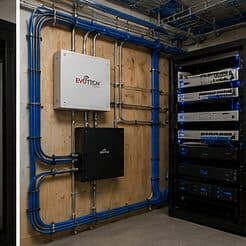
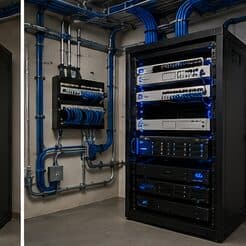
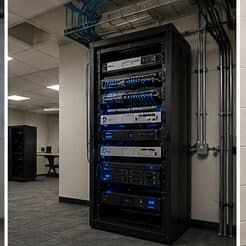
- Locate the rack away from kitchen heat, steam, and wash-down zones
- Rate-limit guest access so it cannot saturate the circuit at peak
- Cover the patio deliberately rather than hoping indoor access points reach
- Put the network equipment and recorder on a UPS
Installing in Sharpstown
The payment environment should sit on its own network segment with restricted access to and from everything else. That is standard practice, it simplifies any compliance conversation the operator has with their payment provider, and it means a compromised guest device cannot reach a terminal. Building it in at installation is straightforward; retrofitting it into a flat network during business hours is not.
Getting Sharpstown work done means planning around the site as it actually is. High tenant turnover in both residential and retail spaces pushes toward serviceable, well-labeled installs that survive changeovers. Slab construction with accessible plenum ceilings in commercial units simplifies pathways compared with the residential blocks. Both matter as much as the design to how and when the work happens. The scope is drawn from the real property, the coverage is stated as a service area rather than an office, and unverifiable specifics about Sharpstown are kept off the page on purpose.
Popular services nearby
Frequently searched near this area — the pages people look for most.
Frequently asked questions
What do restaurants in Sharpstown usually need first?
It varies by site, but the pattern for restaurants holds in Sharpstown: get the network and cabling backbone right, then layer cameras and access on top. What Sharpstown changes is the physical install — the conditions listed above drive routes and equipment placement more than the sector alone does.
Should the point-of-sale system be on the guest Wi-Fi?
No. Payment systems belong on their own network segment with restricted access to and from everything else. Beyond the security argument, it also removes a real operational risk: guests saturating the connection should never be able to slow down payment processing.