Fiber-optic cabling for restaurants, in Pasadena
Fiber-optic cabling for restaurants in Pasadena is a three-part question: what fiber-optic cabling involves, what restaurants need from it, and what Pasadena changes about the install. Older industrial and service-corridor commercial stock, with rugged operational environments harder on equipment than office settings.
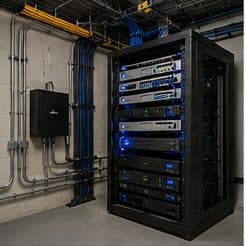
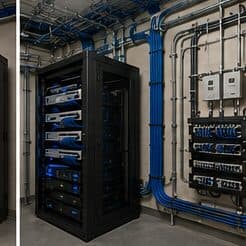
Inside a single building, fiber typically appears as a backbone between the main equipment room and intermediate closets, with copper handling the horizontal runs from those closets out to devices. That split is the standard structured-cabling shape and it exists because each medium is doing what it is good at.
Working around service
Nearly all restaurant installation happens outside operating hours. That does not usually change the total labour, but it changes the sequencing: every session has to end with the site fully operational, because the doors open regardless of whether the project is finished.
Physical constraints compound this. Ceiling access above a kitchen line may only be reachable when equipment is cold and the area is clean. Cable pathways need to avoid hood systems, steam, and grease-laden air. Anything mounted in a wash-down area needs an enclosure appropriate to being sprayed.
- Sessions planned so the site is operational at the end of each one
- Kitchen ceiling access scheduled around cleaning and cool-down
- Pathways routed away from hood systems and grease-laden air
- Appropriate enclosures for wash-down and high-humidity areas
- Equipment position chosen for temperature as much as convenience
What drives the cost of fiber-optic cabling here
Fiber cost concentrates in the route and the terminations rather than the cable itself.
- Route length and construction method, especially for outdoor segments
- Strand count and whether spares are included
- Number of terminations and the method used
- Enclosures, trays, and protection hardware
- Transceivers at each end
- Testing and documentation depth
- Trenching, boring, or aerial work on between-building routes
Pasadena: what the location changes
The starting point for any Pasadena job is one local fact. Older industrial and service-corridor commercial stock, with rugged operational environments harder on equipment than office settings. That single condition shapes where cable can run, where equipment can sit, and how coverage is laid out — more than any spec sheet does. Two more conditions weigh on it. Metal and mixed-construction buildings requiring proper cable support and camera housings rated for the environment. Established residential neighbourhoods predating structured wiring, needing genuine retrofit. Together they make the route specific to this pocket, which is why a short walkthrough or a few clear photos settle the scope faster than a floor plan can.
- Older industrial and service-corridor commercial stock, with rugged operational environments harder on equipment than office settings
- Metal and mixed-construction buildings requiring proper cable support and camera housings rated for the environment
- Established residential neighbourhoods predating structured wiring, needing genuine retrofit
- Coastal-adjacent humidity and driven rain requiring durable exterior sealing
- Network rooms that grew organically and need remediation rather than expansion
Getting it done in Pasadena
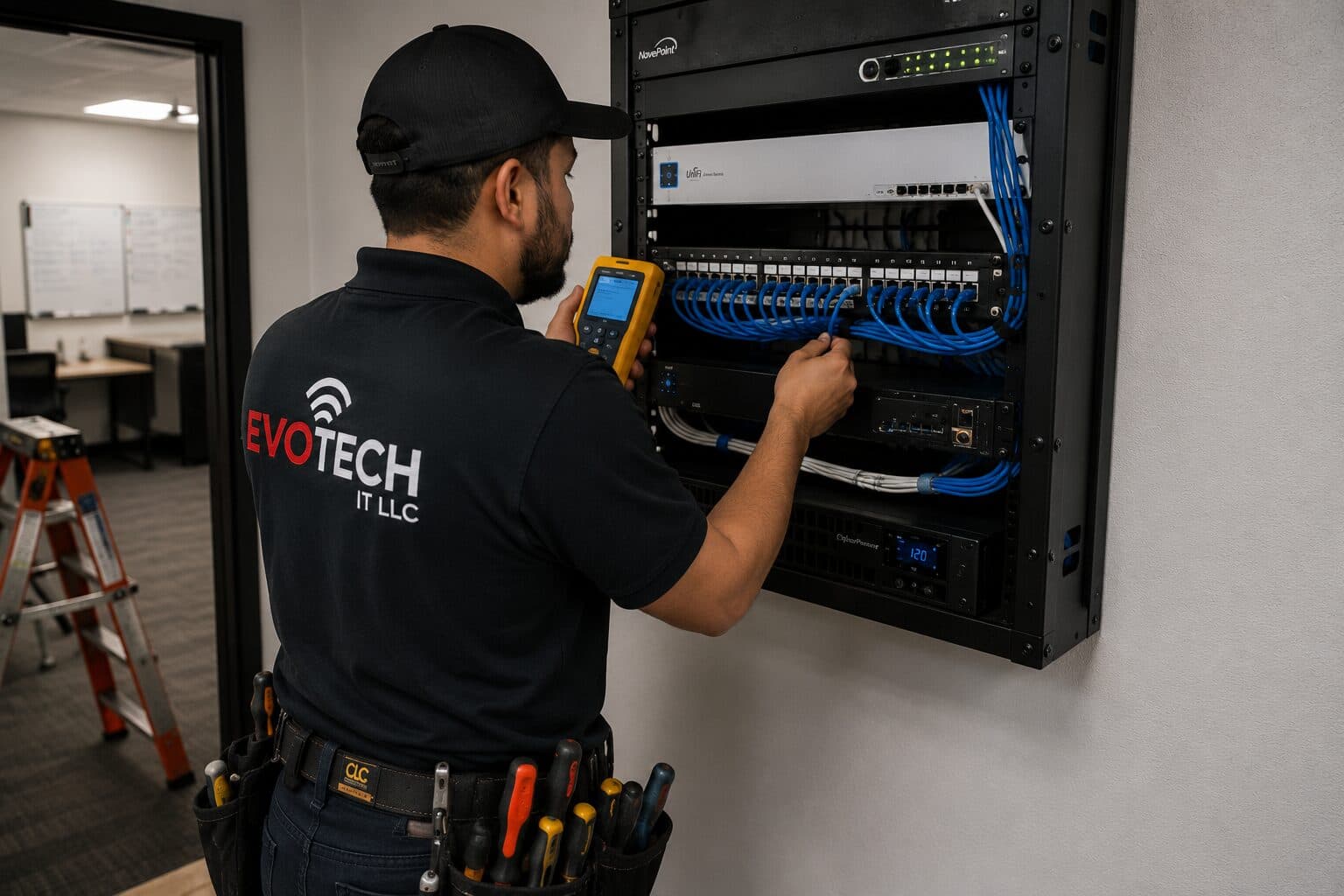
The baseline test is an insertion-loss measurement across the installed link, compared against the calculated budget for that distance and connector count. A link that passes with margin is a link that will tolerate a future re-patch.
In order of consequence: keep the payment systems isolated, put the equipment somewhere it will survive, cover the dining room and patio properly, and place cameras where they answer real questions.
Execution in Pasadena is planned around real conditions, not a template. Coastal-adjacent humidity and driven rain requiring durable exterior sealing. Network rooms that grew organically and need remediation rather than expansion. These decide the sequence, the access, and the method as much as the design does. EVOTECH describes Pasadena as coverage rather than a place it occupies, and omits any area detail it cannot confirm — building and site conditions only, no invented landmarks or promised arrival times.
Popular services nearby
Frequently searched near this area — the pages people look for most.
Frequently asked questions
Is fiber-optic cabling for restaurants different in Pasadena?
The sector needs stay the same, but the install changes with the place. In Pasadena, the conditions above — not the restaurants label — decide routes, mounting, and equipment placement, which is why this page pairs all three.
When is fiber necessary rather than optional?
Two situations make it necessary rather than a preference. First, distance: past the 100-metre copper channel limit there is no compliant copper answer. Second, links between separate buildings, where a copper conductor creates a path for surge and ground-potential differences. Inside those two cases fiber is not an upgrade — it is the correct method.