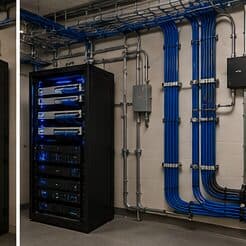
Wireless bridge (point-to-point) for restaurants, in Missouri City
Wireless bridge (point-to-point) for restaurants in Missouri City is a three-part question: what wireless bridge (point-to-point) involves, what restaurants need from it, and what Missouri City changes about the install. Housing stock spanning both established and recent construction, producing materially different retrofit conditions between neighbourhoods.
The engineering is about the path, not the hardware. The two radios need clear line of sight and a clear Fresnel zone (the football-shaped space around the direct line that also has to stay unobstructed), precise alignment so the narrow beams actually meet, and realistic expectations that throughput falls with distance and obstruction. Where those conditions hold, a bridge is reliable; where they don't, no radio fixes it.
The environment is harder on equipment than the traffic is
Restaurant networks do not carry much data. What makes them difficult is everything else: heat and grease near the kitchen, wash-down areas, a guest population that will connect anything to anything, payment systems that must not share a network with either, and an operating schedule that leaves a narrow window for anyone to work.
The result is that restaurant technology projects are planned around constraints rather than capacity. Where equipment can physically live, how it stays clean and cool, what has to stay isolated, and when a technician is allowed on a ladder are the questions that shape the design.
- Kitchen heat, grease, and moisture degrade equipment placed without protection
- Payment systems require separation from guest and general operations traffic
- Guest Wi-Fi demand is unpredictable and must not consume the whole circuit
- Work windows are narrow — before opening, after closing, or on a closure day
What drives the cost of wireless bridge (point-to-point) here
Distance, mounting height, and access drive the cost.
- Distance and the radios/antennas it requires
- Mounting height and structures at each end
- Access for installation at both ends
- Power provision at each end
- Weatherproof mounting and cabling
- Any redundancy or failover
Missouri City: what the location changes
The starting point for any Missouri City job is one local fact. Housing stock spanning both established and recent construction, producing materially different retrofit conditions between neighbourhoods. That single condition shapes where cable can run, where equipment can sit, and how coverage is laid out — more than any spec sheet does. Two more conditions weigh on it. Older homes without structured cabling and with less accessible attic space than newer subdivisions. Newer subdivision homes following the regional pattern of builder panels and good attic access. Together they make the route specific to this pocket, which is why a short walkthrough or a few clear photos settle the scope faster than a floor plan can.
- Housing stock spanning both established and recent construction, producing materially different retrofit conditions between neighbourhoods
- Older homes without structured cabling and with less accessible attic space than newer subdivisions
- Newer subdivision homes following the regional pattern of builder panels and good attic access
- Small office and retail suites where ceiling construction and lease terms are the main variables
- Slab-on-grade construction throughout, keeping attic routing as the primary retrofit path
Getting it done in Missouri City
A bridge is commissioned on signal, throughput, and stability.
The payment environment should sit on its own network segment with restricted access to and from everything else. That is standard practice, it simplifies any compliance conversation the operator has with their payment provider, and it means a compromised guest device cannot reach a terminal. Building it in at installation is straightforward; retrofitting it into a flat network during business hours is not.
Execution in Missouri City is planned around real conditions, not a template. Small office and retail suites where ceiling construction and lease terms are the main variables. Slab-on-grade construction throughout, keeping attic routing as the primary retrofit path. These decide the sequence, the access, and the method as much as the design does. EVOTECH describes Missouri City as coverage rather than a place it occupies, and omits any area detail it cannot confirm — building and site conditions only, no invented landmarks or promised arrival times.
Popular services nearby
Frequently searched near this area — the pages people look for most.
Frequently asked questions
Is wireless bridge (point-to-point) for restaurants different in Missouri City?
The sector needs stay the same, but the install changes with the place. In Missouri City, the conditions above — not the restaurants label — decide routes, mounting, and equipment placement, which is why this page pairs all three.
When should I use a wireless bridge instead of running cable?
When a physical run is genuinely impractical — a road, a parking lot, or a distance that would mean major trenching between two buildings. Where a cable can reasonably go, especially fiber between separately grounded structures, it is more reliable. A bridge is the right tool specifically when the gap can't be crossed physically and there is clear line of sight.