Ethernet installation for restaurants, in Missouri City
Ethernet installation for restaurants in Missouri City is a three-part question: what ethernet installation involves, what restaurants need from it, and what Missouri City changes about the install. Housing stock spanning both established and recent construction, producing materially different retrofit conditions between neighbourhoods.
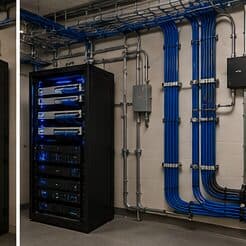
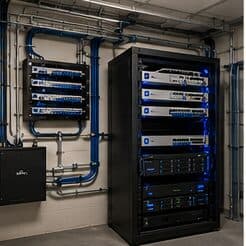
Ethernet installation in an existing building means finding a path from a central equipment position to each room that needs a wired connection, getting cable through that path without opening more wall than necessary, and terminating both ends cleanly. In a two-storey house with an accessible attic, that is often straightforward. In a single-storey house on a slab with a hard ceiling, it is the whole job.
The environment is harder on equipment than the traffic is
Restaurant networks do not carry much data. What makes them difficult is everything else: heat and grease near the kitchen, wash-down areas, a guest population that will connect anything to anything, payment systems that must not share a network with either, and an operating schedule that leaves a narrow window for anyone to work.
The result is that restaurant technology projects are planned around constraints rather than capacity. Where equipment can physically live, how it stays clean and cool, what has to stay isolated, and when a technician is allowed on a ladder are the questions that shape the design.
- Kitchen heat, grease, and moisture degrade equipment placed without protection
- Payment systems require separation from guest and general operations traffic
- Guest Wi-Fi demand is unpredictable and must not consume the whole circuit
- Work windows are narrow — before opening, after closing, or on a closure day
What drives the cost of ethernet installation here
Cost tracks difficulty of access far more than run count. Four easy attic drops can take less time than one drop into an exterior wall with blocking.
- Foundation and ceiling construction
- Attic accessibility, headroom, and working temperature
- Number of drops and their distance from the equipment position
- Whether any drywall cutting and patching is required
- Equipment enclosure, patch panel, and mounting at the head end
- Finish expectations in occupied living space
Missouri City: what the location changes
In Missouri City, the plan is built outward from the conditions that are actually here. Housing stock spanning both established and recent construction, producing materially different retrofit conditions between neighbourhoods. Older homes without structured cabling and with less accessible attic space than newer subdivisions. Newer subdivision homes following the regional pattern of builder panels and good attic access. Each one changes where cable can run, where equipment can sit, and how coverage is shaped, which is why a walkthrough settles a Missouri City scope faster than any generic estimate.
- Housing stock spanning both established and recent construction, producing materially different retrofit conditions between neighbourhoods
- Older homes without structured cabling and with less accessible attic space than newer subdivisions
- Newer subdivision homes following the regional pattern of builder panels and good attic access
- Small office and retail suites where ceiling construction and lease terms are the main variables
- Slab-on-grade construction throughout, keeping attic routing as the primary retrofit path
Getting it done in Missouri City
Every run gets a wire-map and length check at minimum, which catches the errors that actually happen in retrofit work: a reversed pair at a hastily terminated jack, a split pair, or a run longer than it looked.
The payment environment should sit on its own network segment with restricted access to and from everything else. That is standard practice, it simplifies any compliance conversation the operator has with their payment provider, and it means a compromised guest device cannot reach a terminal. Building it in at installation is straightforward; retrofitting it into a flat network during business hours is not.
Getting Missouri City work done means planning around the site as it actually is. Small office and retail suites where ceiling construction and lease terms are the main variables. Slab-on-grade construction throughout, keeping attic routing as the primary retrofit path. Both matter as much as the design to how and when the work happens. The scope is drawn from the real property, the coverage is stated as a service area rather than an office, and unverifiable specifics about Missouri City are kept off the page on purpose.
Popular services nearby
Frequently searched near this area — the pages people look for most.
Frequently asked questions
Is ethernet installation for restaurants different in Missouri City?
The sector needs stay the same, but the install changes with the place. In Missouri City, the conditions above — not the restaurants label — decide routes, mounting, and equipment placement, which is why this page pairs all three.
Can Ethernet be added without cutting into walls?
Often yes, when the destination is an interior wall reachable from an attic or crawl space and there is no blocking in the cavity. When there is no viable cavity path, the choices are a small access cut that then gets patched, a surface raceway, or moving the device to a wall that can be reached. Which one makes sense is worth deciding before work starts rather than mid-pull.