Why this page exists
Technology for restaurants in the 77573 League City area sits where two things meet: how restaurants actually operate, and what the 77573 League City area specifically brings to the building. 77573 covers much of League City — a broad mix of established 1990s-2000s subdivisions and newer master-planned sections in the coastal-adjacent Bay Area.
In order of consequence: keep the payment systems isolated, put the equipment somewhere it will survive, cover the dining room and patio properly, and place cameras where they answer real questions.
What to get right first
In order of consequence: keep the payment systems isolated, put the equipment somewhere it will survive, cover the dining room and patio properly, and place cameras where they answer real questions.
The ordering matters because the failure modes differ. A congested guest network is an annoyance. A payment terminal on a shared flat network is a genuine exposure. Equipment cooked in a hot back room is a recurring replacement cost.
- Segment payment, operations, and guest traffic onto distinct networks
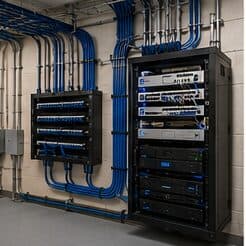
- Locate the rack away from kitchen heat, steam, and wash-down zones
- Rate-limit guest access so it cannot saturate the circuit at peak
- Cover the patio deliberately rather than hoping indoor access points reach
- Put the network equipment and recorder on a UPS
the 77573 League City area: what the location adds
In the 77573 League City area, the plan is built outward from the conditions that are actually here. 77573 covers much of League City — a broad mix of established 1990s-2000s subdivisions and newer master-planned sections in the coastal-adjacent Bay Area. Coastal proximity raises hurricane wind-zone considerations for exterior camera and antenna mounting. Newer sections include structured wiring, while earlier subdivisions are retrofit candidates. Each one changes where cable can run, where equipment can sit, and how coverage is shaped, which is why a walkthrough settles a the 77573 League City area scope faster than any generic estimate.
- 77573 covers much of League City — a broad mix of established 1990s-2000s subdivisions and newer master-planned sections in the coastal-adjacent Bay Area
- Coastal proximity raises hurricane wind-zone considerations for exterior camera and antenna mounting
- Newer sections include structured wiring, while earlier subdivisions are retrofit candidates
- Two-story plans with media rooms make AV prewire and whole-home Wi-Fi common
- Established landscaping favors wired backbones and shades exterior camera views
Segmentation and the point-of-sale question
The payment environment should sit on its own network segment with restricted access to and from everything else. That is standard practice, it simplifies any compliance conversation the operator has with their payment provider, and it means a compromised guest device cannot reach a terminal. Building it in at installation is straightforward; retrofitting it into a flat network during business hours is not.
Operations traffic — kitchen display screens, tablets, printers, back-office computers, phone systems — belongs on a third segment. These need reliability more than bandwidth, and several of them work better wired than wireless. A kitchen display or receipt printer on a cable stops being a wireless troubleshooting problem permanently.
Guest Wi-Fi should be isolated from everything internal, isolated from other guest devices, and rate-limited. Without a limit, a handful of guests streaming can degrade the connection that the payment system depends on, which turns a hospitality feature into an operational risk.
- Payment systems on a dedicated segment with restricted cross-network access
- Kitchen displays, printers, and back-office equipment wired where practical
- Guest network isolated from internal systems and from other guest devices
- Guest bandwidth capped so it cannot starve operations at peak
- Access points covering the dining room, bar, and patio as distinct areas
Installing in the 77573 League City area
Restaurant camera coverage tends to concentrate on a small number of high-value views rather than blanketing the space. The point-of-sale line, the safe or cash-handling area, the back door, and the dry and walk-in storage entrances answer most of the questions that get asked of restaurant footage.
Getting the 77573 League City area work done means planning around the site as it actually is. Two-story plans with media rooms make AV prewire and whole-home Wi-Fi common. Established landscaping favors wired backbones and shades exterior camera views. Both matter as much as the design to how and when the work happens. The scope is drawn from the real property, the coverage is stated as a service area rather than an office, and unverifiable specifics about the 77573 League City area are kept off the page on purpose.
Popular services nearby
Frequently searched near this area — the pages people look for most.
Frequently asked questions
What do restaurants in the 77573 League City area usually need first?
It varies by site, but the pattern for restaurants holds in the 77573 League City area: get the network and cabling backbone right, then layer cameras and access on top. What the 77573 League City area changes is the physical install — the conditions listed above drive routes and equipment placement more than the sector alone does.
Should the point-of-sale system be on the guest Wi-Fi?
No. Payment systems belong on their own network segment with restricted access to and from everything else. Beyond the security argument, it also removes a real operational risk: guests saturating the connection should never be able to slow down payment processing.