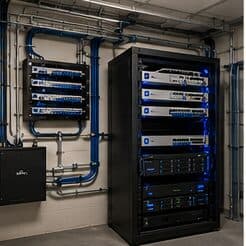
Cat6A cabling for restaurants, in Katy
Cat6A cabling for restaurants in Katy is a three-part question: what cat6a cabling involves, what restaurants need from it, and what Katy changes about the install. Housing stock skewed toward newer, larger single-family construction with wide floor plans that exceed single-router coverage.
Cat6A is specified to 500 MHz and supports 10GBASE-T across a full 100-metre channel. It achieves that mainly by controlling alien crosstalk — the interference between adjacent cables that constrains Cat6 at 10G — through larger construction, tighter pair geometry, and in shielded variants a foil layer.
Working around service
Nearly all restaurant installation happens outside operating hours. That does not usually change the total labour, but it changes the sequencing: every session has to end with the site fully operational, because the doors open regardless of whether the project is finished.
Physical constraints compound this. Ceiling access above a kitchen line may only be reachable when equipment is cold and the area is clean. Cable pathways need to avoid hood systems, steam, and grease-laden air. Anything mounted in a wash-down area needs an enclosure appropriate to being sprayed.
- Sessions planned so the site is operational at the end of each one
- Kitchen ceiling access scheduled around cleaning and cool-down
- Pathways routed away from hood systems and grease-laden air
- Appropriate enclosures for wash-down and high-humidity areas
- Equipment position chosen for temperature as much as convenience
Where cat6a cabling goes wrong — and how it's avoided
Cat6A mistakes tend to come from treating it as a drop-in upgrade rather than a different physical product.
- Ordering Cat6A for an existing pathway without recalculating fill
- Bundling high-PoE Cat6A as tightly as low-power Cat6
- Bonding shields at one end only, or breaking continuity with an unshielded coupler
- Certifying to Cat6 limits and calling the link Cat6A
- Forcing stiff cable into a bend radius sized for thinner cable
Katy: what the location changes
Housing stock skewed toward newer, larger single-family construction with wide floor plans that exceed single-router coverage. In Katy, that is where the plan begins, because it changes cable paths, device placement, and access-point counts before anything else does. Structured media panels commonly present but frequently located in a garage or perimeter utility space rather than centrally. Builder-installed cable often terminated to a panel but not extended to ceiling positions suitable for access points. None of these are generic checklist items — each moves the design in a direction a citywide assumption would miss, and the honest recommendation always depends on what this particular property allows.
- Housing stock skewed toward newer, larger single-family construction with wide floor plans that exceed single-router coverage
- Structured media panels commonly present but frequently located in a garage or perimeter utility space rather than centrally
- Builder-installed cable often terminated to a panel but not extended to ceiling positions suitable for access points
- Slab foundations with accessible attics, making attic-to-interior-wall routing the standard retrofit path
- Suburban commercial development in retail pads and medical suites with suspended-grid ceilings and comparatively straightforward pathway
Getting it done in Katy
Certification to Cat6A runs the same parameter set as Cat6 but across the full 500 MHz range, where margins are naturally tighter. Passing at 250 MHz says nothing about behaviour at 500 MHz, so the test configuration has to match the intended rating.
In order of consequence: keep the payment systems isolated, put the equipment somewhere it will survive, cover the dining room and patio properly, and place cameras where they answer real questions.
On site, the schedule and working method turn on conditions like these. Slab foundations with accessible attics, making attic-to-interior-wall routing the standard retrofit path. Suburban commercial development in retail pads and medical suites with suspended-grid ceilings and comparatively straightforward pathway. Both shape how and when a crew can actually operate, which is why EVOTECH scopes each Katy job from the property itself rather than assuming one approach fits every address. Coverage is stated as a service area, never an office claim, and anything about Katy that cannot be verified is left out instead of invented.
Popular services nearby
Frequently searched near this area — the pages people look for most.
Frequently asked questions
Is cat6a cabling for restaurants different in Katy?
The sector needs stay the same, but the install changes with the place. In Katy, the conditions above — not the restaurants label — decide routes, mounting, and equipment placement, which is why this page pairs all three.
Is Cat6A worth it if nothing today runs 10 gigabit?
Sometimes. The argument for it is that reopening a ceiling is far more expensive than the cable premium, so runs that are hard to reach and likely to matter later are good candidates. The argument against blanket use is pathway fill and labour. A common middle path is Cat6A on uplinks, dense areas, and inaccessible runs, with Cat6 elsewhere.