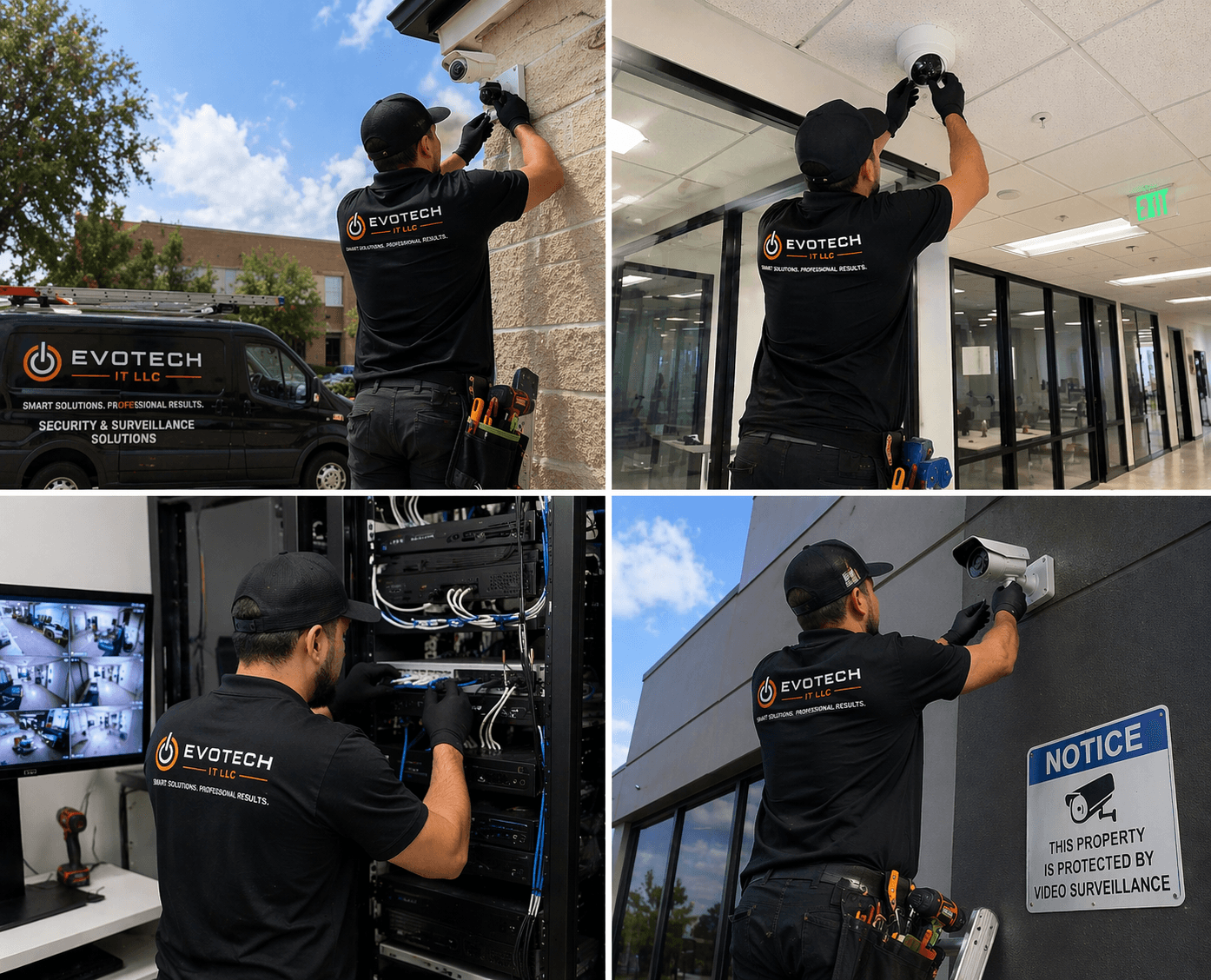
Security-camera installation for restaurants, in Jersey Village
Security-camera installation for restaurants in Jersey Village is a three-part question: what security-camera installation involves, what restaurants need from it, and what Jersey Village changes about the install. Established mid-century residential stock predating structured wiring.
That number is what determines lens choice and mounting distance. A high-resolution camera aimed at a wide area spreads its pixels thin; the same camera aimed at a doorway concentrates them. This is why a well-planned four-camera system regularly outperforms a poorly planned twelve-camera one, and why 'more megapixels' does not by itself produce usable footage.
Segmentation and the point-of-sale question
The payment environment should sit on its own network segment with restricted access to and from everything else. That is standard practice, it simplifies any compliance conversation the operator has with their payment provider, and it means a compromised guest device cannot reach a terminal. Building it in at installation is straightforward; retrofitting it into a flat network during business hours is not.
Operations traffic — kitchen display screens, tablets, printers, back-office computers, phone systems — belongs on a third segment. These need reliability more than bandwidth, and several of them work better wired than wireless. A kitchen display or receipt printer on a cable stops being a wireless troubleshooting problem permanently.
Guest Wi-Fi should be isolated from everything internal, isolated from other guest devices, and rate-limited. Without a limit, a handful of guests streaming can degrade the connection that the payment system depends on, which turns a hospitality feature into an operational risk.
- Payment systems on a dedicated segment with restricted cross-network access
- Kitchen displays, printers, and back-office equipment wired where practical
- Guest network isolated from internal systems and from other guest devices
- Guest bandwidth capped so it cannot starve operations at peak
- Access points covering the dining room, bar, and patio as distinct areas
What drives the cost of security-camera installation here
Camera cost is driven by positions and cable routes, with storage the other major line.
- Camera count and the type each objective requires
- Cable run difficulty, particularly exterior and high-level runs
- Recorder capacity sized to the retention target
- Mounting hardware, junction boxes, and weather-appropriate housings
- Lift or scaffold access for elevated positions
- Network and PoE switching capacity
- Configuration of remote access and user permissions
Jersey Village: what the location changes
What separates a Jersey Village scope from the rest of the city is concrete and local. Established mid-century residential stock predating structured wiring. Compact small-commercial and office buildings suited to single-visit work. Slab-foundation homes with attic-to-interior-wall retrofit routing. That short list is what actually drives the design in this pocket, and it is why photographs or a brief site visit beat a floor plan — the plan follows the building's real constraints, not the neighborhood name on the map.
- Established mid-century residential stock predating structured wiring
- Compact small-commercial and office buildings suited to single-visit work
- Slab-foundation homes with attic-to-interior-wall retrofit routing
- Built-out character meaning mostly retrofit and remediation, not new construction
- Gulf Coast humidity requiring rated exterior housings
Getting it done in Jersey Village
A camera system is commissioned by looking at its recordings, not its live view. Live video on a monitor at midday tells you very little about what the recorded file will show at nine in the evening.
Nearly all restaurant installation happens outside operating hours. That does not usually change the total labour, but it changes the sequencing: every session has to end with the site fully operational, because the doors open regardless of whether the project is finished.
Execution in Jersey Village is planned around real conditions, not a template. Built-out character meaning mostly retrofit and remediation, not new construction. Gulf Coast humidity requiring rated exterior housings. These decide the sequence, the access, and the method as much as the design does. EVOTECH describes Jersey Village as coverage rather than a place it occupies, and omits any area detail it cannot confirm — building and site conditions only, no invented landmarks or promised arrival times.
Popular services nearby
Frequently searched near this area — the pages people look for most.
Frequently asked questions
Is security-camera installation for restaurants different in Jersey Village?
The sector needs stay the same, but the install changes with the place. In Jersey Village, the conditions above — not the restaurants label — decide routes, mounting, and equipment placement, which is why this page pairs all three.
How many cameras does a property need?
Count objectives, not walls. Each area needs a stated purpose — detect activity, recognise a known person, or identify a stranger — and the camera serving it is chosen for that purpose. A property with four well-framed cameras at the points that matter usually produces more useful footage than one with twelve wide shots covering everything approximately.