Low-voltage installation for restaurants, in Jersey Village
Low-voltage installation for restaurants in Jersey Village is a three-part question: what low-voltage installation involves, what restaurants need from it, and what Jersey Village changes about the install. Established mid-century residential stock predating structured wiring.
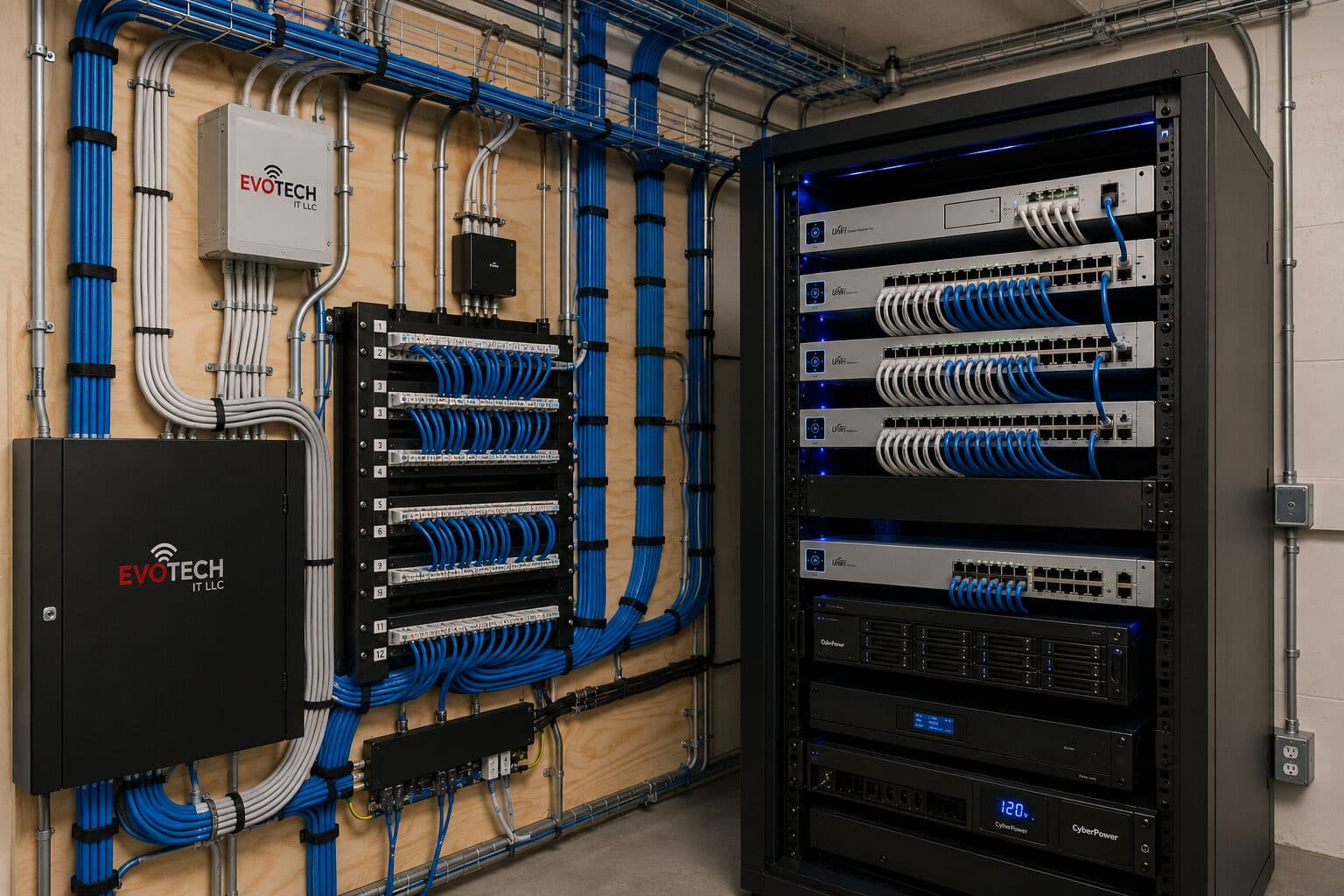
Low-voltage work covers the systems that run on cable rather than mains power: data, wireless, cameras, door access, intercoms, and audio-visual. In a new build or a fit-out these systems share pathways, share an equipment position, and increasingly share a network — so planning them together during rough-in costs far less than adding each one separately after the walls close.
Segmentation and the point-of-sale question
The payment environment should sit on its own network segment with restricted access to and from everything else. That is standard practice, it simplifies any compliance conversation the operator has with their payment provider, and it means a compromised guest device cannot reach a terminal. Building it in at installation is straightforward; retrofitting it into a flat network during business hours is not.
Operations traffic — kitchen display screens, tablets, printers, back-office computers, phone systems — belongs on a third segment. These need reliability more than bandwidth, and several of them work better wired than wireless. A kitchen display or receipt printer on a cable stops being a wireless troubleshooting problem permanently.
Guest Wi-Fi should be isolated from everything internal, isolated from other guest devices, and rate-limited. Without a limit, a handful of guests streaming can degrade the connection that the payment system depends on, which turns a hospitality feature into an operational risk.
- Payment systems on a dedicated segment with restricted cross-network access
- Kitchen displays, printers, and back-office equipment wired where practical
- Guest network isolated from internal systems and from other guest devices
- Guest bandwidth capped so it cannot starve operations at peak
- Access points covering the dining room, bar, and patio as distinct areas
What drives the cost of low-voltage installation here
Scope breadth and schedule conditions drive low-voltage cost more than any single system does.
- Number of systems and total device count
- Pathway construction and whether tray or conduit is required
- Rated penetrations and firestopping
- Number of separate mobilisations the schedule forces
- Occupied versus unoccupied working conditions
- Equipment room build-out
- Commissioning and documentation depth
Jersey Village: what the location changes
In Jersey Village, the plan is built outward from the conditions that are actually here. Established mid-century residential stock predating structured wiring. Compact small-commercial and office buildings suited to single-visit work. Slab-foundation homes with attic-to-interior-wall retrofit routing. Each one changes where cable can run, where equipment can sit, and how coverage is shaped, which is why a walkthrough settles a Jersey Village scope faster than any generic estimate.
- Established mid-century residential stock predating structured wiring
- Compact small-commercial and office buildings suited to single-visit work
- Slab-foundation homes with attic-to-interior-wall retrofit routing
- Built-out character meaning mostly retrofit and remediation, not new construction
- Gulf Coast humidity requiring rated exterior housings
Getting it done in Jersey Village
Each system is commissioned on its own terms, but the low-voltage handover is the point where they are verified together.
Nearly all restaurant installation happens outside operating hours. That does not usually change the total labour, but it changes the sequencing: every session has to end with the site fully operational, because the doors open regardless of whether the project is finished.
On site, the schedule and working method turn on conditions like these. Built-out character meaning mostly retrofit and remediation, not new construction. Gulf Coast humidity requiring rated exterior housings. Both shape how and when a crew can actually operate, which is why EVOTECH scopes each Jersey Village job from the property itself rather than assuming one approach fits every address. Coverage is stated as a service area, never an office claim, and anything about Jersey Village that cannot be verified is left out instead of invented.
Popular services nearby
Frequently searched near this area — the pages people look for most.
Frequently asked questions
Is low-voltage installation for restaurants different in Jersey Village?
The sector needs stay the same, but the install changes with the place. In Jersey Village, the conditions above — not the restaurants label — decide routes, mounting, and equipment placement, which is why this page pairs all three.
When should low-voltage work happen in a construction schedule?
Rough-in sits after electrical and framing and before insulation and drywall. Finish work — terminations, device mounting, and commissioning — happens after paint and ceilings. The risk is that upstream delays compress the rough-in window, so having device locations and pathway plans settled in advance is what keeps that window usable.