Business phone & VoIP for restaurants, in Humble
Business phone & VoIP for restaurants in Humble is a three-part question: what business phone & voip involves, what restaurants need from it, and what Humble changes about the install. A retail and commercial hub with a broad mix of building ages.
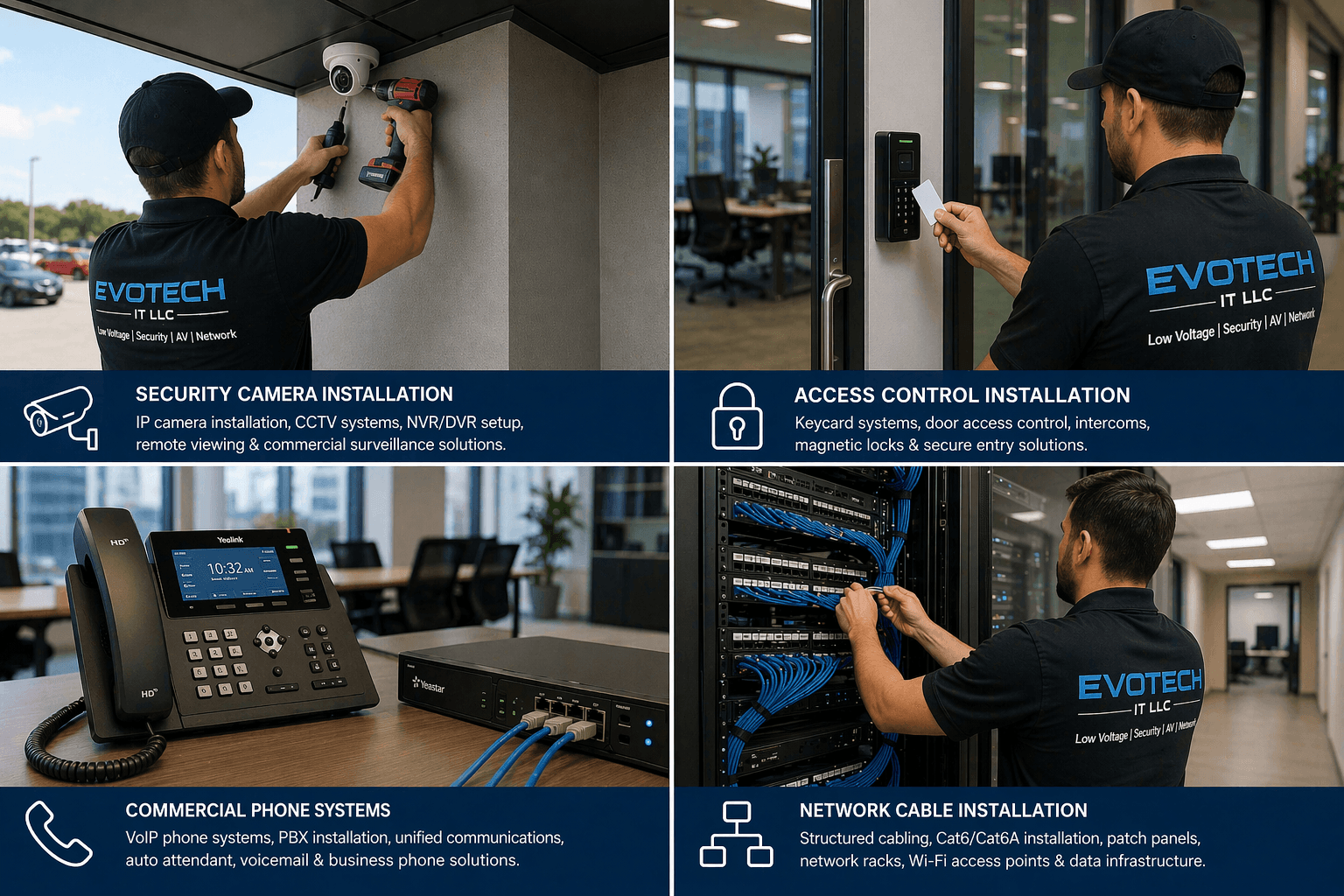
Modern business phones run over the data network — VoIP handsets plug into the same switches as everything else and draw their power from PoE. That is the appeal: one cabling system, central management, and features like auto-attendant, voicemail-to-email, call groups, and remote extensions that older key systems could not offer. The decision that shapes the rest is on-premise versus cloud: an on-site call server you own and maintain, or a hosted service where the provider runs the platform and the site just needs handsets, power, and a good circuit.
What to get right first
In order of consequence: keep the payment systems isolated, put the equipment somewhere it will survive, cover the dining room and patio properly, and place cameras where they answer real questions.
The ordering matters because the failure modes differ. A congested guest network is an annoyance. A payment terminal on a shared flat network is a genuine exposure. Equipment cooked in a hot back room is a recurring replacement cost.
- Segment payment, operations, and guest traffic onto distinct networks
- Locate the rack away from kitchen heat, steam, and wash-down zones
- Rate-limit guest access so it cannot saturate the circuit at peak
- Cover the patio deliberately rather than hoping indoor access points reach
- Put the network equipment and recorder on a UPS
Where business phone & voip goes wrong — and how it's avoided
VoIP disappoints for network reasons far more often than handset reasons.
- Putting phones on a flat, unprioritised network and blaming the handsets for choppy calls
- Sizing for download and running out of upload at busy times
- Adding handsets to a switch with no PoE budget left
- Leaving the phone equipment off a UPS
- Porting numbers before the new system is tested and ready
- No defined process for adding an extension, so the system ossifies
Humble: what the location changes
A retail and commercial hub with a broad mix of building ages. In Humble, that is where the plan begins, because it changes cable paths, device placement, and access-point counts before anything else does. Warehousing and distribution requiring aisle coverage and longer runs. Older commercial stock needing pathway remediation and rack cleanup. None of these are generic checklist items — each moves the design in a direction a citywide assumption would miss, and the honest recommendation always depends on what this particular property allows.
- A retail and commercial hub with a broad mix of building ages
- Warehousing and distribution requiring aisle coverage and longer runs
- Older commercial stock needing pathway remediation and rack cleanup
- Retail point-of-sale environments requiring network segmentation
- Slab-foundation residential across established and newer neighbourhoods
Getting it done in Humble
Phones are commissioned by making real calls under real conditions, not by confirming the handsets register.
Restaurant camera coverage tends to concentrate on a small number of high-value views rather than blanketing the space. The point-of-sale line, the safe or cash-handling area, the back door, and the dry and walk-in storage entrances answer most of the questions that get asked of restaurant footage.
On site, the schedule and working method turn on conditions like these. Retail point-of-sale environments requiring network segmentation. Slab-foundation residential across established and newer neighbourhoods. Both shape how and when a crew can actually operate, which is why EVOTECH scopes each Humble job from the property itself rather than assuming one approach fits every address. Coverage is stated as a service area, never an office claim, and anything about Humble that cannot be verified is left out instead of invented.
Popular services nearby
Frequently searched near this area — the pages people look for most.
Frequently asked questions
Is business phone & voip for restaurants different in Humble?
The sector needs stay the same, but the install changes with the place. In Humble, the conditions above — not the restaurants label — decide routes, mounting, and equipment placement, which is why this page pairs all three.
Why do our VoIP calls sound choppy when the internet seems fine?
Almost always jitter or contention rather than raw bandwidth. Voice packets are time-sensitive, and on a network that treats them the same as a backup or a large upload they get delayed or dropped whenever the network is busy. A dedicated voice segment with quality-of-service prioritisation fixes the majority of these cases without changing the internet plan.