Commercial Wi-Fi for restaurants, in Conroe
Commercial Wi-Fi for restaurants in Conroe is a three-part question: what commercial wi-fi involves, what restaurants need from it, and what Conroe changes about the install. Fast commercial and medical growth with newer buildouts and tenant-improvement conditions.
The second thing commercial wireless has to solve, which home networks do not, is separation. Guest devices, staff devices, point-of-sale terminals, cameras, and building systems have no business sharing one flat network. Keeping them apart limits what a compromised device can reach and makes troubleshooting far simpler.
What to get right first
In order of consequence: keep the payment systems isolated, put the equipment somewhere it will survive, cover the dining room and patio properly, and place cameras where they answer real questions.
The ordering matters because the failure modes differ. A congested guest network is an annoyance. A payment terminal on a shared flat network is a genuine exposure. Equipment cooked in a hot back room is a recurring replacement cost.
- Segment payment, operations, and guest traffic onto distinct networks
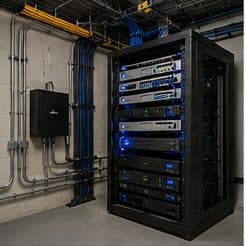
- Locate the rack away from kitchen heat, steam, and wash-down zones
- Rate-limit guest access so it cannot saturate the circuit at peak
- Cover the patio deliberately rather than hoping indoor access points reach
- Put the network equipment and recorder on a UPS
What drives the cost of commercial wi-fi here
The variables that move a commercial wireless quote most are ceiling access and density.
- Access-point count driven by capacity requirements
- Cable run difficulty, particularly in hard-lid or high-ceiling areas
- Lift or scaffold requirements for high mounting positions
- Switching capacity and PoE budget
- Number of segmented networks and associated configuration
- Survey depth and whether a post-installation validation survey is included
- After-hours work windows in operating businesses
Conroe: what the location changes
What separates a Conroe scope from the rest of the city is concrete and local. Fast commercial and medical growth with newer buildouts and tenant-improvement conditions. Older commercial stock needing pathway remediation. Larger residential properties, including lake-area homes with outbuildings. That short list is what actually drives the design in this pocket, and it is why photographs or a brief site visit beat a floor plan — the plan follows the building's real constraints, not the neighborhood name on the map.
- Fast commercial and medical growth with newer buildouts and tenant-improvement conditions
- Older commercial stock needing pathway remediation
- Larger residential properties, including lake-area homes with outbuildings
- Detached structures and longer runs raising distance considerations
- Ongoing new construction where prewire is the high-value decision
Getting it done in Conroe
Commercial validation happens under load, because an empty office at eight in the morning tells you almost nothing about a full one at eleven.
Restaurant camera coverage tends to concentrate on a small number of high-value views rather than blanketing the space. The point-of-sale line, the safe or cash-handling area, the back door, and the dry and walk-in storage entrances answer most of the questions that get asked of restaurant footage.
Execution in Conroe is planned around real conditions, not a template. Detached structures and longer runs raising distance considerations. Ongoing new construction where prewire is the high-value decision. These decide the sequence, the access, and the method as much as the design does. EVOTECH describes Conroe as coverage rather than a place it occupies, and omits any area detail it cannot confirm — building and site conditions only, no invented landmarks or promised arrival times.
Popular services nearby
Frequently searched near this area — the pages people look for most.
Frequently asked questions
Is commercial wi-fi for restaurants different in Conroe?
The sector needs stay the same, but the install changes with the place. In Conroe, the conditions above — not the restaurants label — decide routes, mounting, and equipment placement, which is why this page pairs all three.
How many access points does a business space need?
It comes out of density rather than area. A quiet office floor might be covered by a handful of access points; a conference-heavy floor with the same square footage might need more, concentrated where people gather. The count is an output of counting devices per area and understanding what they do — which is why a walkthrough beats a per-square-foot rule.