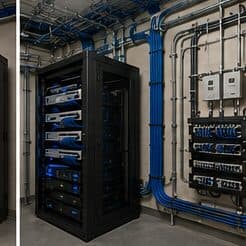
PoE camera installation for restaurants, in Baytown
PoE camera installation for restaurants in Baytown is a three-part question: what poe camera installation involves, what restaurants need from it, and what Baytown changes about the install. An industrial and refining base with rugged operational environments.
A PoE camera takes its power from the same Ethernet cable that carries its video, which removes the need for a local outlet at every mounting position. That is the entire practical appeal: one run per camera, no electrician at each soffit, and centralised power that can sit behind a UPS so the cameras stay up during a short outage.
What to get right first
In order of consequence: keep the payment systems isolated, put the equipment somewhere it will survive, cover the dining room and patio properly, and place cameras where they answer real questions.
The ordering matters because the failure modes differ. A congested guest network is an annoyance. A payment terminal on a shared flat network is a genuine exposure. Equipment cooked in a hot back room is a recurring replacement cost.
- Segment payment, operations, and guest traffic onto distinct networks
- Locate the rack away from kitchen heat, steam, and wash-down zones
- Rate-limit guest access so it cannot saturate the circuit at peak
- Cover the patio deliberately rather than hoping indoor access points reach
- Put the network equipment and recorder on a UPS
What drives the cost of poe camera installation here
The power design and the cable routes dominate.
- Camera count and their power classes
- Switch capacity, both ports and PoE budget
- Cable run count, length, and route difficulty
- Exterior mounting hardware and weather sealing
- UPS sizing
- Elevated access requirements
Baytown: what the location changes
In Baytown, the plan is built outward from the conditions that are actually here. An industrial and refining base with rugged operational environments. Older commercial stock needing pathway remediation and rack cleanup. Newer retail development with more straightforward conditions. Each one changes where cable can run, where equipment can sit, and how coverage is shaped, which is why a walkthrough settles a Baytown scope faster than any generic estimate.
- An industrial and refining base with rugged operational environments
- Older commercial stock needing pathway remediation and rack cleanup
- Newer retail development with more straightforward conditions
- Coastal humidity and driven rain requiring durable exterior sealing and surge protection
- Slab-foundation residential following the regional pattern
Getting it done in Baytown
The meaningful PoE test is under peak load after dark, because that is the condition that exposes budget problems.
Restaurant camera coverage tends to concentrate on a small number of high-value views rather than blanketing the space. The point-of-sale line, the safe or cash-handling area, the back door, and the dry and walk-in storage entrances answer most of the questions that get asked of restaurant footage.
Getting Baytown work done means planning around the site as it actually is. Coastal humidity and driven rain requiring durable exterior sealing and surge protection. Slab-foundation residential following the regional pattern. Both matter as much as the design to how and when the work happens. The scope is drawn from the real property, the coverage is stated as a service area rather than an office, and unverifiable specifics about Baytown are kept off the page on purpose.
Popular services nearby
Frequently searched near this area — the pages people look for most.
Frequently asked questions
Is poe camera installation for restaurants different in Baytown?
The sector needs stay the same, but the install changes with the place. In Baytown, the conditions above — not the restaurants label — decide routes, mounting, and equipment placement, which is why this page pairs all three.
Why do cameras reboot at night but work fine during the day?
Almost always PoE budget. Infrared illuminators engage after dark and the total draw rises, pushing the switch past its budget. It presents as intermittent camera dropouts and gets misdiagnosed as a network fault. The fix is a switch with sufficient budget and headroom, calculated from peak draw rather than idle.