Ethernet installation for restaurants, in Baytown
Ethernet installation for restaurants in Baytown is a three-part question: what ethernet installation involves, what restaurants need from it, and what Baytown changes about the install. An industrial and refining base with rugged operational environments.
The wired connection itself is worth the effort for specific reasons: desktops and consoles that never have to compete for airtime, ceiling access points fed by cable rather than repeating a wireless signal, cameras and doorbells powered over the same run, and a television that streams without depending on Wi-Fi conditions.
What to get right first
In order of consequence: keep the payment systems isolated, put the equipment somewhere it will survive, cover the dining room and patio properly, and place cameras where they answer real questions.
The ordering matters because the failure modes differ. A congested guest network is an annoyance. A payment terminal on a shared flat network is a genuine exposure. Equipment cooked in a hot back room is a recurring replacement cost.
- Segment payment, operations, and guest traffic onto distinct networks
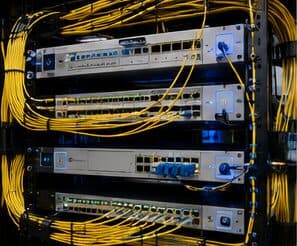
- Locate the rack away from kitchen heat, steam, and wash-down zones
- Rate-limit guest access so it cannot saturate the circuit at peak
- Cover the patio deliberately rather than hoping indoor access points reach
- Put the network equipment and recorder on a UPS
What drives the cost of ethernet installation here
Cost tracks difficulty of access far more than run count. Four easy attic drops can take less time than one drop into an exterior wall with blocking.
- Foundation and ceiling construction
- Attic accessibility, headroom, and working temperature
- Number of drops and their distance from the equipment position
- Whether any drywall cutting and patching is required
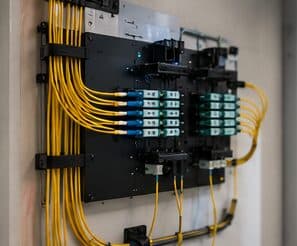
- Equipment enclosure, patch panel, and mounting at the head end
- Finish expectations in occupied living space
Baytown: what the location changes
The starting point for any Baytown job is one local fact. An industrial and refining base with rugged operational environments. That single condition shapes where cable can run, where equipment can sit, and how coverage is laid out — more than any spec sheet does. Two more conditions weigh on it. Older commercial stock needing pathway remediation and rack cleanup. Newer retail development with more straightforward conditions. Together they make the route specific to this pocket, which is why a short walkthrough or a few clear photos settle the scope faster than a floor plan can.
- An industrial and refining base with rugged operational environments
- Older commercial stock needing pathway remediation and rack cleanup
- Newer retail development with more straightforward conditions
- Coastal humidity and driven rain requiring durable exterior sealing and surge protection
- Slab-foundation residential following the regional pattern
Getting it done in Baytown
Every run gets a wire-map and length check at minimum, which catches the errors that actually happen in retrofit work: a reversed pair at a hastily terminated jack, a split pair, or a run longer than it looked.
Restaurant camera coverage tends to concentrate on a small number of high-value views rather than blanketing the space. The point-of-sale line, the safe or cash-handling area, the back door, and the dry and walk-in storage entrances answer most of the questions that get asked of restaurant footage.
Getting Baytown work done means planning around the site as it actually is. Coastal humidity and driven rain requiring durable exterior sealing and surge protection. Slab-foundation residential following the regional pattern. Both matter as much as the design to how and when the work happens. The scope is drawn from the real property, the coverage is stated as a service area rather than an office, and unverifiable specifics about Baytown are kept off the page on purpose.
Popular services nearby
Frequently searched near this area — the pages people look for most.
Frequently asked questions
Is ethernet installation for restaurants different in Baytown?
The sector needs stay the same, but the install changes with the place. In Baytown, the conditions above — not the restaurants label — decide routes, mounting, and equipment placement, which is why this page pairs all three.
Can Ethernet be added without cutting into walls?
Often yes, when the destination is an interior wall reachable from an attic or crawl space and there is no blocking in the cavity. When there is no viable cavity path, the choices are a small access cut that then gets patched, a surface raceway, or moving the device to a wall that can be reached. Which one makes sense is worth deciding before work starts rather than mid-pull.