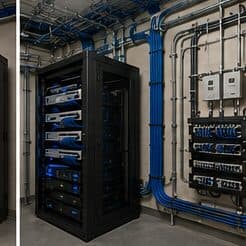
In-wall cable concealment for professional offices, in Spring
In-wall cable concealment for professional offices in Spring is a three-part question: what in-wall cable concealment involves, what professional offices need from it, and what Spring changes about the install. Retail and food-service commercial base where payment-system separation is a standing requirement.
Concealing the cables behind a wall-mounted TV or AV setup is what turns it from a device with wires hanging down into something that looks built-in. The signal cables — HDMI, network, speaker — can be routed inside the wall to a recessed box behind the display, but power is different: a standard power cord must never be run inside a wall. Power is handled with a recessed outlet behind the display or an in-wall rated power solution, which keeps the installation safe and to code.
Fit-outs, occupied floors, and landlords
The easiest time to do office low-voltage work is during a fit-out, when ceilings are open and the space is empty. Work in an occupied office is entirely feasible but slower, with furniture protection, containment, and noise consideration all adding time.
Multi-tenant buildings introduce a third party. Base-building rules on core access, riser use, after-hours work, and ceiling penetration vary considerably, and confirming them before scheduling avoids a crew arriving to find they cannot access the riser.
- Fit-out timing preferred where the schedule allows
- Furniture protection and containment in occupied areas
- Base-building rules on riser and core access confirmed in advance
- After-hours access arrangements agreed with building management
- Noise-sensitive work scheduled outside core hours
What drives the cost of in-wall cable concealment here
Wall construction and the power solution drive the cost.
- Wall construction and cavity contents
- Recessed outlet or rated power-relocation kit
- Distance and number of cables
- Any access cuts and their patch-and-paint
- Surface raceway where no in-wall path exists
- Whether it is bundled with a TV or soundbar mount
Spring: what the location changes
In Spring, the plan is built outward from the conditions that are actually here. Retail and food-service commercial base where payment-system separation is a standing requirement. Ceiling construction varying considerably between adjacent units, from open deck to hard lid to suspended grid. Restaurant kitchen environments requiring equipment placement away from heat, steam, and grease-laden air. Each one changes where cable can run, where equipment can sit, and how coverage is shaped, which is why a walkthrough settles a Spring scope faster than any generic estimate.
- Retail and food-service commercial base where payment-system separation is a standing requirement
- Ceiling construction varying considerably between adjacent units, from open deck to hard lid to suspended grid
- Restaurant kitchen environments requiring equipment placement away from heat, steam, and grease-laden air
- Storefront glazing on retail units complicating daylight entrance camera placement
- Residential areas following the regional slab-foundation and attic-routing pattern
Getting it done in Spring
Concealment is judged by a clean result and a safe, code-compliant power path.
In an office, the technology most people judge is the meeting room, and the two things they judge it on are whether the far end can hear them and whether the meeting started on time. Both are solvable, and both are more about microphone coverage and simple control than about display specification.
Getting Spring work done means planning around the site as it actually is. Storefront glazing on retail units complicating daylight entrance camera placement. Residential areas following the regional slab-foundation and attic-routing pattern. Both matter as much as the design to how and when the work happens. The scope is drawn from the real property, the coverage is stated as a service area rather than an office, and unverifiable specifics about Spring are kept off the page on purpose.
Frequently asked questions
Is in-wall cable concealment for professional offices different in Spring?
The sector needs stay the same, but the install changes with the place. In Spring, the conditions above — not the professional offices label — decide routes, mounting, and equipment placement, which is why this page pairs all three.
Can the power cord be hidden in the wall too?
Not the standard cord — running one inside a wall is against code and a genuine hazard. Power is concealed correctly with a recessed outlet behind the display or a rated in-wall power-relocation kit, which puts the outlet where the TV needs it without burying a cord. The signal cables can go in the wall; power is handled the right way.