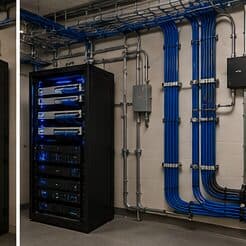
PoE camera installation for professional offices, in Rosenberg
PoE camera installation for professional offices in Rosenberg is a three-part question: what poe camera installation involves, what professional offices need from it, and what Rosenberg changes about the install. Warehousing and light-industrial buildings along the highway corridor, with metal construction that reflects wireless signal and needs proper cable support.
A PoE camera takes its power from the same Ethernet cable that carries its video, which removes the need for a local outlet at every mounting position. That is the entire practical appeal: one run per camera, no electrician at each soffit, and centralised power that can sit behind a UPS so the cameras stay up during a short outage.
Fit-outs, occupied floors, and landlords
The easiest time to do office low-voltage work is during a fit-out, when ceilings are open and the space is empty. Work in an occupied office is entirely feasible but slower, with furniture protection, containment, and noise consideration all adding time.
Multi-tenant buildings introduce a third party. Base-building rules on core access, riser use, after-hours work, and ceiling penetration vary considerably, and confirming them before scheduling avoids a crew arriving to find they cannot access the riser.
- Fit-out timing preferred where the schedule allows
- Furniture protection and containment in occupied areas
- Base-building rules on riser and core access confirmed in advance
- After-hours access arrangements agreed with building management
- Noise-sensitive work scheduled outside core hours
What drives the cost of poe camera installation here
The power design and the cable routes dominate.
- Camera count and their power classes
- Switch capacity, both ports and PoE budget
- Cable run count, length, and route difficulty
- Exterior mounting hardware and weather sealing
- UPS sizing
- Elevated access requirements
Rosenberg: what the location changes
In Rosenberg, the plan is built outward from the conditions that are actually here. Warehousing and light-industrial buildings along the highway corridor, with metal construction that reflects wireless signal and needs proper cable support. An older rail-town commercial core with masonry buildings and limited existing pathway. Newer suburban subdivisions on slab foundations following the regional attic-routing pattern. Each one changes where cable can run, where equipment can sit, and how coverage is shaped, which is why a walkthrough settles a Rosenberg scope faster than any generic estimate.
- Warehousing and light-industrial buildings along the highway corridor, with metal construction that reflects wireless signal and needs proper cable support
- An older rail-town commercial core with masonry buildings and limited existing pathway
- Newer suburban subdivisions on slab foundations following the regional attic-routing pattern
- Dust exposure in industrial and distribution environments, affecting rack and equipment placement
- Gulf Coast humidity and driven-rain events requiring rated exterior housings and sealed penetrations
Getting it done in Rosenberg
The meaningful PoE test is under peak load after dark, because that is the condition that exposes budget problems.
In an office, the technology most people judge is the meeting room, and the two things they judge it on are whether the far end can hear them and whether the meeting started on time. Both are solvable, and both are more about microphone coverage and simple control than about display specification.
Getting Rosenberg work done means planning around the site as it actually is. Dust exposure in industrial and distribution environments, affecting rack and equipment placement. Gulf Coast humidity and driven-rain events requiring rated exterior housings and sealed penetrations. Both matter as much as the design to how and when the work happens. The scope is drawn from the real property, the coverage is stated as a service area rather than an office, and unverifiable specifics about Rosenberg are kept off the page on purpose.
Frequently asked questions
Is poe camera installation for professional offices different in Rosenberg?
The sector needs stay the same, but the install changes with the place. In Rosenberg, the conditions above — not the professional offices label — decide routes, mounting, and equipment placement, which is why this page pairs all three.
Why do cameras reboot at night but work fine during the day?
Almost always PoE budget. Infrared illuminators engage after dark and the total draw rises, pushing the switch past its budget. It presents as intermittent camera dropouts and gets misdiagnosed as a network fault. The fix is a switch with sufficient budget and headroom, calculated from peak draw rather than idle.