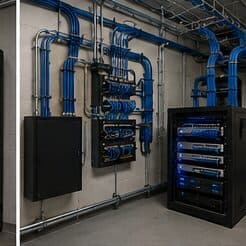
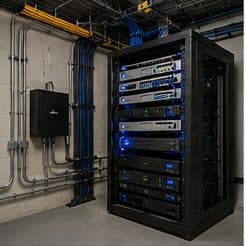
Low-voltage installation for professional offices, in Richmond
Low-voltage installation for professional offices in Richmond is a three-part question: what low-voltage installation involves, what professional offices need from it, and what Richmond changes about the install. High proportion of new residential and commercial construction, making rough-in timing the dominant scheduling factor.
Low-voltage work covers the systems that run on cable rather than mains power: data, wireless, cameras, door access, intercoms, and audio-visual. In a new build or a fit-out these systems share pathways, share an equipment position, and increasingly share a network — so planning them together during rough-in costs far less than adding each one separately after the walls close.
Meeting rooms first
In an office, the technology most people judge is the meeting room, and the two things they judge it on are whether the far end can hear them and whether the meeting started on time. Both are solvable, and both are more about microphone coverage and simple control than about display specification.
After that: wireless capacity in the areas where people gather, enough desk outlets to survive a layout change, and an equipment room that someone can actually work in.
- Meeting-room audio coverage matched to the seating, not to the room's floor area
- One obvious action that starts a meeting
- Wireless capacity concentrated where people gather
- Two outlets at each desk position rather than one
- Equipment room with ventilation, power, and working clearance
What changes low-voltage installation from job to job
Low-voltage scope depends heavily on how many systems are in play and how coordinated the schedule is.
- Which systems are included and whether they share pathways
- Building size, floor count, and pathway complexity
- New construction versus occupied retrofit
- Ceiling type and how much of the pathway is accessible
- Number and type of rated penetrations
- Equipment room provision and whether it exists yet
- Schedule reliability and whether the rough-in window is likely to compress
- Gap between rough-in and finish, which affects protection and re-identification
Richmond: what the location changes
In Richmond, the plan is built outward from the conditions that are actually here. High proportion of new residential and commercial construction, making rough-in timing the dominant scheduling factor. Larger lots producing long runs to gates, outbuildings, and driveway camera positions that approach or exceed copper distance limits. Slab-on-grade construction with the rough-in window falling between electrical and drywall. Each one changes where cable can run, where equipment can sit, and how coverage is shaped, which is why a walkthrough settles a Richmond scope faster than any generic estimate.
- High proportion of new residential and commercial construction, making rough-in timing the dominant scheduling factor
- Larger lots producing long runs to gates, outbuildings, and driveway camera positions that approach or exceed copper distance limits
- Slab-on-grade construction with the rough-in window falling between electrical and drywall
- Conduit and sleeve decisions made during rough-in determining what is possible for the following decade
- Detached structures common enough that between-building links are a routine design question rather than an exception
Getting it done in Richmond
Each system is commissioned on its own terms, but the low-voltage handover is the point where they are verified together.
Office camera requirements are usually limited: the main entrance, the suite door, any rear or service entrance, and sometimes the server or equipment room. Interior open-plan coverage is less common and is worth questioning when requested, since it changes the character of the workplace for limited benefit.
Getting Richmond work done means planning around the site as it actually is. Conduit and sleeve decisions made during rough-in determining what is possible for the following decade. Detached structures common enough that between-building links are a routine design question rather than an exception. Both matter as much as the design to how and when the work happens. The scope is drawn from the real property, the coverage is stated as a service area rather than an office, and unverifiable specifics about Richmond are kept off the page on purpose.
Popular services nearby
Frequently searched near this area — the pages people look for most.
Frequently asked questions
Is low-voltage installation for professional offices different in Richmond?
The sector needs stay the same, but the install changes with the place. In Richmond, the conditions above — not the professional offices label — decide routes, mounting, and equipment placement, which is why this page pairs all three.
When should low-voltage work happen in a construction schedule?
Rough-in sits after electrical and framing and before insulation and drywall. Finish work — terminations, device mounting, and commissioning — happens after paint and ceilings. The risk is that upstream delays compress the rough-in window, so having device locations and pathway plans settled in advance is what keeps that window usable.