Paging & PA systems for professional offices, in League City
Paging & PA systems for professional offices in League City is a three-part question: what paging & pa systems involves, what professional offices need from it, and what League City changes about the install. Coastal proximity raising the weight on exterior sealing, rated housings, and surge protection.
A paging or PA system carries announcements across a space so they are heard clearly wherever people are — an office, a warehouse floor, a school, a retail back-of-house. The work is coverage and clarity: enough distributed speakers that a page is intelligible everywhere rather than blasting near one horn and inaudible elsewhere, sensible zones so a page can go to the right area, and priority so a page overrides background music rather than fighting it.
Meeting rooms first
In an office, the technology most people judge is the meeting room, and the two things they judge it on are whether the far end can hear them and whether the meeting started on time. Both are solvable, and both are more about microphone coverage and simple control than about display specification.
After that: wireless capacity in the areas where people gather, enough desk outlets to survive a layout change, and an equipment room that someone can actually work in.
- Meeting-room audio coverage matched to the seating, not to the room's floor area
- One obvious action that starts a meeting
- Wireless capacity concentrated where people gather
- Two outlets at each desk position rather than one
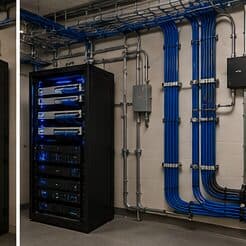
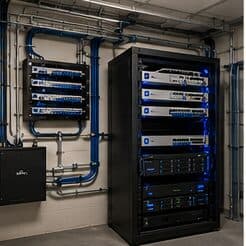
- Equipment room with ventilation, power, and working clearance
Where paging & pa systems goes wrong — and how it's avoided
Paging fails on coverage, zones, and priority.
- One loud speaker instead of distributed coverage
- Office speakers that cannot cut through warehouse noise
- No zones, so every page goes everywhere
- No page-over-music priority
- Speaker density too low for the ceiling height
- No phone integration, forcing a separate paging station
League City: what the location changes
In League City, the plan is built outward from the conditions that are actually here. Coastal proximity raising the weight on exterior sealing, rated housings, and surge protection. Storm-season resilience planning, favouring UPS and failover where uptime matters. Newer suburban slab-foundation homes with multi-room coverage needs. Each one changes where cable can run, where equipment can sit, and how coverage is shaped, which is why a walkthrough settles a League City scope faster than any generic estimate.
- Coastal proximity raising the weight on exterior sealing, rated housings, and surge protection
- Storm-season resilience planning, favouring UPS and failover where uptime matters
- Newer suburban slab-foundation homes with multi-room coverage needs
- Growing medical and retail commercial space
- Gulf Coast humidity and driven-rain events as a routine design factor
Getting it done in League City
A paging system is commissioned by listening in every area under real conditions.
Office camera requirements are usually limited: the main entrance, the suite door, any rear or service entrance, and sometimes the server or equipment room. Interior open-plan coverage is less common and is worth questioning when requested, since it changes the character of the workplace for limited benefit.
Getting League City work done means planning around the site as it actually is. Growing medical and retail commercial space. Gulf Coast humidity and driven-rain events as a routine design factor. Both matter as much as the design to how and when the work happens. The scope is drawn from the real property, the coverage is stated as a service area rather than an office, and unverifiable specifics about League City are kept off the page on purpose.
Frequently asked questions
Is paging & pa systems for professional offices different in League City?
The sector needs stay the same, but the install changes with the place. In League City, the conditions above — not the professional offices label — decide routes, mounting, and equipment placement, which is why this page pairs all three.
Why can't we just use one loud speaker to page?
Because it is deafening up close and unintelligible across the room. Paging works through distributed speakers at a sensible density so the announcement is clear everywhere at a comfortable level. In a noisy warehouse that means horn speakers with the projection to cut through; in an office, discreet ceiling speakers spread for even coverage.