Gate & license-plate cameras for professional offices, in League City
Gate & license-plate cameras for professional offices in League City is a three-part question: what gate & license-plate cameras involves, what professional offices need from it, and what League City changes about the install. Coastal proximity raising the weight on exterior sealing, rated housings, and surge protection.
The other half of the job is getting to the gate. Entry points are often far from the building, so power and a reliable connection to a gate or driveway position have to be planned — frequently a fiber or intermediate-powered run rather than a stretched copper one — along with mounting that gives the right angle and distance for the plate.
Meeting rooms first
In an office, the technology most people judge is the meeting room, and the two things they judge it on are whether the far end can hear them and whether the meeting started on time. Both are solvable, and both are more about microphone coverage and simple control than about display specification.
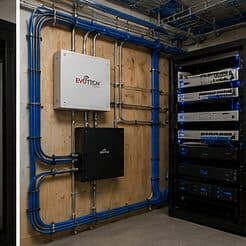
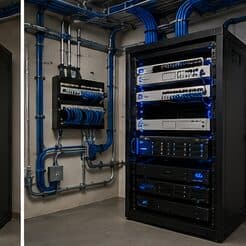
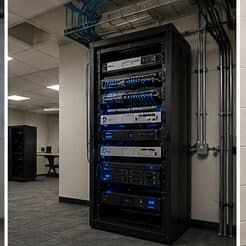
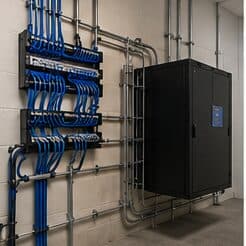
After that: wireless capacity in the areas where people gather, enough desk outlets to survive a layout change, and an equipment room that someone can actually work in.
- Meeting-room audio coverage matched to the seating, not to the room's floor area
- One obvious action that starts a meeting
- Wireless capacity concentrated where people gather
- Two outlets at each desk position rather than one
- Equipment room with ventilation, power, and working clearance
Where gate & license-plate cameras goes wrong — and how it's avoided
Entry camera systems fail when one camera is asked to do two jobs.
- Expecting one camera to both show the scene and read plates
- A slow shutter smearing plates on moving vehicles
- Uncontrolled infrared blowing out the reflective plate
- Field of view too wide to resolve a plate
- Stretching copper to a gate beyond its reach
- Skipping the overview camera and losing context
League City: what the location changes
The starting point for any League City job is one local fact. Coastal proximity raising the weight on exterior sealing, rated housings, and surge protection. That single condition shapes where cable can run, where equipment can sit, and how coverage is laid out — more than any spec sheet does. Two more conditions weigh on it. Storm-season resilience planning, favouring UPS and failover where uptime matters. Newer suburban slab-foundation homes with multi-room coverage needs. Together they make the route specific to this pocket, which is why a short walkthrough or a few clear photos settle the scope faster than a floor plan can.
- Coastal proximity raising the weight on exterior sealing, rated housings, and surge protection
- Storm-season resilience planning, favouring UPS and failover where uptime matters
- Newer suburban slab-foundation homes with multi-room coverage needs
- Growing medical and retail commercial space
- Gulf Coast humidity and driven-rain events as a routine design factor
Getting it done in League City
Entry cameras are verified against their objectives, day and night.
Office camera requirements are usually limited: the main entrance, the suite door, any rear or service entrance, and sometimes the server or equipment room. Interior open-plan coverage is less common and is worth questioning when requested, since it changes the character of the workplace for limited benefit.
Execution in League City is planned around real conditions, not a template. Growing medical and retail commercial space. Gulf Coast humidity and driven-rain events as a routine design factor. These decide the sequence, the access, and the method as much as the design does. EVOTECH describes League City as coverage rather than a place it occupies, and omits any area detail it cannot confirm — building and site conditions only, no invented landmarks or promised arrival times.
Frequently asked questions
Is gate & license-plate cameras for professional offices different in League City?
The sector needs stay the same, but the install changes with the place. In League City, the conditions above — not the professional offices label — decide routes, mounting, and equipment placement, which is why this page pairs all three.
Can one camera watch the gate and read plates?
Rarely well. Reading a plate needs a fast shutter, a narrow view, a shallow angle, and controlled infrared — settings that make the plate legible also make the wider scene dark. A general overview camera cannot resolve a plate on a moving vehicle. The reliable approach is two cameras: one for the scene, one dedicated to plates.