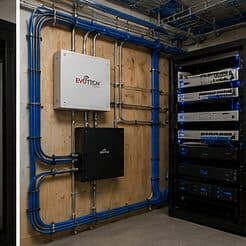
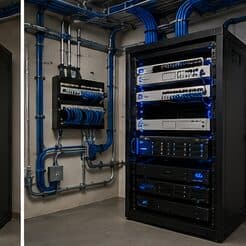
Low-voltage installation for professional offices, in Fulshear
Low-voltage installation for professional offices in Fulshear is a three-part question: what low-voltage installation involves, what professional offices need from it, and what Fulshear changes about the install. Predominantly recent residential construction, so prewire timing rather than retrofit access is the usual constraint.
Low-voltage work covers the systems that run on cable rather than mains power: data, wireless, cameras, door access, intercoms, and audio-visual. In a new build or a fit-out these systems share pathways, share an equipment position, and increasingly share a network — so planning them together during rough-in costs far less than adding each one separately after the walls close.
Density is concentrated, not distributed
An office floor's network demand is not spread evenly. Individual desks are undemanding. Meeting rooms concentrate a dozen people, their laptops and phones, a display system, and a video call into one radio cell for an hour at a time. That concentration is where the design effort belongs.
The second characteristic is churn. Desk layouts change, teams grow, hot-desking arrives and departs. Offices benefit from more outlets than the current plan requires and from wireless coverage designed around areas rather than around today's seating chart.
- Demand concentrated in meeting and collaboration areas
- Desk layouts changing more often than the cabling can economically follow
- Video calls as the most visible and least forgiving workload
- Printers, phones, and access points adding to the wired device count
Where low-voltage installation goes wrong — and how it's avoided
The expensive low-voltage mistakes all happen before anyone pulls cable.
- Specifying systems one at a time instead of planning them together
- Sizing the equipment room for the network only
- Missing the rough-in window and having to retrofit through closed walls
- Leaving device locations unresolved and guessing during rough-in
- Making rated penetrations without sleeves and firestopping
- Leaving cable unlabeled and unprotected between rough-in and finish
Fulshear: what the location changes
In Fulshear, the plan is built outward from the conditions that are actually here. Predominantly recent residential construction, so prewire timing rather than retrofit access is the usual constraint. Large single-family floor plans requiring multiple wired coverage positions rather than a single router. Builder-provided media enclosures frequently undersized, unventilated, or awkwardly positioned for wireless coverage. Each one changes where cable can run, where equipment can sit, and how coverage is shaped, which is why a walkthrough settles a Fulshear scope faster than any generic estimate.
- Predominantly recent residential construction, so prewire timing rather than retrofit access is the usual constraint
- Large single-family floor plans requiring multiple wired coverage positions rather than a single router
- Builder-provided media enclosures frequently undersized, unventilated, or awkwardly positioned for wireless coverage
- Slab-on-grade foundations with accessible attics for post-construction additions
- Larger lots with detached garages and outbuildings needing their own deliberate connectivity approach
Getting it done in Fulshear
Each system is commissioned on its own terms, but the low-voltage handover is the point where they are verified together.
Wireless capacity should be planned from peak simultaneous use in each area. A floor with several meeting rooms in constant use needs more cells concentrated around them than its square footage would suggest, and those cells need a channel plan that stops them contending with each other.
Getting Fulshear work done means planning around the site as it actually is. Slab-on-grade foundations with accessible attics for post-construction additions. Larger lots with detached garages and outbuildings needing their own deliberate connectivity approach. Both matter as much as the design to how and when the work happens. The scope is drawn from the real property, the coverage is stated as a service area rather than an office, and unverifiable specifics about Fulshear are kept off the page on purpose.
Frequently asked questions
Is low-voltage installation for professional offices different in Fulshear?
The sector needs stay the same, but the install changes with the place. In Fulshear, the conditions above — not the professional offices label — decide routes, mounting, and equipment placement, which is why this page pairs all three.
When should low-voltage work happen in a construction schedule?
Rough-in sits after electrical and framing and before insulation and drywall. Finish work — terminations, device mounting, and commissioning — happens after paint and ceilings. The risk is that upstream delays compress the rough-in window, so having device locations and pathway plans settled in advance is what keeps that window usable.