Why this page exists
Wireless bridge (point-to-point) for new construction is shaped by how the space is used, not just by the service itself. New construction bring their own operating constraints, and this page pairs what wireless bridge (point-to-point) actually involves with what that environment changes about it.
A point-to-point wireless bridge connects two buildings or locations across a distance where trenching fiber is impractical — a yard, a road, a parking lot between two structures. A pair of directional radios, aimed precisely at each other, carry the network link through the air. It is the right tool when a physical run is genuinely not feasible, and it depends almost entirely on one thing: a clear, unobstructed line of sight between the two points.
One window, and it does not reopen
Low-voltage rough-in happens in a specific slot: after framing and electrical, before insulation and drywall. Inside that window, running a cable anywhere is straightforward. Once drywall goes up, the same cable costs many times more and sometimes cannot be run at all.
The asymmetry is the whole story of new-construction low voltage. Decisions made cheaply during rough-in become expensive or impossible afterwards, which is why the pre-rough-in planning conversation is worth more than any equipment choice made later.
- Rough-in window sits between electrical and drywall
- Upstream delays compress the window without extending the deadline
- Post-drywall changes cost many times more, if they are possible at all
- Finish work happens months later, after paint and ceilings
What wireless bridge (point-to-point) usually involves
The defining problem is the path. Trees, buildings, or terrain between the two points block or degrade the link, and even a partially obstructed Fresnel zone — foliage that fills in seasonally, a new structure — cuts throughput or drops the link. A bridge planned without confirming clear line of sight and Fresnel clearance is a bridge that works until the trees leaf out.
The second is alignment and expectations. Directional radios have narrow beams that must be aimed precisely at each other; a few degrees off and the link is weak or absent. And people expect wired-equivalent speed at any distance, when throughput realistically declines with distance, obstruction, and interference — a bridge is a reliable link within its limits, not an unlimited one.
- Trees, buildings, or terrain blocking or degrading the path
- Fresnel zone obstructed, cutting throughput even with visible line of sight
- Seasonal foliage filling in and degrading a link that worked in winter
- Radios misaligned, so the narrow beams do not meet
- Expecting wired speed regardless of distance and obstruction
- Interference from other radios in a congested band
What to rough in even without a final design
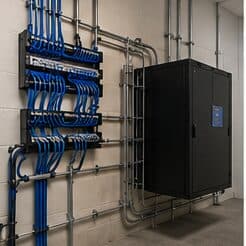
Full system design is often not finished when the rough-in window arrives. That is normal, and it is not a reason to skip the pathway. Running conduit or sleeves to likely positions preserves the option cheaply even when the eventual equipment is undecided.
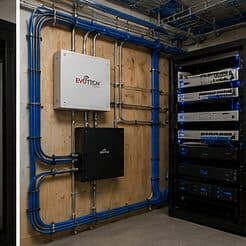
For a commercial building, the reliable rough-in set is: cable to every likely device outlet, ceiling positions for access points spaced for the intended coverage, camera positions at entries and approaches, door positions with cable to the controller location, and pathway to any likely display or AV position. Plus, in every case, a properly located equipment room.
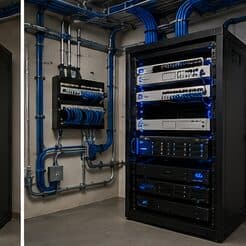
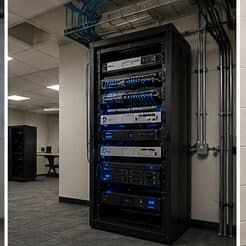
The equipment room deserves particular emphasis because it is the most commonly under-provisioned item. It has to hold the network rack, camera recorder, access-control panel, and any AV equipment, with dedicated power, ventilation, and clearance to work. Sizing it from the network alone is a decision that gets discovered eighteen months later.
- Sleeves and conduit to likely positions even before final design
- Ceiling access-point positions spaced for the intended coverage
- Camera positions at entries, approaches, and service areas
- Cable from every controlled door to the controller position
- Equipment room with dedicated power, ventilation, and working clearance
Line of sight, the Fresnel zone, alignment, and honest throughput
Line of sight is necessary but not sufficient. Beyond a visible clear path, the Fresnel zone — an elliptical region around the direct line — has to stay largely clear, which means the link often needs more height than 'we can see the other roof' suggests, because ground, foliage, and structures intrude on that zone. Confirming the path, and the height needed to clear it, is the first and most important step.
- Confirmed clear line of sight and Fresnel-zone clearance
- Enough mounting height to clear ground, foliage, and structures
- Directional antennas aligned precisely and mounted solidly
- Throughput specified realistically for distance and obstruction
- Band and channel chosen against local interference
- PoE power and weatherproof mounting at each end
Frequently asked questions
What changes about wireless bridge (point-to-point) in new construction?
The operating environment does. New construction bring specific constraints — how the space is used, when work can happen, and what has to keep running — and those shape the wireless bridge (point-to-point) plan as much as the service's own technical requirements.
When should I use a wireless bridge instead of running cable?
When a physical run is genuinely impractical — a road, a parking lot, or a distance that would mean major trenching between two buildings. Where a cable can reasonably go, especially fiber between separately grounded structures, it is more reliable. A bridge is the right tool specifically when the gap can't be crossed physically and there is clear line of sight.
What has to be decided before rough-in?
Device locations, the equipment room position, and the pathway plan. Equipment selection can wait — you can run cable to a position without knowing which camera or access point will go there. What cannot wait is the decision about where things go, because that is what determines where cable is pulled while the walls are open.