Projector & screen installation for new construction, in Tomball
Projector & screen installation for new construction in Tomball is a three-part question: what projector & screen installation involves, what new construction need from it, and what Tomball changes about the install. A historic small-town core with masonry buildings and limited pathway.
Those three inputs drive the whole design. The projector's throw ratio and the desired image size fix where it mounts; the seating distance sets a sensible screen size; and the room's light determines whether an ambient-light-rejecting screen is needed or whether the room can be darkened. The mount, the screen, and the long cable run follow from there.
One window, and it does not reopen
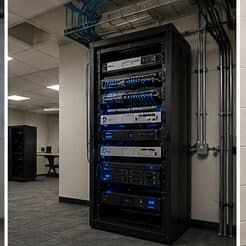
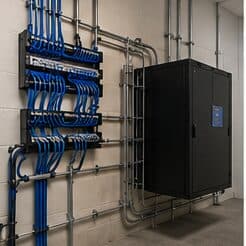
Low-voltage rough-in happens in a specific slot: after framing and electrical, before insulation and drywall. Inside that window, running a cable anywhere is straightforward. Once drywall goes up, the same cable costs many times more and sometimes cannot be run at all.
The asymmetry is the whole story of new-construction low voltage. Decisions made cheaply during rough-in become expensive or impossible afterwards, which is why the pre-rough-in planning conversation is worth more than any equipment choice made later.
- Rough-in window sits between electrical and drywall
- Upstream delays compress the window without extending the deadline
- Post-drywall changes cost many times more, if they are possible at all
- Finish work happens months later, after paint and ceilings
What changes projector & screen installation from job to job
Scope depends on the room, the light, and the mounting.
- Screen size and type for the room and light
- Projector throw ratio and mounting distance
- Ceiling mount height and structure
- Long cable run length and whether an extender is needed
- Ambient light control versus an ALR screen
- Motorised versus fixed screen
Tomball: what the location changes
The starting point for any Tomball job is one local fact. A historic small-town core with masonry buildings and limited pathway. That single condition shapes where cable can run, where equipment can sit, and how coverage is laid out — more than any spec sheet does. Two more conditions weigh on it. Growing retail and medical buildouts with suspended-grid ceilings and tenant-improvement conditions. Larger properties and outbuildings toward the northern edge, bringing longer runs. Together they make the route specific to this pocket, which is why a short walkthrough or a few clear photos settle the scope faster than a floor plan can.
- A historic small-town core with masonry buildings and limited pathway
- Growing retail and medical buildouts with suspended-grid ceilings and tenant-improvement conditions
- Larger properties and outbuildings toward the northern edge, bringing longer runs
- Slab-foundation residential across established and newer subdivisions
- Gulf Coast humidity requiring rated exterior housings and sealed penetrations
Getting it done in Tomball
A projector is commissioned by confirming geometry, light, and signal.
Full system design is often not finished when the rough-in window arrives. That is normal, and it is not a reason to skip the pathway. Running conduit or sleeves to likely positions preserves the option cheaply even when the eventual equipment is undecided.
Execution in Tomball is planned around real conditions, not a template. Slab-foundation residential across established and newer subdivisions. Gulf Coast humidity requiring rated exterior housings and sealed penetrations. These decide the sequence, the access, and the method as much as the design does. EVOTECH describes Tomball as coverage rather than a place it occupies, and omits any area detail it cannot confirm — building and site conditions only, no invented landmarks or promised arrival times.
Frequently asked questions
Is projector & screen installation for new construction different in Tomball?
The sector needs stay the same, but the install changes with the place. In Tomball, the conditions above — not the new construction label — decide routes, mounting, and equipment placement, which is why this page pairs all three.
How far should the projector be from the screen?
It is set by the projector's throw ratio and the screen size you want — a calculation, not a guess. The projector produces a given image size only at the right distance, so the mount goes where the geometry says, kept square to the screen so keystone correction, which softens the image, stays minimal.