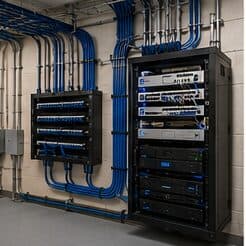
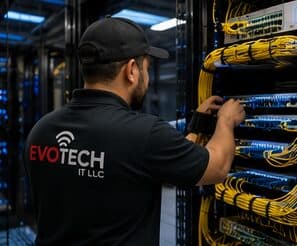
Cat6A cabling for new construction, in The Woodlands
Cat6A cabling for new construction in The Woodlands is a three-part question: what cat6a cabling involves, what new construction need from it, and what The Woodlands changes about the install. Mature tree cover on many residential lots, attenuating outdoor wireless signal and generating constant motion in camera scenes.
Cat6A is specified to 500 MHz and supports 10GBASE-T across a full 100-metre channel. It achieves that mainly by controlling alien crosstalk — the interference between adjacent cables that constrains Cat6 at 10G — through larger construction, tighter pair geometry, and in shielded variants a foil layer.
Positions to prewire even if cameras come later
Camera positions are among the cheapest things to prewire and among the most annoying to retrofit, because they are usually exterior, high, and behind finished soffit. Running cable to likely positions during rough-in preserves the option at almost no cost.
The positions worth prewiring in nearly every building: primary entrance, rear or service entrance, any delivery or receiving point, parking approaches, and the equipment room itself. In residential construction, add the front door for a doorbell and the driveway approach.
- Primary and secondary entrance positions
- Delivery, receiving, and service door approaches
- Parking and vehicle approach positions
- Doorbell position in residential builds
- Cable terminated and labeled even where no camera is installed yet
What drives the cost of cat6a cabling here
Cat6A raises cost in three places at once — material, pathway, and labour — which is why selective specification usually beats blanket specification.
- Cable and component cost per run
- Pathway modifications where fill limits are exceeded
- Termination time, especially for shielded constructions
- Rack space and cable management to dress larger cable cleanly
- Test time at the higher frequency range
The Woodlands: what the location changes
In The Woodlands, the plan is built outward from the conditions that are actually here. Mature tree cover on many residential lots, attenuating outdoor wireless signal and generating constant motion in camera scenes. Corporate and professional office stock with meeting-room density driving wireless capacity requirements. Larger residential lots with detached structures and outbuildings beyond practical house-coverage range. Each one changes where cable can run, where equipment can sit, and how coverage is shaped, which is why a walkthrough settles a The Woodlands scope faster than any generic estimate.
- Mature tree cover on many residential lots, attenuating outdoor wireless signal and generating constant motion in camera scenes
- Corporate and professional office stock with meeting-room density driving wireless capacity requirements
- Larger residential lots with detached structures and outbuildings beyond practical house-coverage range
- Master-planned development producing relatively consistent, newer commercial construction with usable pathway
- Wooded exterior camera positions requiring careful framing to avoid constant vegetation-triggered motion events
Getting it done in The Woodlands
Certification to Cat6A runs the same parameter set as Cat6 but across the full 500 MHz range, where margins are naturally tighter. Passing at 250 MHz says nothing about behaviour at 500 MHz, so the test configuration has to match the intended rating.
Low-voltage rough-in happens in a specific slot: after framing and electrical, before insulation and drywall. Inside that window, running a cable anywhere is straightforward. Once drywall goes up, the same cable costs many times more and sometimes cannot be run at all.
On site, the schedule and working method turn on conditions like these. Master-planned development producing relatively consistent, newer commercial construction with usable pathway. Wooded exterior camera positions requiring careful framing to avoid constant vegetation-triggered motion events. Both shape how and when a crew can actually operate, which is why EVOTECH scopes each The Woodlands job from the property itself rather than assuming one approach fits every address. Coverage is stated as a service area, never an office claim, and anything about The Woodlands that cannot be verified is left out instead of invented.
Popular services nearby
Frequently searched near this area — the pages people look for most.
Frequently asked questions
Is cat6a cabling for new construction different in The Woodlands?
The sector needs stay the same, but the install changes with the place. In The Woodlands, the conditions above — not the new construction label — decide routes, mounting, and equipment placement, which is why this page pairs all three.
Is Cat6A worth it if nothing today runs 10 gigabit?
Sometimes. The argument for it is that reopening a ceiling is far more expensive than the cable premium, so runs that are hard to reach and likely to matter later are good candidates. The argument against blanket use is pathway fill and labour. A common middle path is Cat6A on uplinks, dense areas, and inaccessible runs, with Cat6 elsewhere.